

Key Takeaways
- Tire pressure should be checked monthly using the vehicle's door placard spec, not the number on the tire sidewall.
- The penny test is a quick way to check tread depth, but a dedicated gauge gives more precise readings.
- Most vehicles benefit from tire rotation every 5,000–7,500 miles to even out wear patterns.
- Under-inflated tires reduce fuel economy, accelerate wear, and compromise handling and braking.
- Tires worn below 2/32 of an inch tread depth are legally unsafe and should be replaced promptly.
What you will need
Why Tire Basics Matter More Than Most Drivers Realize
Tires are the only part of your vehicle in direct contact with the road. Their condition directly affects braking distance, steering response, fuel economy, and the risk of a blowout. Yet tire maintenance is among the most commonly neglected routines, often because it feels technical or time-consuming. In reality, the three fundamentals — pressure, tread depth, and rotation — require minimal tools, modest time, and no prior mechanical experience.
Neglecting tires also hits the wallet. Under-inflated tires increase rolling resistance, which reduces fuel efficiency. Skipping rotation causes uneven wear that forces premature replacement of the entire set. These are costs that are largely avoidable, as covered in depth in our look at vehicle maintenance costs that catch drivers off guard.
Good tire habits also support safe driving in challenging conditions. Adequate tread depth is especially critical in rain and snow — for a full picture of how your tires perform in adverse weather, see driving in rain, snow, ice, and fog.
What you will need
What You'll Need Before You Start
The tools required are inexpensive and widely available. A quality tire pressure gauge — either digital or dial-type — is worth owning rather than relying on the free gauges sometimes found at gas stations, which can be inaccurate. A tread depth gauge costs only a few dollars and gives far more precise readings than coins alone. Access to an air source completes the kit.
Tire pressure gauge
Measures the air pressure inside each tire in PSI so you can inflate or deflate to the correct spec.
Tread depth gauge
Gives a precise measurement of remaining tread depth in 32nds of an inch.
U.S. penny or quarter
Used as a quick visual check for tread wear when a gauge is not available.
Air compressor or pump
Used to inflate tires to the correct pressure after checking.
Step-by-Step: Check, Adjust, and Rotate
Follow these steps in order. Pressure and tread checks can be done at home in about ten minutes. Rotation requires a lift or jack stands and is typically done by a mechanic or tire shop, though understanding the process helps you verify the work is being done correctly and on schedule.
Find your correct tire pressure specification
Do not rely on the number stamped on the tire sidewall — that figure is the maximum pressure the tire can hold, not the target pressure for your vehicle. Instead, look for the placard on the driver's door jamb or inside the fuel-filler flap. Your owner's manual also lists the recommended PSI for front and rear tires, which sometimes differ.
Check pressure when tires are cold
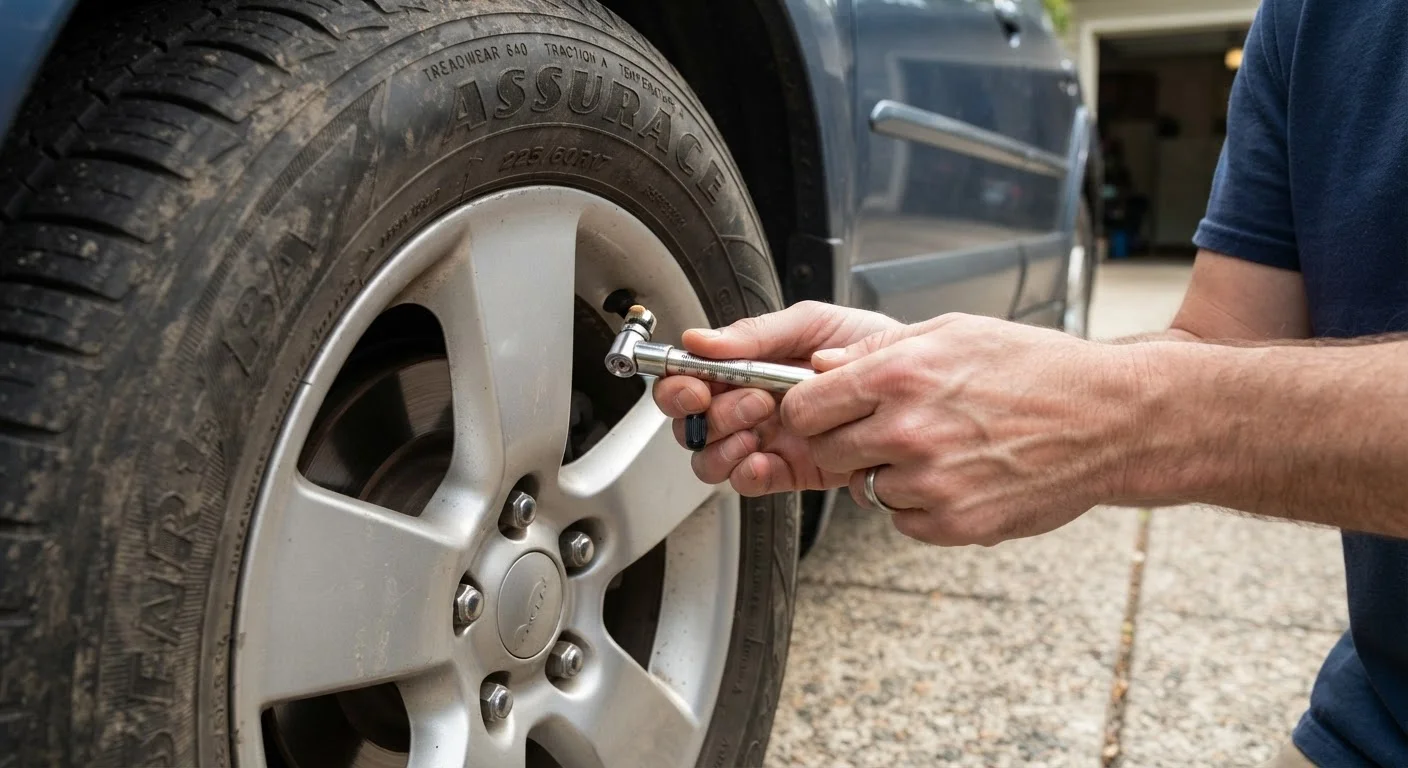
Tire pressure rises as tires heat up from driving. For the most accurate reading, check pressure after the vehicle has been sitting for at least three hours, or before driving more than one mile. Remove the valve cap, press the gauge firmly and squarely onto the valve stem, and read the PSI. Repeat on all four tires — and don't forget the spare.
Inflate or deflate to the target PSI
If a tire is low, attach an air compressor hose to the valve stem and add air in short bursts, rechecking frequently. If a tire is over-inflated, use the small pin on the back of most gauges — or a pen cap — to depress the valve core and release air slowly. Recheck after adjustment and replace the valve cap securely.
Measure tread depth on each tire
A tread depth gauge is the most reliable tool. Insert the probe into the main tread groove and press until it seats, then read the measurement in 32nds of an inch. New tires typically start at 10/32" to 11/32". The legal minimum in most U.S. states is 2/32", but many safety organizations recommend replacing tires at 4/32" for better wet-weather grip. Check multiple grooves across the tire width — uneven readings signal an alignment or inflation problem.
For a quick check, use the penny test: insert a penny into the tread groove with Lincoln's head pointing down. If you can see all of Lincoln's head, the tread is at or below 2/32" and the tire needs immediate replacement. A quarter used the same way tests for 4/32" depth.
Rotate tires on the right schedule
Tires wear unevenly because front tires handle most steering and, on front-wheel-drive vehicles, most drive forces as well. Rotating moves tires to different axle positions to distribute wear more evenly, extending overall tire life. A common interval is every 5,000–7,500 miles, though always defer to your owner's manual. Many drivers align rotation with oil changes to simplify scheduling.
Common rotation patterns include front-to-rear (same side), cross-rotation, and full-cross patterns for directional or staggered fitments — the correct pattern depends on whether your tires are directional, non-directional, or if your vehicle has different front and rear tire sizes. A qualified mechanic or tire technician can confirm the right pattern for your setup.
Pair Tire Checks With Seasonal Maintenance
Temperature changes affect tire pressure more than most drivers realize. Making pressure and tread checks part of a seasonal routine — alongside battery, wipers, and coolant inspections — helps catch problems before they become hazards. See our seasonal car maintenance checklist for a complete walkthrough.
TPMS Is a Warning System, Not a Substitute
Many vehicles have a Tire Pressure Monitoring System (TPMS) that illuminates a dashboard warning light when pressure drops significantly — typically 25% below the recommended level. By the time this light appears, the tire is already meaningfully under-inflated. Use a manual gauge monthly rather than waiting for the TPMS light to prompt action.
Worn Tires Are a Safety Risk, Not Just a Cost
Tires at or below 2/32" tread depth have significantly reduced ability to channel water away from the contact patch, dramatically increasing the risk of hydroplaning. This is not a minor inconvenience — it is a documented safety hazard. If any tire has reached this threshold, it should be replaced before the vehicle is driven in wet conditions. Driving on bald tires can also affect your auto insurance claim if an accident occurs.
Fitting Tire Care Into Your Broader Maintenance Routine
Tire checks are easiest to maintain when they're anchored to an existing habit — once a month when you fill up with fuel, or at each oil change. If you're newer to car ownership and want to understand how tires fit into the full picture of vehicle upkeep, our first-time driver's guide to basic car care is a solid starting point. For a structured look at all maintenance intervals, your car's maintenance schedule, explained breaks down what to do and when.
Drivers keeping older vehicles running longer should pay particular attention to tire age in addition to tread depth — rubber degrades over time regardless of visible wear. Our guide to keeping a high-mileage car on the road addresses this and other considerations for higher-mileage vehicles.
With consistent attention, tire maintenance is one of the simplest and highest-value habits a driver can build — protecting both safety and long-term ownership costs.