

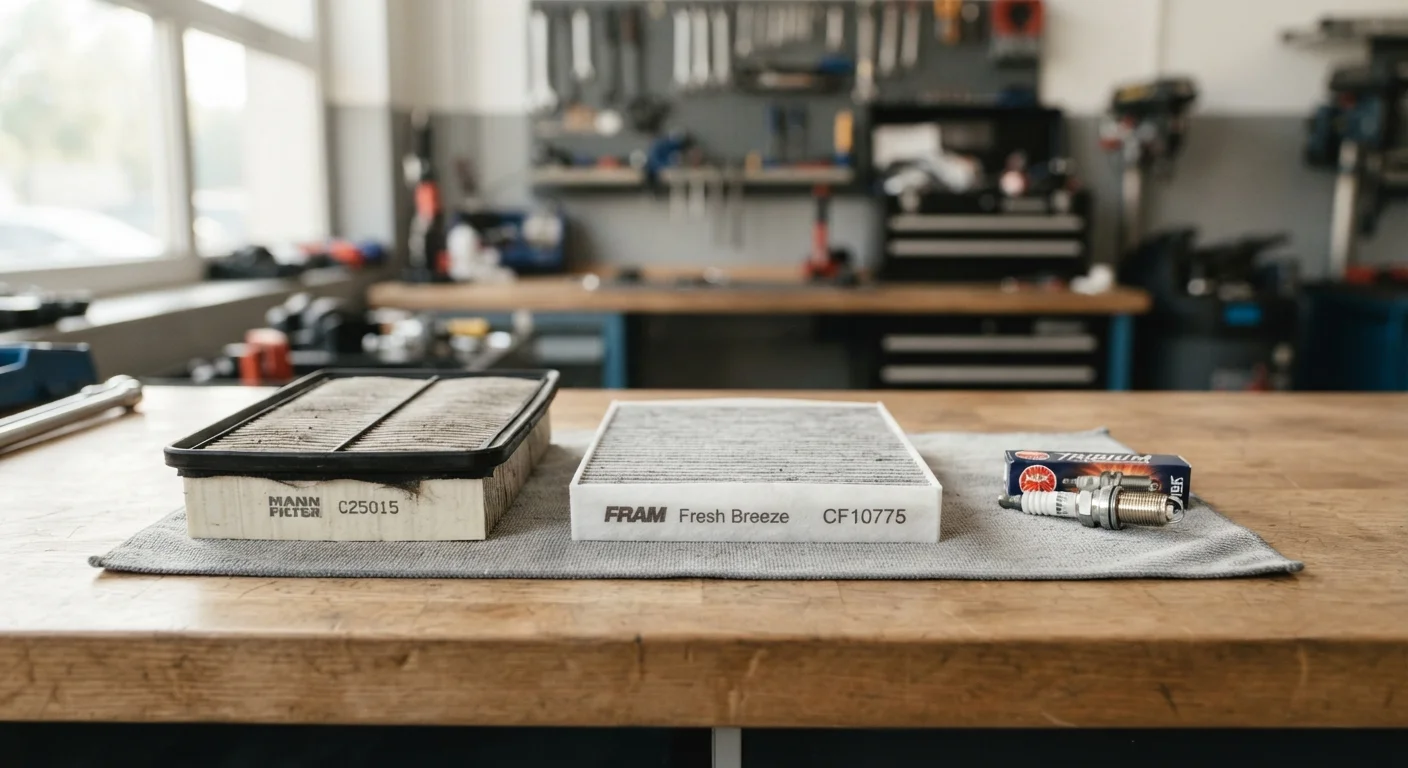
Key Takeaways
- Engine air filters should typically be replaced every 15,000–30,000 miles, depending on driving conditions.
- Cabin air filters affect the air quality inside your vehicle and are often overlooked at service intervals.
- Worn spark plugs can reduce fuel efficiency, cause rough idling, and eventually trigger a check-engine light.
- All three components are relatively inexpensive and often DIY-accessible with basic tools.
- Neglecting these parts can quietly create larger, costlier mechanical problems over time.
Why Small Parts Deserve More Attention
Most drivers think about oil changes and tire rotations, but a handful of smaller components quietly determine how well a car breathes, burns fuel, and keeps its occupants comfortable. Engine air filters, cabin air filters, and spark plugs are cheap, straightforward to replace, and routinely underserviced — a combination that makes them among the most impactful items to understand in your maintenance routine.
Staying on top of these parts is part of following a sensible maintenance schedule. As we cover in your car's maintenance schedule, explained, small intervals add up to meaningful protection for your vehicle's long-term reliability.
Engine Air Filter: Your Engine's First Line of Defense
The engine air filter stops dust, pollen, dirt, and debris from entering the combustion chamber. A clean filter allows the correct air-to-fuel ratio that efficient combustion requires. As it clogs, airflow is restricted — and the engine has to work harder to compensate.
What to watch for: Reduced acceleration, a noticeable drop in fuel economy, or a visibly grey and dirty filter element are the most common signs. In severe cases, a clogged filter can contribute to rough idling or a failed emissions test.
General replacement interval: Most manufacturers recommend replacement every 15,000 to 30,000 miles, but dusty or unpaved driving environments shorten that window considerably. Check your owner's manual for the interval specific to your vehicle.
DIY accessibility: On most vehicles, the engine air filter sits in a clearly marked housing near the top of the engine and requires no tools to access — making it one of the easiest self-service items you can handle.
A clogged engine air filter forces your engine to work harder, quietly draining fuel efficiency over time.
Cabin Air Filter: The Air You Actually Breathe
The cabin air filter cleans the air flowing through your vehicle's heating, ventilation, and air conditioning (HVAC) system before it reaches the passenger compartment. It captures pollen, dust, mold spores, and exhaust particulates — making it particularly relevant for anyone with allergies or respiratory sensitivities.
What to watch for: Weak airflow from the vents even at high fan settings, persistent musty or stale odors, and increased dust on the dashboard are all signs the cabin filter may be overdue for replacement.
General replacement interval: Roughly every 15,000 to 25,000 miles is a common guideline, though this varies by manufacturer and environment. Urban drivers in high-pollution areas may need to replace it more frequently.
DIY accessibility: Location varies by vehicle — many cabin filters are accessed through the glove box or under the dashboard — but the job is generally straightforward. Your owner's manual or a vehicle-specific tutorial can walk you through it.
A saturated cabin filter doesn't just reduce airflow — it can push contaminants directly into the air passengers breathe.
Spark Plugs: The Ignition Point of Everything
Spark plugs ignite the air-fuel mixture inside each engine cylinder. That controlled explosion is what drives your pistons and, ultimately, moves your car. When spark plugs wear out, ignition becomes inconsistent — and the ripple effects touch fuel economy, emissions, and drivability.
What to watch for: Rough idling or engine misfires, noticeably reduced acceleration, difficulty starting (especially in cold weather), and a illuminated check-engine light are the most recognizable symptoms of worn plugs.
General replacement interval: Conventional copper plugs typically require replacement every 30,000 miles. Extended-life iridium or platinum plugs may last 60,000 to 100,000 miles or more — but again, your owner's manual is the definitive reference for your specific engine.
DIY accessibility: Replacing spark plugs is a feasible DIY task on many engines, but requires a torque wrench and the correct plug gap for your vehicle. On engines with limited access or coil-on-plug designs, a mechanic may be the safer choice.
These costs fit neatly into the broader picture of vehicle maintenance costs that catch drivers off guard — individually modest, but consequential when deferred.
Worn spark plugs don't fail all at once — they degrade gradually, quietly costing you fuel economy and performance.
What Neglect Actually Looks Like
The consequences of ignoring these three components rarely announce themselves with a dramatic breakdown. Instead, they tend to show up as gradual degradation: a sluggish throttle response, a musty smell from the vents, or a fuel gauge that seems to drop faster than it used to. By the time most drivers notice, the problem has usually been building for months.
Check All Three at the Same Service Visit
Because engine air filters, cabin filters, and spark plugs share similar replacement windows, inspecting all three at the same time is efficient and cost-effective. Ask your mechanic to check them together, or build them into a single DIY session. Bundling these checks prevents any one component from slipping through the cracks between service visits.
That slow-burn cost pattern is exactly what the hidden costs of skipping routine maintenance explores in detail — small neglected items that quietly escalate into expensive repairs. Checking these three components at every major service interval is one of the simplest ways to stay ahead of that curve. For high-mileage vehicles, the stakes are even higher; see our guide on keeping a high-mileage car on the road for a broader maintenance perspective.
This article is for general informational purposes only. Always consult your vehicle's owner's manual and, where in doubt, a qualified mechanic before performing any maintenance.