

Key Takeaways
- Each weather condition demands a distinct set of speed, spacing, and steering adjustments — not just a blanket slowdown.
- Hydroplaning on wet roads can occur at speeds as low as 35 mph on worn tires or standing water.
- Ice offers friction levels roughly 10 times lower than dry pavement, making overcorrection the leading cause of spin-outs.
- In dense fog, high beams scatter light back at you — low beams and fog lights are always the correct choice.
- Vehicle readiness — tires, wipers, and lights — is the foundation every driving habit depends on.
Why Condition-Specific Habits Matter
Most drivers know to slow down when the weather turns. But reacting generically to bad conditions — simply lifting slightly off the accelerator — leaves significant safety margins on the table. Rain, snow, ice, and fog each alter your vehicle's physics and your own perception in fundamentally different ways, and each calls for a different set of compensations.
According to the Federal Highway Administration, weather-related crashes account for roughly 21% of all vehicle crashes in the United States annually. The majority of those occur on wet pavement and during rainfall — not in extreme winter storms — which means everyday rain driving is where most drivers are most exposed. Understanding what actually changes under each condition gives you a framework that goes far beyond instinct.
Pair sharp situational awareness with a proactive, defensive driving mindset and you dramatically improve your margin for error in any weather.
21%
US crashes linked to weather conditions
According to the Federal Highway Administration, roughly 21% of annual vehicle crashes in the US are weather-related.
~35 mph
Speed at which hydroplaning can begin
Hydroplaning can occur at speeds as low as 35 mph on standing water, particularly with worn or under-inflated tires.
10x
Lower friction on ice vs. dry pavement
Ice can reduce road friction coefficients to roughly one-tenth of those found on dry pavement, dramatically shrinking safe stopping margins.
Driving in Rain: Traction, Hydroplaning, and Visibility
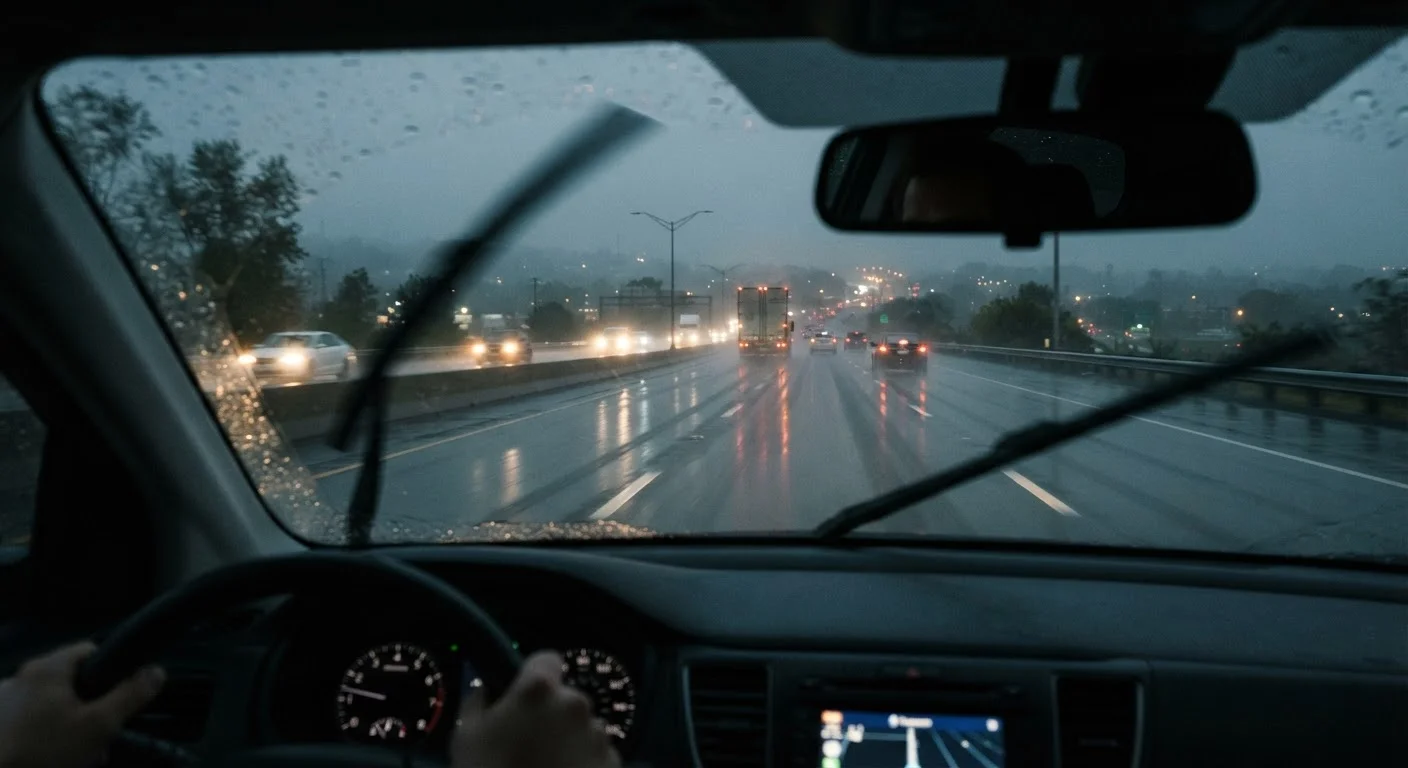
Rain's primary danger is the reduction in tire-to-road friction. Water films between your tires and the pavement, and if that film builds up faster than your tires can displace it, your vehicle hydroplanes — meaning the tires ride on water rather than gripping the road surface. Hydroplaning can begin at around 35 mph on standing water, particularly with tires that have worn tread.
Key adjustments for rain driving:
- Increase following distance to at least four seconds — double the dry-road minimum. Wet stopping distances are significantly longer than most drivers expect. See our quick reference on stopping distances by condition for specifics.
- Reduce speed gradually before curves and intersections, not while in them.
- Avoid sudden steering inputs or hard braking, which can trigger a skid on wet surfaces.
- Turn on headlights — not just for your own visibility, but so other drivers see you. Many states legally require lights when wipers are in use.
- Steer gently through a hydroplane: ease off the accelerator, hold the wheel straight, and allow the tires to regain contact. Do not brake sharply.
Check Your Wiper Blades Before Storm Season
Streaking or chattering wiper blades can reduce forward visibility dramatically in heavy rain. Test them at the start of each rainy season and replace if they leave any uncleared arcs. Quality blades are one of the least expensive safety upgrades on any vehicle.
Heavy rain also impairs visibility. Keep your wiper blades in good condition and use your defroster to prevent interior fogging.
Driving in Snow: Speed, Momentum, and Gentle Inputs
Packed snow reduces traction considerably compared to dry pavement, but it is more predictable than ice. The governing principle in snow is momentum management: because stopping takes far longer, you want to reduce speed well ahead of where you need to stop, and maintain steady, deliberate momentum rather than accelerating and braking in bursts.
- Accelerate slowly from stops to prevent wheel spin. On front-wheel-drive vehicles, spinning the drive wheels in snow can cause the car to push forward unpredictably.
- Follow at six to eight seconds or more behind the vehicle ahead.
- Downshift on descents (or use a lower drive mode if available) to use engine braking rather than relying solely on your brakes on long downhill stretches.
- Know what your ABS does and does not do: antilock braking prevents wheel lockup but does not shorten stopping distance on loose snow — it helps you maintain steering control while braking.
- Clear all snow from your vehicle before driving — roof snow becomes a hazard to vehicles behind you when it slides off.
Check that your tires are appropriate for winter conditions. Adequate tread depth and correct tire pressure are non-negotiable in snow.
Driving on Ice: The Most Unforgiving Surface
Ice — particularly black ice, the thin, nearly transparent glaze that forms on bridges, overpasses, and shaded roadways — is the most hazardous surface a driver encounters. Friction coefficients on ice can be roughly ten times lower than on dry pavement, meaning your normal inputs become wildly disproportionate to the vehicle's response.
Black Ice Offers Almost No Warning
Black ice forms a near-invisible glaze that looks like a wet road surface. It appears most commonly on bridges, overpasses, exit ramps, and shaded stretches in below-freezing temperatures. If the road suddenly feels unusually quiet under your tires or your steering feels light, suspect ice and ease off the accelerator immediately — do not brake sharply.
Key principles for icy roads:
- Drive at speeds where you could stop within the distance you can see. On ice, that may mean 15–20 mph even on roads you know well.
- Never cruise on cruise control on ice — it prevents the minute throttle adjustments that help maintain control, and a loss of traction can accelerate the vehicle before the system responds.
- Brake by applying steady, gentle pressure. With ABS-equipped vehicles, maintain firm pressure and let the system modulate — do not pump the brakes.
- Steer into a rear-wheel skid (turn the wheel in the direction the rear is sliding) with small, controlled inputs. Overcorrecting is the most common cause of spin-outs on ice.
- Bridges and overpasses freeze first — approach them with extra caution even when adjacent road surfaces seem clear.
Understanding how reaction time factors into emergency braking is especially relevant on ice, where the window between stimulus and loss of control is extremely narrow.
Before driving on ice, test your braking response in an empty parking lot at low speed to get a feel for how your specific vehicle's ABS behaves on that surface.
Every vehicle responds slightly differently on ice, and a controlled low-stakes test helps calibrate your expectations before you face an emergency situation on a live road.
In any adverse condition, resist the urge to match the speed of traffic around you if that speed feels unsafe — create your own buffer and accept that arriving later is always preferable.
Social pressure to keep pace with other drivers is a documented factor in weather-related crash chains; your stopping distance is your own responsibility, not a group consensus.
Driving in Fog: Managing Low Visibility
Fog doesn't change road surface friction the way precipitation does, but it creates a disorienting visual environment where distances and speeds become very difficult to judge accurately. Dense fog can reduce visibility to a few car lengths, effectively removing the reaction time buffer that safe driving depends on.
- Use low beams and fog lights — never high beams. High beams scatter off water droplets in the fog and reflect back at you, worsening visibility rather than improving it.
- Slow down to a speed where you can stop within your visible range. This is sometimes called the limit of visibility rule and is the single most important fog-driving principle.
- Use the road's edge markings or painted lines as guidance rather than the taillights of the car in front of you — following taillights can cause you to close distance unconsciously.
- Signal early for turns and braking so drivers behind you have maximum time to respond.
- If fog is severe enough, pull safely off the road — turn off your lights so approaching vehicles don't use them as a target, and activate your hazard lights only if you are stopped.
Fog conditions share some low-visibility characteristics with night driving. Our guide on adjustments for driving after dark covers additional perception strategies relevant to both environments.
Vehicle Readiness Across All Conditions
No driving technique compensates for a vehicle that isn't ready for the conditions. Before adverse weather arrives, make sure these systems are in good shape:
- Tires: Check tread depth and pressure regularly. Worn or under-inflated tires lose traction far faster in wet or cold conditions. Our tire basics guide walks you through what to check.
- Wipers: Streaking or skipping blades reduce visibility when you need it most. Replace blades at least annually, or sooner if performance degrades.
- Lights: All exterior lights — headlights, taillights, brake lights — must function correctly. Other drivers depend on them as much as you do.
- Brakes: Have brake pads and rotors inspected regularly. Worn brakes extend stopping distances even on dry pavement.
- Defroster and HVAC: A clear windshield is a basic requirement. Ensure front and rear defrosters work before cold season arrives.
A full seasonal vehicle check is the most effective single step you can take. Our seasonal maintenance checklist covers everything to review as conditions shift.
Ultimately, the driver who adapts — slowing down, spacing out, using lights correctly, and keeping inputs smooth — has a fundamentally different risk profile than one who drives in adverse conditions the same way they drive in fair weather. The habits covered here aren't complex. They require awareness and intentional adjustment, and that is entirely within every driver's control.