

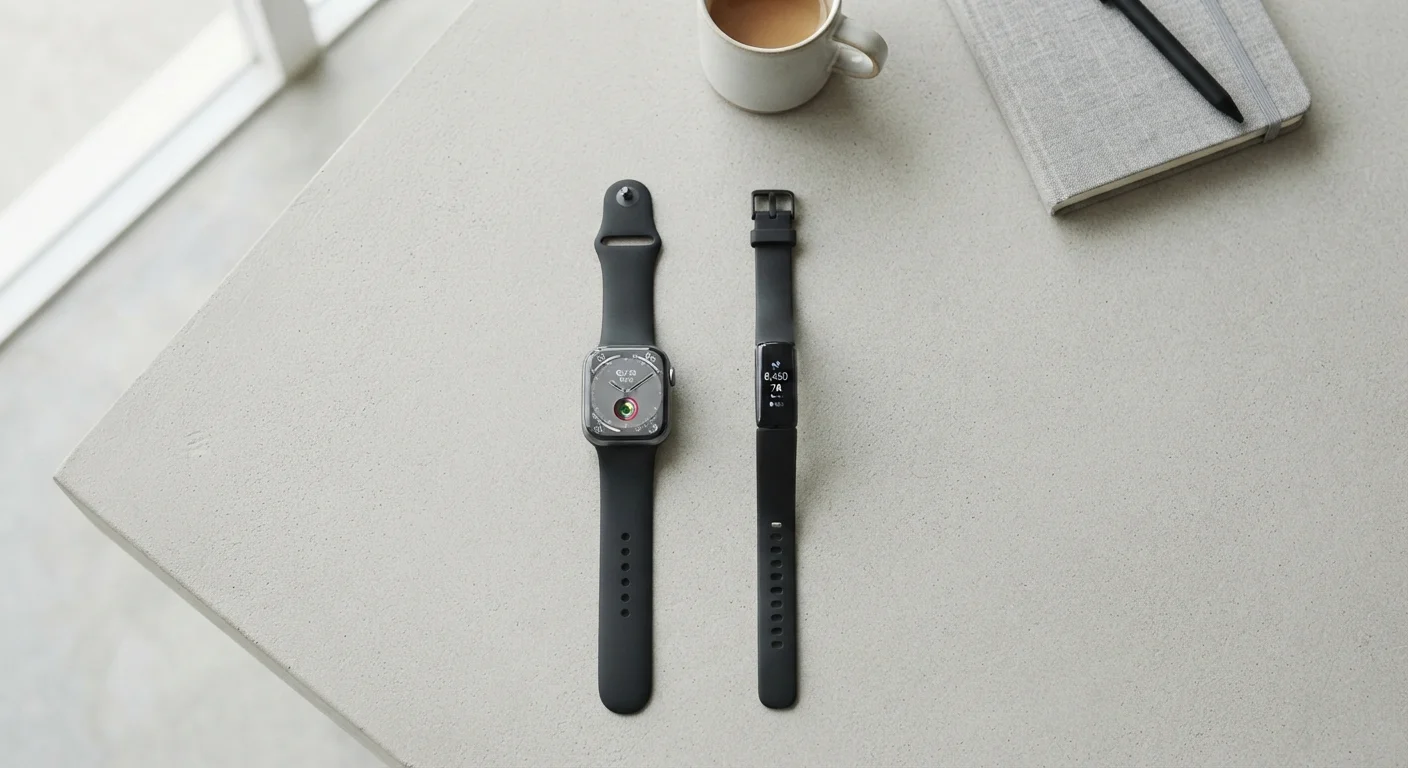
Key Takeaways
- Smartwatches handle notifications, apps, and payments alongside health tracking; fitness trackers stay focused on movement and biometrics.
- Battery life is a significant practical difference — fitness trackers typically last days to weeks longer per charge.
- Fitness trackers tend to cost less upfront and carry a lighter, less intrusive profile on the wrist.
- Smartwatches require more frequent charging and often depend on a paired smartphone for full functionality.
- Neither device replaces professional medical assessment — both measure trends, not clinical diagnoses.
Option A
Smartwatch
The all-in-one wrist computer.
Best for: Users who want notifications, apps, payments, and health tracking in one device.
Option B
Fitness Tracker
The focused, long-lasting activity companion.
Best for: Active users who prioritize accurate health metrics, long battery life, and a lightweight form factor.
If you want your wrist device to handle daily communications and apps
Smartwatch
Smartwatches surface calls, messages, and third-party apps directly on your wrist, reducing how often you need to reach for your phone.
If long battery life and lightweight wear are your top priorities
Fitness Tracker
Fitness trackers routinely run a week or more on a single charge and are less obtrusive during sleep tracking or intense workouts.
If you want a focused health and activity monitoring tool at a lower price point
Fitness Tracker
Most fitness trackers deliver reliable step counting, heart rate, and sleep data at a significantly lower cost than full smartwatches.
If you want contactless payments and GPS navigation from your wrist
Smartwatch
Built-in NFC for payments and standalone GPS for route tracking are standard on most smartwatches but rare on fitness trackers.
If you're new to wearables and want a simple, low-commitment starting point
Fitness Tracker
A fitness tracker is easier to set up, less overwhelming to use daily, and typically more forgiving in price if you decide wearables aren't for you.
What Actually Separates These Two Devices
On the surface, smartwatches and fitness trackers look nearly identical — both strap to your wrist, both sync to your phone, and both track your heart rate. The meaningful differences, though, are in scope and priority. A fitness tracker is purpose-built around health and movement data. A smartwatch is a general-purpose wrist computer that also happens to track health metrics.
Fitness trackers measure steps, active minutes, sleep stages, heart rate, and sometimes blood oxygen levels. Their hardware and software are tuned for accuracy in those specific areas. Smartwatches do all of that too, but they layer in notification mirroring, app ecosystems, voice assistants, contactless payments, and in some cases cellular connectivity. That added capability comes with trade-offs: larger casings, shorter battery life, and higher price tags.
For a deeper look at what's actually happening inside a tracker's sensors, this breakdown of fitness tracker measurements explains how each metric is captured — and how much confidence to place in the readings.
| Criterion | Smartwatch | Fitness Tracker |
|---|---|---|
| Primary purpose | General-purpose wrist computer | Health and activity monitoring |
| Typical battery life | 1–2 days | 5–14 days |
| Notifications & apps | Full app ecosystem | Limited or none |
| GPS | Usually built-in | Often connected via phone |
| Contactless payments | Common | Rare |
| Price range (approx.) | $150–$400+ | $30–$150 |
| Form factor | Larger screen, heavier | Slim, lightweight band |
| Sleep tracking comfort | Charging may interrupt | Better suited for overnight wear |
Battery Life, Design, and Day-to-Day Wear
Battery life is arguably the most practical distinguishing factor for everyday use. Fitness trackers routinely last five to fourteen days on a single charge, depending on which features are active. Smartwatches — particularly those with bright displays, always-on modes, or LTE radios — often need daily or every-other-day charging. For anyone who tracks sleep consistently, nightly charging is a real disruption.
Design philosophy also diverges. Fitness trackers are typically slim bands engineered to disappear on the wrist — a deliberate choice to make all-day and all-night wear effortless. Smartwatches trend larger, because screen real estate matters when you're reading messages or tapping through menus. That size difference affects everything from workout comfort to how the device looks at a formal dinner.
5–14 days
Typical fitness tracker battery life
Most mid-range fitness trackers on the market achieve multi-day battery life under standard use conditions, compared to one to two days for many smartwatches.
~20%
Calorie burn estimate error margin
Research published in peer-reviewed exercise science journals has found consumer wearable calorie estimates can deviate by 15–30% from indirect calorimetry measurements.
$30–$400+
Combined wearable price spectrum
Entry-level fitness trackers start below $50, while feature-complete smartwatches can exceed $400, reflecting a wide range of use cases and capability levels.
If managing device syncing across multiple platforms is a concern, this guide to pairing wearables across devices walks through the process cleanly.
Health Tracking: Shared Ground and Important Gaps
Both device categories share a common sensor foundation: optical heart rate monitoring, an accelerometer for motion, and in many cases an SpO2 sensor for blood oxygen estimation. Where they diverge is in advanced health features. Electrocardiogram (ECG) readings, irregular rhythm notifications, and blood pressure estimation capabilities are more commonly found in smartwatches. However, it's worth understanding what these readings actually represent — and what they don't — before treating them as medical data.
Understanding what smartwatch health metrics can and cannot tell you is essential reading before you start making health decisions based on wrist-based readings. Neither a smartwatch nor a fitness tracker replaces a clinical assessment — both are tools for tracking personal trends over time.
Calorie burn estimates deserve specific mention. Both device types generate these figures, but calorie count accuracy from wearables carries real uncertainty that is easy to overlook. Use those numbers as rough directional guides rather than precise measurements.
Wearables Are Not Medical Devices
Heart rate readings, SpO2 estimates, and ECG features on consumer wearables are designed for general wellness awareness, not clinical diagnosis. Regulatory clearance (such as FDA 510(k)) applies to specific features on specific devices and does not make a wearable equivalent to medical-grade equipment. If you have health concerns based on any reading from a wearable, consult a qualified healthcare professional — do not rely on the device alone.
Cost, Ecosystem, and the Privacy Angle
Price ranges for each category vary widely, but fitness trackers consistently offer a lower entry point. Entry-level trackers begin below $50, while capable mid-range options sit between $80 and $150. Smartwatches span from around $150 for basic models to several hundred dollars for feature-complete options. Neither price tier guarantees any specific level of accuracy.
Ecosystem matters too. Smartwatches often work best when paired with the same brand's smartphone — some features are limited or unavailable when mixing platforms. Fitness trackers tend to be more flexible, with apps available across iOS and Android without meaningful loss of functionality.
Finally, both device types collect intimate personal data — location, heart rate, sleep patterns, and activity history. Understanding what your wearable collects and where that data goes is worth reviewing before you commit to any platform. If you're still deciding whether wearables are right for you at all, this practical starting point for wearable shoppers offers useful orientation.