

Key Takeaways
- Fitness trackers use multiple distinct sensors, each designed to measure a specific type of data.
- Step counts and heart rate are generally reliable for trend tracking, but carry meaningful margins of error.
- SpO2 (blood oxygen) readings on consumer trackers are not medical-grade and should not replace clinical testing.
- Algorithms, not raw sensor data alone, determine most of the metrics displayed on your device.
- Skin tone, device fit, and movement can all affect sensor accuracy.
- Fitness tracker data is best used as a personal trend guide, not a diagnostic tool.
Fitness Tracker
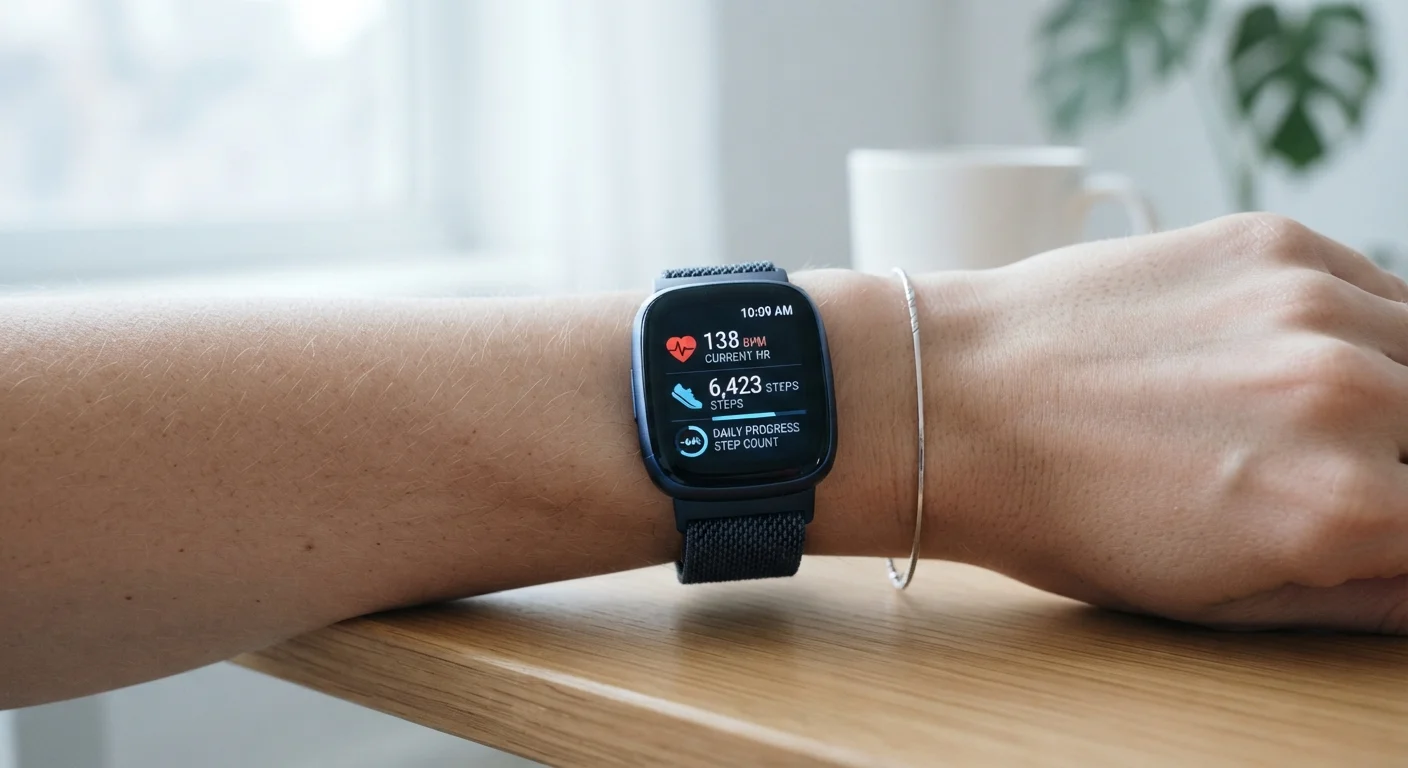
A fitness tracker is a wearable device — typically worn on the wrist — that uses built-in sensors to continuously or periodically measure physical activity, heart rate, sleep patterns, and other health-related data. It translates raw sensor signals into readable metrics like step counts, calories burned, and heart rate. Most trackers sync this data to a smartphone app for longer-term trend analysis.
Consumer-grade fitness trackers use photoplethysmography (PPG) for heart rate, MEMS accelerometers for motion, and pulse oximetry for blood oxygen — all operating under algorithmic interpretation, not clinical-grade measurement.
The Sensors Inside Your Tracker
Every metric your fitness tracker displays starts with a physical sensor. Understanding what each one does demystifies the numbers on your screen — and clarifies why some readings are more reliable than others.
Accelerometer: This is the foundational sensor in virtually all trackers. A MEMS (Micro-Electro-Mechanical System) accelerometer measures changes in velocity across three axes. Your device uses this data to count steps, log distance, detect elevation changes, and classify activity types like walking, running, or swimming.
Photoplethysmography (PPG) sensor: The green (and sometimes red/infrared) LEDs on the back of your tracker shine light into your skin. Blood absorbs light differently depending on whether it's oxygen-rich or oxygen-poor, and whether a pulse is pushing through at that moment. A photodetector measures the reflected light, and an algorithm converts those fluctuations into a heart rate reading.
Pulse oximetry (SpO2): Using red and infrared LEDs together, some trackers estimate blood oxygen saturation — the percentage of hemoglobin carrying oxygen. This is the same principle used in hospital fingertip oximeters, though consumer implementations are not certified to medical standards.
GPS: Many trackers include or connect to GPS to map outdoor routes and measure distance more accurately than accelerometer-based estimates alone. Built-in GPS draws more battery; some devices rely on a paired smartphone's GPS instead.
~3%
Typical resting heart rate error (PPG trackers)
Multiple independent validation studies suggest consumer PPG devices show mean absolute errors roughly in the 3–5 bpm range at rest, though exercise conditions increase this figure.
20–30%
Potential calorie estimate error range
Research published in peer-reviewed journals has found fitness tracker calorie expenditure estimates can deviate from indirect calorimetry by 20% or more depending on device and activity type.
3-axis
Axes measured by a MEMS accelerometer
All consumer fitness trackers rely on triaxial accelerometers to detect movement in three-dimensional space, enabling step detection and activity classification.
How the Data Gets Interpreted
Raw sensor signals are noisy and ambiguous on their own. A wrist movement could be a walking stride, a hand wave, or someone chopping vegetables. This is where algorithms — proprietary software models built into the device's firmware — do the heavy lifting.
For step counting, the accelerometer produces a continuous stream of motion data. The algorithm applies filters to isolate rhythmic, repetitive patterns that resemble walking or running cadence. The result is what appears as your step total, but it is an estimate, not a direct count.
Sleep tracking works similarly. The tracker combines near-motionless periods detected by the accelerometer with heart rate variability (HRV) patterns — subtle beat-to-beat variations that shift between sleep stages — to infer when you transitioned from light to deep or REM sleep. This can broadly reflect your sleep architecture but is less precise than clinical polysomnography.
Calorie estimation introduces additional variables: your weight, height, age, and sex (entered during setup), combined with activity intensity signals, feed a metabolic model. The output varies meaningfully between device brands and from individual to individual.
“Wearable sensors are genuinely useful for motivating activity and tracking broad trends, but the data they produce reflects an estimate of physiology — not a direct measurement. Treating them as precision instruments leads to misinterpretation.”
— Dr. Mitesh Patel, Physician and researcher in digital health behavior change
For a broader look at how these metrics connect to health decisions, see what smartwatch health data can and cannot tell you.
What Affects Accuracy — and What to Expect
Knowing accuracy limitations helps you use tracker data more wisely rather than dismissing it or over-relying on it.
- Device fit: A loose band allows the sensor to shift, introducing motion artifacts into the PPG signal and skewing heart rate readings.
- Skin tone and tattoos: Darker skin tones and ink can absorb more of the LED light, reducing the signal-to-noise ratio for PPG-based metrics. Manufacturers continue to refine sensor arrays to reduce this disparity.
- Activity type: High-intensity or irregular movements — like boxing, rowing, or weight training — create more motion artifacts, making real-time heart rate less reliable during those sessions.
- Placement and motion: Running with a stroller or gesturing with your hands frequently while walking can affect step counts.
Improve Accuracy With Simple Habits
Wear your tracker snugly — about one finger-width above the wrist bone — so the sensor maintains consistent contact with your skin. During workouts, allow a brief warm-up period before relying on real-time heart rate readings, as the sensor needs a few seconds to stabilize its signal. Consistently entering accurate profile data (age, weight, height) also improves the quality of calorie and activity estimates.
If you're weighing whether a full smartwatch or a dedicated tracker suits your lifestyle better, this comparison of smartwatches and fitness trackers breaks down the practical trade-offs. And if you're new to the wearable category altogether, this practical starting point for wearables shoppers covers the full landscape.
This article is for general informational purposes only and does not constitute medical advice. Consult a qualified healthcare professional for any health concerns or before making decisions based on wearable health data.