

Key Takeaways
- Smartwatches measure trends reliably, but individual readings can vary from clinical-grade equipment.
- Heart rate monitoring is among the most validated features; ECG capabilities are more limited in scope.
- Sleep tracking provides useful pattern data but cannot diagnose sleep disorders.
- Setup errors and fit issues significantly affect data accuracy.
- Smartwatch alerts should prompt a conversation with a doctor, not replace one.
- No consumer wearable is a substitute for professional medical evaluation.
Smartwatch Health Data
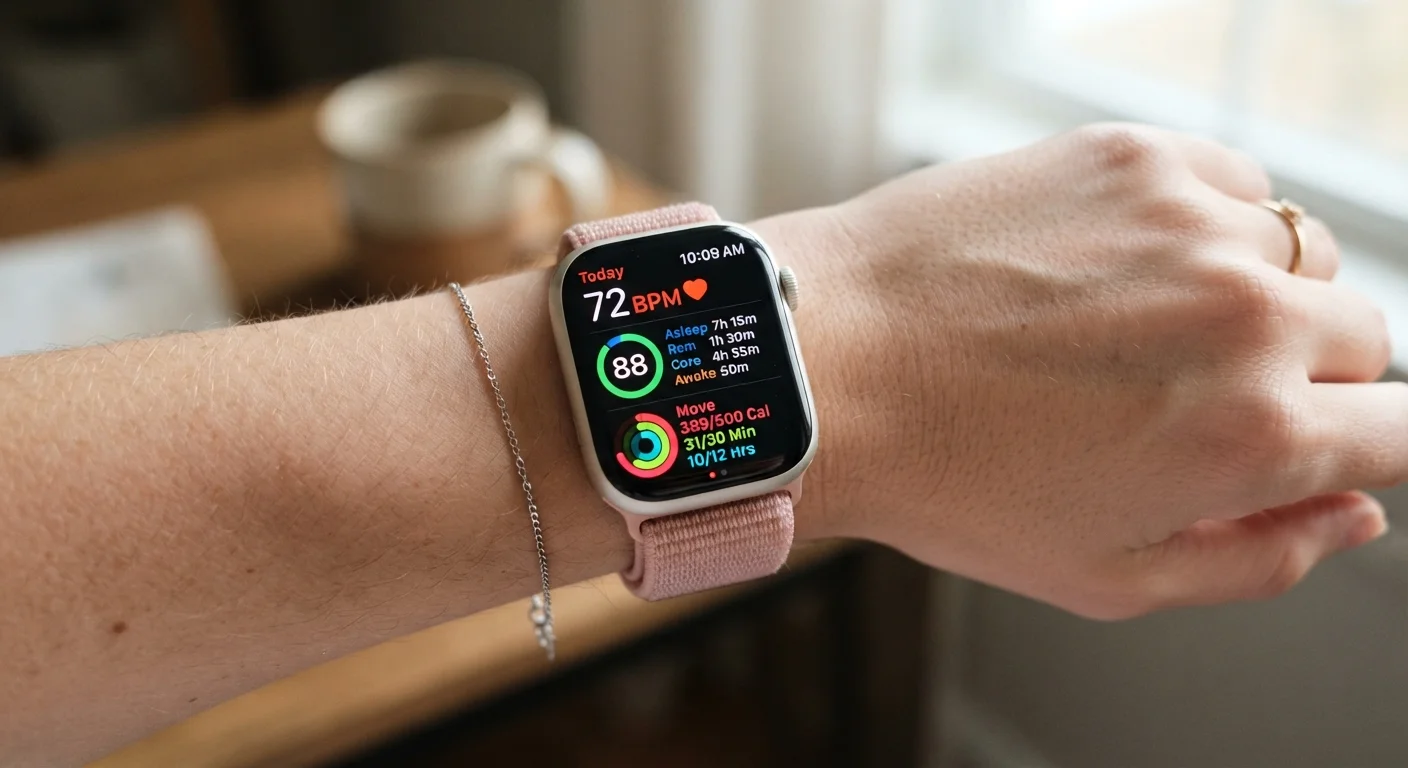
Smartwatch health data refers to the physiological and behavioral measurements collected by sensors embedded in a wrist-worn device. These include metrics like heart rate, blood oxygen saturation, sleep stages, and activity levels. The data is processed by the device's software and displayed as scores, trends, or alerts in a companion app.
Most consumer smartwatches use photoplethysmography (PPG)—an optical sensor that measures blood volume changes through the skin—rather than clinical-grade electrodes, which affects measurement precision compared to medical devices.
What Smartwatch Sensors Actually Measure
Modern smartwatches pack several sensors into a thin band: an optical heart rate sensor, an accelerometer for movement detection, a gyroscope, and in many cases a dedicated ECG electrode and a blood oxygen (SpO2) sensor. Each serves a different purpose, and understanding what they physically detect helps set realistic expectations.
The optical heart rate sensor shines light onto your skin and measures how much is reflected back as blood pulses through capillaries. This is effective for tracking trends over time. The ECG electrode, by contrast, records the electrical signals of your heartbeat—a genuine clinical measurement, though in a simplified single-lead form compared to the 12-lead ECGs used in hospitals. SpO2 sensors estimate the oxygen saturation of your blood using two wavelengths of light.
See our deep dive into wearable sensors for a more detailed breakdown of how each component works and its real-world precision.
~70%
Accuracy of wrist-based SpO2 vs. clinical oximeters
Research published in medical journals has found consumer wrist-based SpO2 sensors can underperform clinical-grade fingertip pulse oximeters, particularly on diverse skin tones.
1 lead
ECG leads on most consumer smartwatches
Clinical ECGs use 12 leads for comprehensive cardiac assessment; consumer smartwatches record a single-lead trace suited only for rhythm screening, not full cardiac diagnosis.
~80%
Adults who own a wearable and track health metrics
Industry surveys consistently show a substantial majority of wearable owners use health-tracking features, though reliance on results for health decisions varies widely.
Where the Data Is Genuinely Useful
Smartwatch health data earns its keep in a few specific areas. Resting heart rate trend tracking is one of the most validated consumer wearable features—a sustained unexplained rise in resting heart rate can be an early signal worth discussing with a clinician. Similarly, long-term sleep duration patterns can reveal habits you'd otherwise overlook, even if the exact stage breakdowns aren't clinical-grade.
ECG readings have cleared regulatory review for detecting certain arrhythmias, particularly atrial fibrillation (AFib). This is a meaningful capability: AFib often has no obvious symptoms, and an opportunistic capture on a wrist device has prompted some people to seek care they didn't know they needed. That said, a single-lead wearable ECG is a screening tool, not a diagnostic one.
Activity metrics—steps, active minutes, cardio load—are useful for behavioral feedback. They encourage movement and provide a consistent personal baseline, even if the absolute numbers aren't perfectly precise. Optimizing your sleep tracking setup can also meaningfully improve the reliability of nightly readings.
Use Trends, Not Single Readings
Instead of reacting to one unusual data point, review your metrics over a week or more. Most smartwatch companion apps display rolling averages for resting heart rate, sleep duration, and activity—these trend lines are more meaningful than any individual measurement. If a trend persists, that's when to flag it for a clinician.
Where Smartwatch Data Falls Short
Consumer wearables are not medical devices in the regulatory sense, and that distinction matters. Blood pressure monitoring on smartwatches—still an emerging feature—lacks the validation of an arm-cuff sphygmomanometer and should not be used to manage hypertension. Stress scores are inferred from heart rate variability and are useful as relative indicators, not as clinical assessments of psychological state.
Sleep stage data is a common area of confusion. Wearables classify sleep using movement and heart rate patterns, not brain wave activity (EEG). The result is an approximation. Conditions like sleep apnea cannot be detected by wrist motion; a formal sleep study is the appropriate diagnostic tool.
Setup also affects data quality more than most users realize. A loose fit, incorrect profile data, or outdated firmware can quietly skew readings. Review the common setup mistakes that undermine health data to ensure your baseline readings are as reliable as possible.
Regulatory Status Matters
Some smartwatch health features—such as ECG and AFib detection—have received clearance from the U.S. Food and Drug Administration (FDA) as medical-grade screening tools. Others, like stress scores and sleep staging, are consumer wellness features without equivalent regulatory review. Checking which category a specific feature falls into helps set appropriate expectations for its reliability.
When to Take the Data to a Doctor
Smartwatch alerts and unusual readings are prompts for conversation, not conclusions. If your device flags a possible irregular rhythm, a persistently elevated resting heart rate, or a string of low SpO2 readings, treat that as a reason to check in with your healthcare provider—not as a diagnosis.
Context matters enormously. A single abnormal reading during a workout, after a poor night of sleep, or while wearing a cold-temperature device may reflect sensor conditions rather than physiology. Consistent patterns over days or weeks carry more weight than isolated data points.
It's worth noting that the privacy dimension of health data is also significant. Your device collects intimate physiological information, and how that data is stored and shared varies by platform. The privacy implications of wearable health data are worth understanding before relying heavily on any platform's ecosystem.
This article is for general informational purposes only and does not constitute medical advice. Always consult a qualified healthcare professional for personal health concerns, diagnosis, or treatment decisions.