

Key Takeaways
- Cosmetic ingredients are listed in descending order by concentration — highest amount appears first.
- Ingredients at 1% or below can appear in any order, so their position tells you less than it seems.
- INCI names are standardized scientific terms that differ from marketing language on the front of the pack.
- Fragrance and certain preservatives are among the most common triggers for skin sensitivity.
- A longer ingredient list doesn't automatically signal a more effective or safer formula.
What you will need
How Cosmetic Labels Are Legally Structured
In the United States, the FDA requires cosmetic manufacturers to list ingredients on product labels using a standardized system called INCI — International Nomenclature of Cosmetic Ingredients. These are the scientific Latin or chemical names you see crowding the back of a bottle, and they're deliberately universal so that the same ingredient reads identically regardless of brand or country of origin.
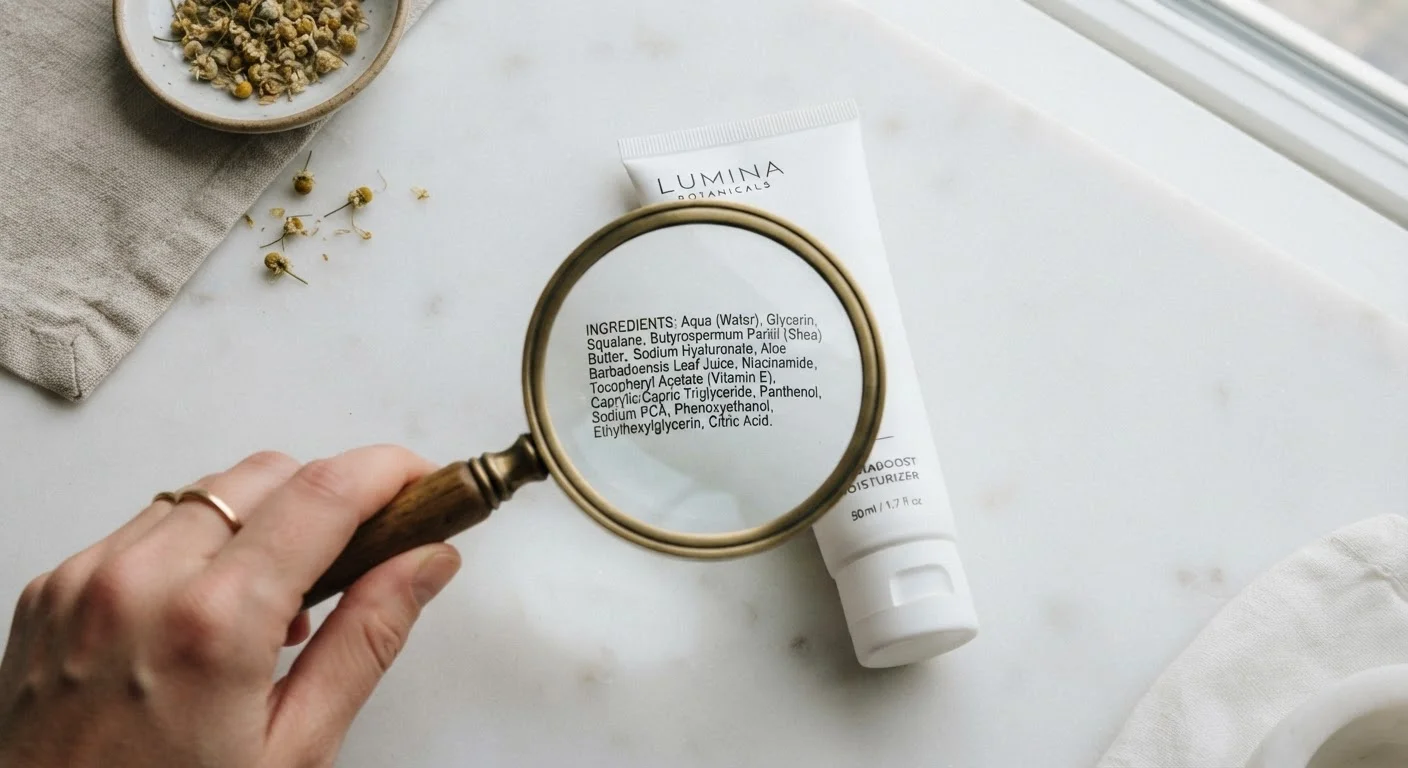
The single most important structural rule: ingredients are listed in descending order of concentration. Whatever appears first makes up the largest proportion of the formula. For most moisturizers and serums, that's water (aqua). What appears near the bottom is present in a much smaller quantity.
There's a significant nuance, however. Once ingredient concentrations fall to 1% or below, the manufacturer can list them in any order. This means a compelling active like niacinamide could appear mid-list but still be present only in trace amounts — or it could be genuinely well-dosed. Position alone can't tell you which. For a deeper look at how specific actives function, see our plain-language reference to common skincare actives.
What you will need
What to Look For (and What to Watch Out For)
Once you understand the structure, you can read a label with a more critical eye. Here's where to focus:
- Water position: If water (aqua) is the first ingredient in a serum claiming to be 10% vitamin C, that concentration claim warrants scrutiny.
- Active ingredients: Key actives like retinol, hyaluronic acid, or glycolic acid should ideally appear in the first half of the list to suggest a meaningful dose. Our skin concerns and ingredients reference can help you identify what to look for based on your priorities.
- Fragrance: Listed as fragrance, parfum, or individual fragrant compounds, this is one of the more common causes of contact dermatitis. Fragrance in skincare carries real trade-offs worth understanding before you buy.
- Preservatives: Ingredients like phenoxyethanol or sodium benzoate keep products shelf-stable and safe. Their presence is generally a sign of responsible formulation, though some individuals with sensitive skin may react to specific ones.
- Sunscreen actives: These are regulated as OTC drug ingredients in the US, so they'll appear in a separate "Active Ingredients" section at the top of the label — not within the standard cosmetic ingredient list. For more context, see our guide to chemical vs. physical sunscreen formulas.
Use INCI Names as Your Anchor
INCI names are consistent across every brand, so learning a handful of key ones — aqua, retinol, niacinamide, tocopherol (vitamin E) — pays dividends across every product you evaluate. Marketing names vary wildly; the INCI list doesn't.
Marketing Language vs. the Actual List
Front-of-pack claims — "enriched with bakuchiol," "powered by peptides," "with vitamin C" — are marketing statements, not concentration guarantees. A product can legally make these claims even if the highlighted ingredient appears near the very bottom of the list.
This doesn't mean the product won't work. Some ingredients are effective at low concentrations. But it's worth cross-referencing front claims against the actual ingredient list before assuming you're getting a high-dose formula.
Similarly, "natural," "clean," and "non-toxic" have no standardized legal definition in US cosmetics regulation. They are marketing terms, not regulatory categories. The ingredient list — not the front label — is your most reliable source of information.
Unregulated Label Claims Are Common
Terms like "clean," "natural," "non-toxic," and "dermatologist-tested" carry no standardized legal definition in US cosmetics regulation. They are marketing descriptors and should not be taken as safety or efficacy certifications. Always rely on the ingredient list itself for an honest picture of what's in the formula.
Once you feel confident reading labels, putting that knowledge to use becomes more intuitive. Understanding product composition also helps you make smarter decisions about skincare layering and product order, since formulas interact with one another. If you're aiming for simplicity, our minimalist skincare guide offers a practical framework for doing more with less.
This article is for general informational and educational purposes only. It is not a substitute for advice from a licensed dermatologist or healthcare professional. If you have a skin condition or specific sensitivities, consult a qualified professional before changing your skincare routine.