

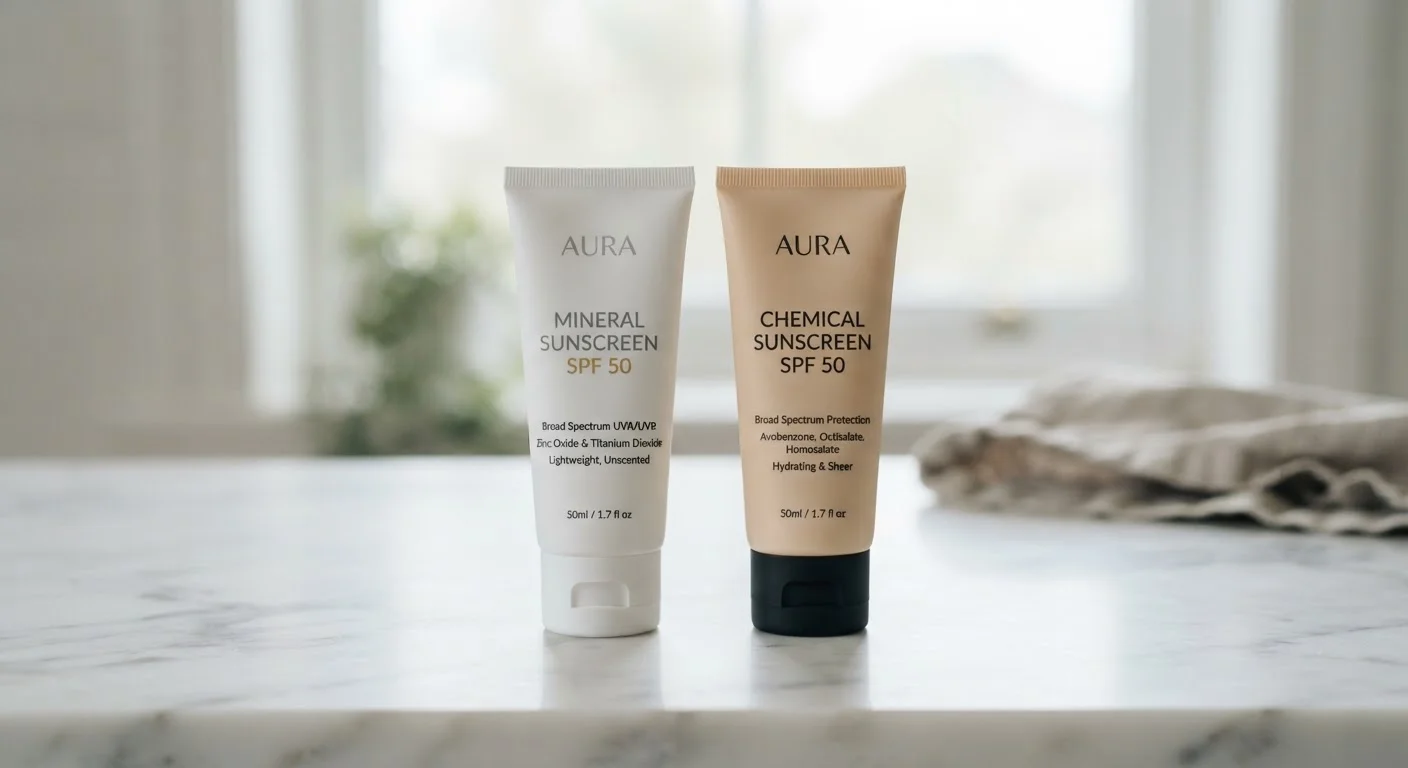
Key Takeaways
- Chemical sunscreens absorb UV rays and convert them to heat; physical sunscreens reflect UV rays away from the skin.
- Physical formulas work immediately upon application; chemical formulas generally need about 20 minutes to activate.
- Sensitive and acne-prone skin types often tolerate mineral (physical) sunscreens better due to fewer irritating ingredients.
- Neither type guarantees complete protection — broad-spectrum SPF 30 or higher, applied generously, matters most.
- Checking the active ingredient list is the fastest way to identify which type of sunscreen you're using.
Option A
Chemical Sunscreen
The lightweight, invisible daily-wear option.
Best for: Those who want a sheer, makeup-friendly finish and don't have sensitive or reactive skin.
Option B
Physical Sunscreen
The gentle, mineral-based barrier for sensitive skin.
Best for: Those with sensitive, acne-prone, or hyperpigmentation-prone skin who want immediate broad-spectrum protection.
If you wear makeup daily and want a seamless, lightweight base
Chemical Sunscreen
Chemical formulas absorb quickly and leave no white cast, making them easier to layer under foundation and tinted products.
If you have sensitive, rosacea-prone, or reactive skin
Physical Sunscreen
Mineral actives like zinc oxide and titanium dioxide are generally less likely to trigger irritation or flushing than chemical UV filters.
If you have deeper skin tones and want to avoid a white or ashy residue
Chemical Sunscreen
Traditional physical formulas can leave a visible white cast on deeper complexions, though newer tinted mineral options are narrowing this gap.
If you're applying sunscreen on young children or postpartum skin
Physical Sunscreen
Dermatologists and pediatric guidance commonly suggests mineral sunscreens for younger or more vulnerable skin, though you should consult a healthcare provider for personal guidance.
If you're swimming or exercising outdoors and need reliable water resistance
Chemical Sunscreen
Many water-resistant sport formulas use chemical filters that tend to adhere more consistently during prolonged activity, though both types require reapplication after 40–80 minutes in water.
How Each Formula Actually Works
Understanding the core mechanism behind each sunscreen type helps you choose more intentionally — and use your formula correctly.
Chemical sunscreens contain organic (carbon-based) UV-filter ingredients such as avobenzone, octinoxate, oxybenzone, or homosalate. These molecules absorb ultraviolet radiation and release it as a small amount of heat rather than allowing it to penetrate deeper into skin. Because these filters need time to bind to skin cells, most formulations require roughly 20 minutes between application and sun exposure to be effective.
Physical sunscreens — also called mineral sunscreens — rely on inorganic mineral actives: zinc oxide, titanium dioxide, or both. These minerals sit on top of the skin's surface and scatter or reflect UV radiation before it can be absorbed. Because they work immediately on contact, there's no waiting period after application. For a deeper look at how to decode the ingredient list on any sunscreen or skincare product, see our label-reading guide.
| Criterion | Chemical Sunscreen | Physical Sunscreen |
|---|---|---|
| How it works | Absorbs UV rays, releases as heat | Reflects and scatters UV rays |
| Active ingredients | Avobenzone, oxybenzone, octocrylene | Zinc oxide, titanium dioxide |
| Time to effectiveness | ~20 minutes after application | Immediate upon application |
| Finish on skin | Sheer, lightweight, no white cast | Can leave white cast; tinted versions available |
| Sensitive skin compatibility | May cause irritation in some | Generally better tolerated |
| Makeup wearability | Blends easily under makeup | Thicker texture; tinted formulas help |
| Environmental stability | Some filters degrade in sunlight | More photostable overall |
Skin Type Compatibility and Sensitivities
The right choice often comes down to how your skin reacts — not just personal preference.
Oily or acne-prone skin: Some chemical filters, particularly oxybenzone and avobenzone, can feel occlusive or comedogenic for certain individuals. Lightweight gel-based chemical formulas often work well for this skin type. Mineral options with non-comedogenic bases are also widely recommended by dermatologists for breakout-prone complexions.
Sensitive or rosacea-prone skin: Chemical filters occasionally cause stinging, redness, or contact reactions in reactive skin types. Zinc oxide in particular has documented anti-inflammatory properties, making physical formulas a commonly suggested starting point. That said, sensitivity varies from person to person — patch testing any new sunscreen is a smart habit regardless of formula type.
Deeper skin tones: Traditionally formulated physical sunscreens can leave a noticeable white or grayish cast on medium-to-deep complexions. The cosmetic industry has improved significantly with micronized minerals and tinted mineral formulas, but chemical sunscreens typically remain easier to blend invisibly on a wider range of skin tones.
Patch Testing: A Simple Safety Step
If you're switching sunscreen types or trying a new formula, apply a small amount to your inner forearm or behind the ear and wait 24–48 hours before applying it to your face. This is especially useful for identifying contact reactions to chemical filters or preservatives. It's a quick habit that can save significant skin irritation, particularly for those with known sensitivities. Your dermatologist can advise on formal allergy testing if you experience repeated reactions.
What to Look for on the Label
Federal regulation in the US requires sunscreens to declare their active ingredients separately from inactive ones. The active ingredient panel is your clearest guide to formula type: if you see zinc oxide or titanium dioxide, it's a physical (mineral) sunscreen. If you see names like avobenzone, octocrylene, or homosalate, it's chemical. Some formulations combine both and are known as hybrid sunscreens.
Beyond formula type, look for these markers when choosing any sunscreen:
- Broad-spectrum: Confirms protection against both UVA (aging and DNA damage) and UVB (burning) rays. This label is regulated by the FDA.
- SPF 30 or higher: SPF 30 filters approximately 97% of UVB rays. Higher SPF offers marginally more protection but no formula blocks 100%.
- Water resistance rating: Labels may claim 40 or 80 minutes of water resistance — not waterproof. Reapplication is still essential.
It's also worth checking your understanding of common sunscreen misconceptions before committing to a routine. Sunscreen myths that quietly damage your skin covers several persistent beliefs — including the idea that darker skin tones don't need SPF — that the evidence doesn't support.
SPF 30
Minimum recommended daily SPF
The American Academy of Dermatology recommends SPF 30 or higher as a baseline for everyday broad-spectrum protection.
~25%
Estimated average sunscreen underapplication
Research published in dermatology literature suggests people typically apply only 25–50% of the sunscreen amount used in official SPF testing, significantly reducing effective protection.
2 hours
Maximum reapplication interval outdoors
Dermatological guidance recommends reapplying sunscreen every two hours during outdoor exposure, regardless of formula type.
Layering Sunscreen Into Your Routine
Where sunscreen sits in your skincare sequence matters as much as which formula you choose. As a general principle, sunscreen is applied as the final skincare step before makeup — after moisturizer, serums, and any treatment products. Physical sunscreens, because they work by sitting on the skin's surface, are particularly sensitive to being diluted or disrupted by applying other products over them too quickly.
Chemical sunscreens are usually applied before moisturizer in some routine approaches, though guidance varies by formulation. If you're uncertain about the correct sequence for your specific products, our skincare layering guide walks through the logic behind product order in practical terms.
One principle holds across both types: amount matters. Studies consistently show that most people apply far less sunscreen than the quantity used in SPF testing. Dermatologists commonly reference about a quarter teaspoon for the face alone as a useful starting estimate — though the right amount for you depends on your face size, formula type, and coverage area. Consult a dermatologist if you're unsure what's appropriate for your skin and lifestyle. For a full seasonal approach to sun protection and skin health, see our all-in-one seasonal skincare guide.
This article is for general informational and educational purposes only and does not constitute medical or dermatological advice. Consult a qualified healthcare professional or board-certified dermatologist for guidance tailored to your skin type and health needs.