

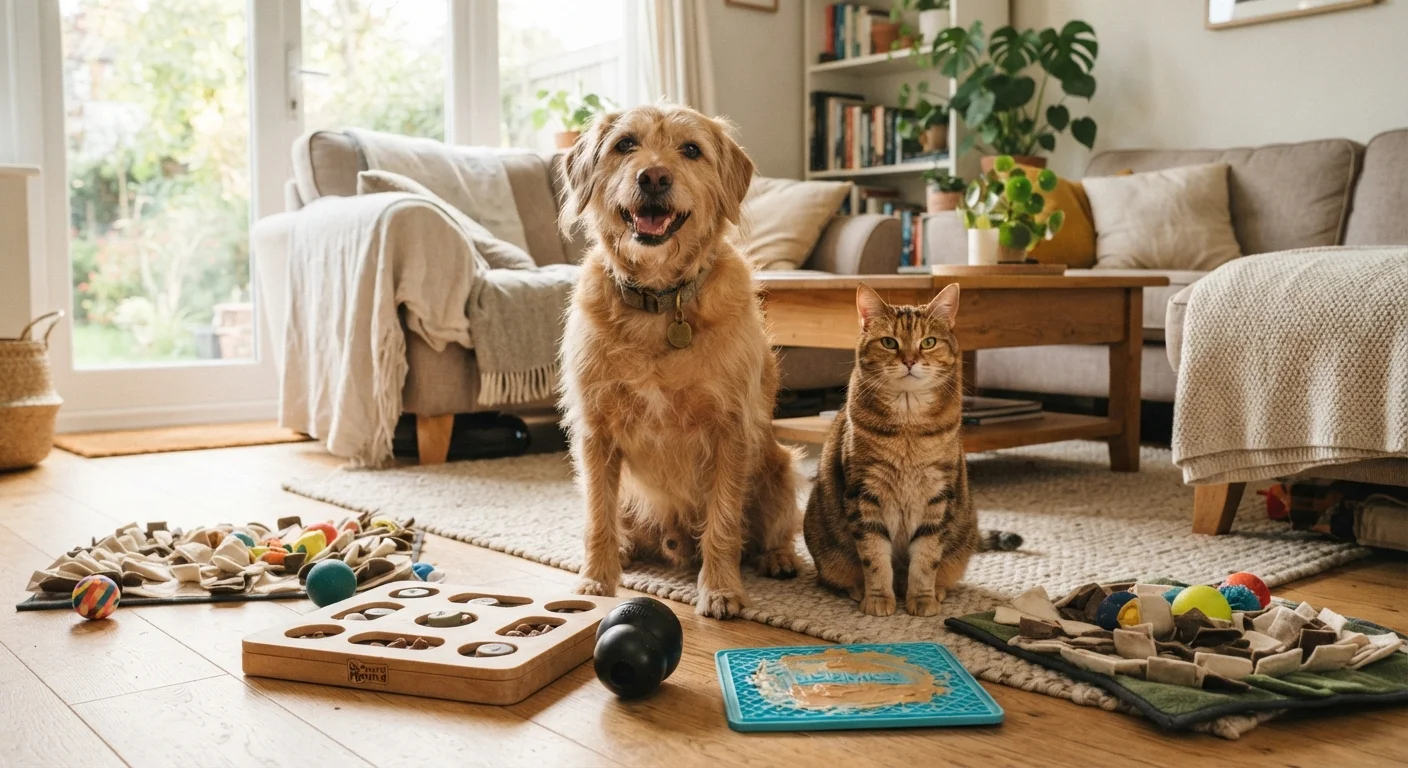
Key Takeaways
- Mental stimulation is a recognized component of pet welfare, not a luxury.
- Boredom in pets can escalate into anxiety, destructive behavior, and compulsive habits.
- Dogs and cats have distinct cognitive needs that require different enrichment approaches.
- Even 10–15 minutes of structured mental engagement daily can meaningfully reduce problem behaviors.
- Training sessions double as mental workouts and strengthen the human-animal bond.
Mental Stimulation for Pets
Mental stimulation refers to any activity that engages a pet's brain — requiring them to think, problem-solve, explore, or learn. Just as physical exercise keeps muscles healthy, mental engagement keeps the mind active and balanced. For dogs and cats, this can include puzzle feeders, scent work, training exercises, and novelty in their environment.
In applied animal behavior, mental stimulation is a core component of environmental enrichment — a framework used by veterinary behaviorists to promote species-appropriate cognitive and sensory engagement.
Why the Brain Is Part of Pet Health
When pet owners think about their animal's health, diet and exercise usually come to mind first. But veterinary behaviorists and applied animal behavior researchers increasingly recognize the brain as a core health organ — one that requires regular, appropriate engagement to stay in balance.
Domestic dogs and cats are descended from animals whose survival depended on complex cognitive tasks: tracking prey, navigating territory, reading social cues, and solving spatial problems. Indoor pets retain those neural systems. When those systems go unused, the results aren't just inconvenient — they can be genuinely harmful to the animal's wellbeing.
The field of environmental enrichment, developed originally for zoo and laboratory animals, has shaped how veterinarians now think about companion pet care. Enrichment isn't about entertainment — it's about meeting a species' behavioral and psychological needs in a way that reduces stress and supports healthy functioning. Mental stimulation sits at the center of that framework.
Mental and Physical Needs Work Together
Mental stimulation complements — but does not replace — physical exercise. A well-rounded pet care routine addresses both. If your pet shows sudden behavioral changes, consult a veterinarian to rule out underlying medical causes before attributing the issue to enrichment alone. Behavior is a health signal, and a vet visit is always the right first step when something seems off.
What Counts as Mental Stimulation
Mental stimulation covers a wide range of activities, but they share a common requirement: the pet must actively engage its brain to complete them. Passive exposure — background TV noise, for example — doesn't qualify. The key ingredient is cognitive effort.
For Dogs
- Puzzle feeders and food-dispensing toys: Require the dog to manipulate the toy to access food, combining problem-solving with reward.
- Scent work and nose games: Hiding treats around a room or introducing structured nose work taps into a dog's extraordinary olfactory system — one of the most cognitively demanding senses to engage.
- Obedience and trick training: Short, reward-based training sessions (5–10 minutes) require focus and decision-making. See how positive reinforcement works to make these sessions effective.
- Novel environments and controlled socialization: Introducing new smells, surfaces, and social contexts gives the brain new information to process.
For Cats
- Hunting-sequence play: Wand toys and prey-like objects allow cats to stalk, pounce, and capture — mimicking the full predatory sequence their brains are wired for.
- Food puzzles and slow feeders: Replacing a standard bowl with a puzzle feeder transforms mealtime into a problem-solving event.
- Vertical space and window access: Visual monitoring of the environment is a core feline cognitive need. Perches, cat trees, and bird feeders outside windows provide ongoing sensory input.
Start Small, Stay Consistent
You don't need to overhaul your pet's routine overnight. Pick one enrichment activity — a puzzle feeder at dinnertime or a five-minute nose game before bed — and practice it consistently for two weeks before adding more. Consistency builds habit faster than intensity, and a sustainable routine delivers better long-term results than an elaborate one you abandon.
What Happens When Pets Are Under-Stimulated
Boredom in pets isn't a minor inconvenience — it's a welfare concern. When cognitive needs go unmet for sustained periods, animals often develop what behaviorists call displacement behaviors: actions that redirect frustrated drives in ways that may become compulsive over time.
In dogs, this commonly shows up as destructive chewing, excessive barking, digging, or pacing. In cats, under-stimulation can present as over-grooming (sometimes to the point of hair loss), repetitive vocalization, or inter-cat aggression in multi-cat households. Both species may develop attention-seeking behaviors that owners often inadvertently reinforce.
Chronic under-stimulation has also been linked to generalized anxiety in pets. An anxious dog or cat is harder to train, more reactive to environmental changes, and more likely to develop secondary health issues linked to chronic stress. This is why addressing mental enrichment is increasingly considered part of preventive veterinary care — not a behavioral add-on.
70%
Pet owners reporting behavioral problems in under-stimulated pets
Survey data from veterinary behavioral practice studies consistently show a majority of behavior complaints are linked to inadequate environmental enrichment.
5–10 min
Daily training session length recommended by behaviorists
Applied animal behaviorists generally recommend multiple short, focused training sessions rather than one long session to maximize cognitive engagement.
1 in 6
Dogs meeting criteria for anxiety-related disorders
A large-scale study published in Scientific Reports (2020) found approximately 72% of dogs showed anxiety-related behaviors, with compulsive and inattentive behaviors among the most common.
How to Build Mental Enrichment Into Daily Life
Effective mental stimulation doesn't require expensive equipment or hours of free time. The most sustainable approach is to weave small enrichment moments into routines you already have. Feeding time, walks, and play sessions all offer built-in opportunities.
A practical starting point: replace one regular bowl meal per day with a food puzzle or scatter-feeding (spreading kibble across a sniff mat or the lawn). This single change introduces problem-solving and extends engagement without adding significant time to your routine. Our guide on integrating training into daily life offers additional frameworks for building enrichment into existing schedules.
Rotate enrichment options regularly. Novelty itself is cognitively stimulating — a toy that's been ignored for two weeks may recapture interest when reintroduced. Environmental variety, such as rearranging a cat's climbing structure or changing a walk route for your dog, provides low-effort cognitive input.
For new pet owners still setting up their space, creating a stimulating home environment from the start makes it much easier to maintain enrichment as a daily habit. For a deeper look at the full spectrum of enrichment types — sensory, social, cognitive, and physical — see why pets need enrichment.
This article is for general informational and educational purposes only and is not a substitute for professional veterinary advice. Always consult a licensed veterinarian for concerns about your pet's health or behavior.