

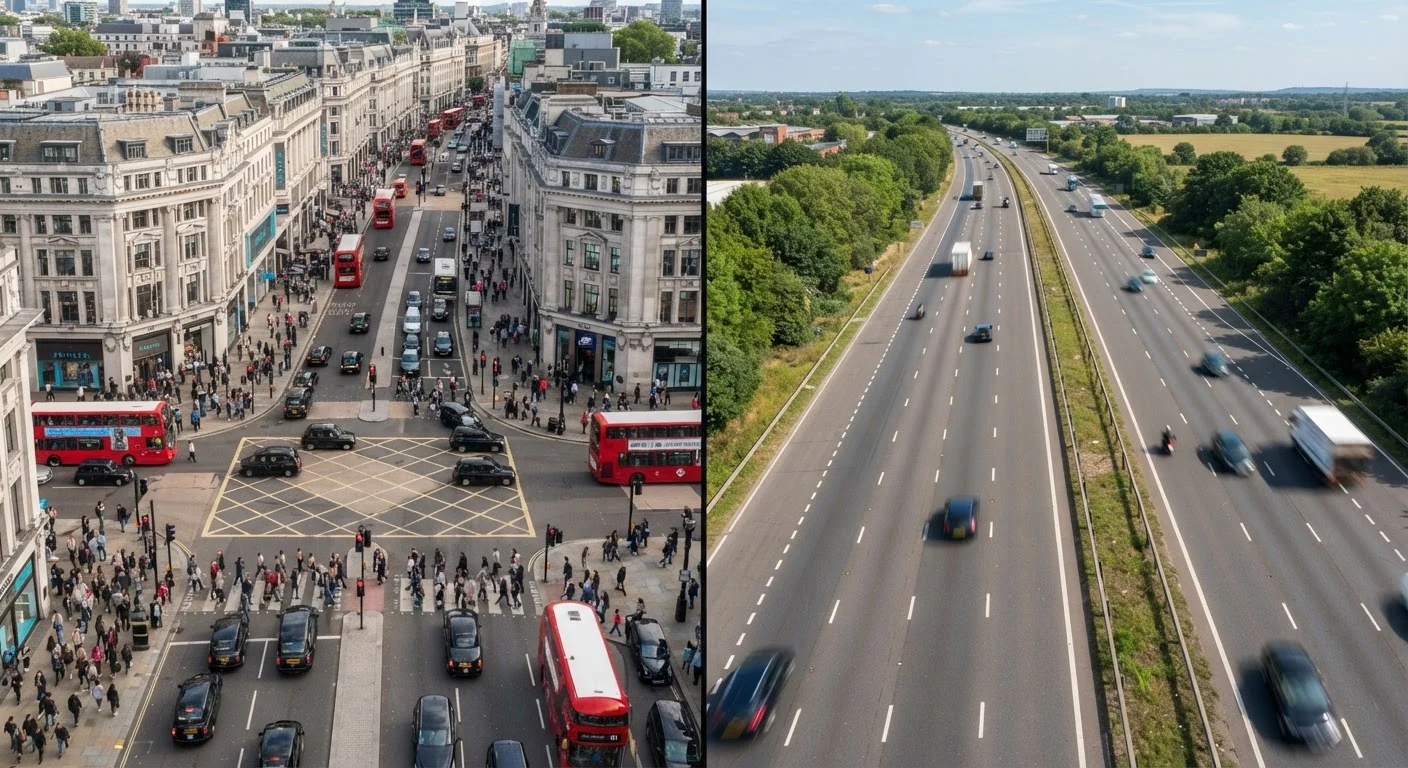
Key Takeaways
- Highway crashes tend to be more severe due to higher speeds, even though they occur less frequently than city crashes.
- City driving involves more frequent hazard encounters — pedestrians, cyclists, intersections, and unpredictable stops.
- Driver fatigue is a greater highway risk; distraction and reaction-time demands are more acute in city traffic.
- Appropriate following distance differs significantly between highway speeds and stop-and-go urban conditions.
- Understanding each environment's risk profile helps drivers adapt their habits proactively rather than reactively.
Option A
Highway Driving
High-speed, high-consequence — where sustained attention is the primary safety tool.
Best for: Covering long distances efficiently, but demands consistent speed management and fatigue awareness.
Option B
City Driving
Lower speeds, but far more variables to track at once.
Best for: Navigating dense urban environments where hazards appear quickly, frequently, and from all directions.
If you primarily drive rural or interstate routes
Highway Driving awareness strategies
Focus on fatigue management, following distance at speed, and maintaining lane discipline — the risks here are lower in frequency but higher in severity.
If you navigate dense urban areas daily
City Driving awareness strategies
Prioritize active scanning at intersections, pedestrian awareness, and minimizing distraction — hazards are frequent and close-range.
If you regularly switch between both environments
Both risk profiles equally
Transitioning between highway and city driving requires a conscious mental reset — speeds, hazard types, and attention demands shift significantly within minutes.
The Core Difference: Speed vs. Complexity
Highway and city driving aren't simply fast versus slow — they represent fundamentally different operating environments, each demanding a distinct set of skills and attentional priorities.
On highways, the primary hazard is speed itself. At 65–75 mph, stopping distances expand dramatically, and the margin for error shrinks accordingly. A brief lapse in attention — even two seconds — covers the length of a football field. Crashes that do occur at these speeds tend to produce more serious injuries than equivalent urban incidents.
City driving inverts this equation. Speeds are lower, but the density of hazards is far greater. Pedestrians crossing mid-block, cyclists in adjacent lanes, vehicles pulling from parking spaces, delivery trucks stopped in travel lanes, and signal changes all demand rapid, near-constant attention shifts. The frequency of potential conflict points is substantially higher within any given mile of urban travel.
Both environments reward a defensive driving mindset — but the specific habits that mindset produces look quite different depending on where you're driving.
| Criterion | Highway Driving | City Driving |
|---|---|---|
| Typical speed range | 55–80 mph | 15–45 mph |
| Crash frequency | Lower per mile | Higher per mile |
| Crash severity | Generally higher | Generally lower |
| Primary hazard type | Speed, fatigue, merging | Intersections, pedestrians, congestion |
| Attention demand | Sustained, monotony risk | Rapid, frequent switching |
| Following distance needed | 3–4+ seconds | 2–3 seconds (stop-and-go) |
| Distraction risk | High (long stretches invite mind-wandering) | High (dense inputs, phone use) |
| Weather sensitivity | High (hydroplaning, fog) | Moderate (slower speeds help) |
Highway-Specific Hazards: What Drivers Underestimate
Highway driving feels routine, and that familiarity is itself a risk. Driver fatigue accumulates on long, monotonous stretches where the visual environment changes little. Research from the National Highway Traffic Safety Administration (NHTSA) consistently identifies drowsy driving as a significant contributor to fatal highway crashes.
Merging and lane changes are another elevated-risk activity on multi-lane roads. Blind spots that seem manageable at low speed become more consequential at highway velocity, where vehicles close distance quickly. If you want to build confidence in these specific maneuvers, our guide on merging and lane changes on multi-lane roads covers technique in detail.
Weather amplifies all highway risks. Wet pavement at highway speed increases hydroplaning risk; fog compresses stopping distances relative to visibility. For a deeper look at how conditions change the equation, see our breakdown on driving in rain, snow, ice, and fog.
~70%
Fatal crashes occurring on rural and highway roads
Despite lower traffic volumes, NHTSA data consistently shows rural and non-urban roads account for a disproportionate share of traffic fatalities due to higher speeds and longer emergency response times.
40%
Of urban crashes involving intersections
The Federal Highway Administration estimates that roughly 40 percent of all crashes in the US occur at or near intersections, the majority of which are in urban settings.
2 sec
Distraction window covering ~176 feet at 60 mph
NHTSA research illustrates how even a brief two-second distraction at highway speed covers a significant distance, leaving little time to respond to sudden hazards.
City-Specific Hazards: Managing Constant Complexity
Urban environments generate what traffic safety researchers sometimes call a high-conflict density — meaning the number of potential crash scenarios per mile is significantly elevated. Intersections are the most statistically dangerous locations in city driving; a meaningful share of urban crashes involve right-of-way violations, failure to yield, or red-light running.
Distraction is acutely dangerous in city traffic. At 30 mph, a two-second distraction still covers nearly 90 feet — plenty of distance for a pedestrian to step off a curb or a vehicle ahead to brake suddenly. Even hands-free phone use carries cognitive load that reduces hazard detection. Our article on cognitive distraction behind the wheel explains why the mental engagement of a phone call persists even when your hands are free.
Aggressive behavior also surfaces more in urban settings, where competition for space is constant. Recognizing early signs of escalation — in other drivers and in yourself — is a practical urban safety skill. See our piece on road rage and aggressive driving for strategies to de-escalate.
Adapting Your Habits to Each Environment
The most prepared drivers don't use a single driving style universally — they adjust their approach based on where they are and what the environment demands.
On highways: Increase following distance to at least three to four seconds at speed, take scheduled breaks on long trips to counter fatigue, and avoid relying on cruise control as a substitute for active attention. Night driving compounds highway risk further; consider our guide on what changes after dark for targeted strategies.
In cities: Reduce speed proactively before intersections rather than relying on reaction time, give cyclists and pedestrians a wider buffer than feels instinctively necessary, and treat yellow lights as a cue to prepare to stop rather than accelerate.
New and younger drivers face elevated risk in both environments during their first year behind the wheel. Our analysis of teen driver crash data highlights the specific factors that make early driving experience particularly consequential.
Insurance Implications of Your Driving Environment
Where you drive most frequently can influence your auto insurance risk profile. Insurers often consider factors such as annual mileage, urban versus rural garaging location, and commute type when assessing premiums. If your driving environment has changed significantly — such as moving from a rural area to a dense city — it may be worth reviewing your coverage. For a general overview of coverage categories, see our coverage types guide. Always consult a licensed insurance agent for advice specific to your situation, as coverage terms and pricing vary by provider and state.