

Key Takeaways
- Hands-free phone use still imposes significant cognitive load on drivers.
- Research consistently shows slower reaction times and reduced hazard detection during phone conversations, even with both hands on the wheel.
- The brain cannot fully multitask — conversation competes with driving for the same mental resources.
- Voice-activated commands and dictation add their own momentary cognitive demands.
- Awareness of the limitation is the first step toward safer phone habits behind the wheel.
Cognitive Distraction
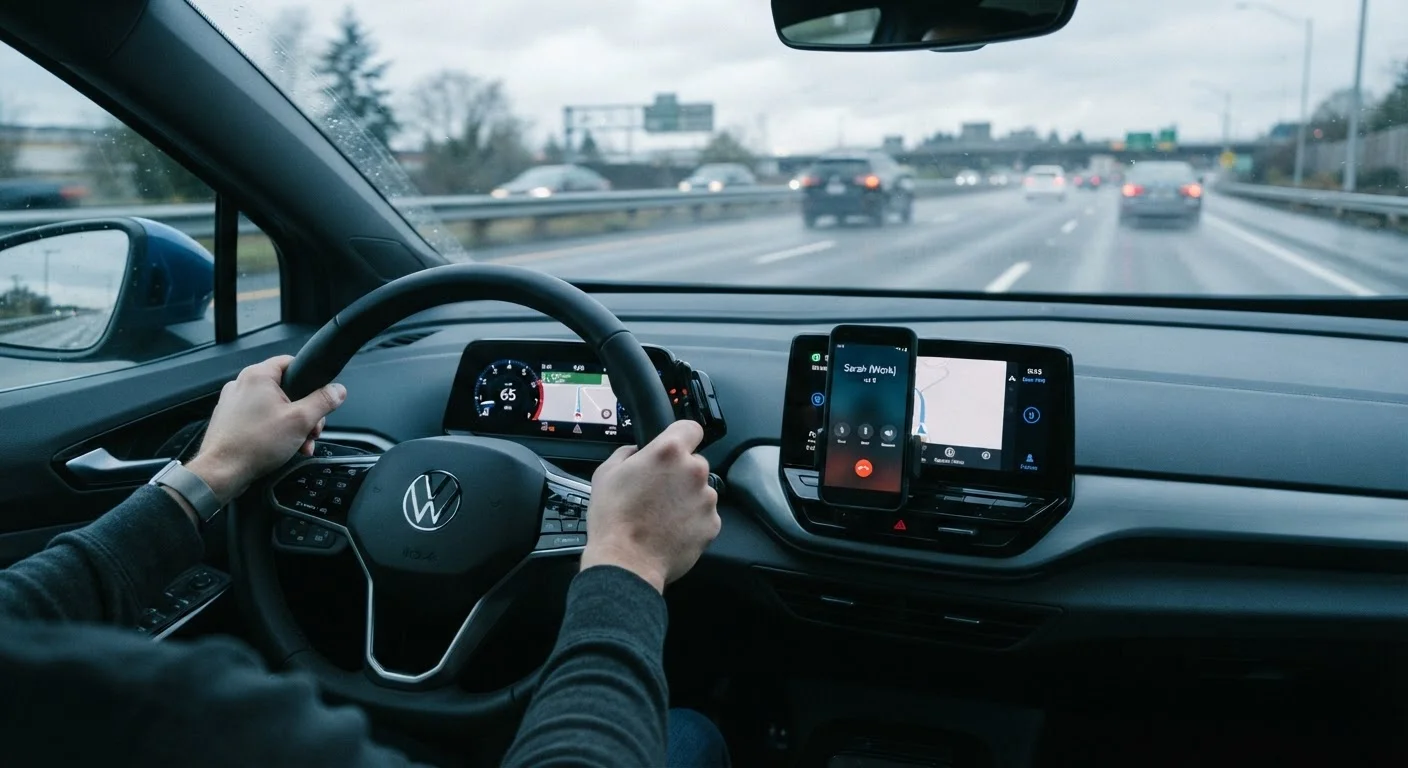
Cognitive distraction occurs when a driver's mental attention is diverted from the task of driving, even if their eyes remain on the road and their hands stay on the wheel. It's the internal kind of distraction — the mind is somewhere else. Hands-free phone use is a common and widely underestimated source of this mental load.
Researchers distinguish three distraction types: visual (eyes off road), manual (hands off wheel), and cognitive (mind off task). Hands-free technology addresses only the first two.
The Myth of the Safe Hands-Free Call
Many drivers feel a genuine sense of responsibility when they switch from holding a phone to using a Bluetooth headset or a dash-mounted speakerphone. Hands on the wheel, eyes on the road — it feels right. Laws in most U.S. states reinforce this instinct by banning handheld phone use while permitting hands-free alternatives. The message absorbed by many drivers is that the hands-free option is essentially safe.
That conclusion goes further than the evidence supports. Traffic safety researchers — including those at the AAA Foundation for Traffic Safety and the National Safety Council — have documented that phone conversations, whether handheld or hands-free, impose a consistent cognitive load that degrades driving performance. The hands are on the wheel, but a significant portion of the brain's attention is elsewhere.
Understanding why this happens requires a brief look at how attention actually works — and why the brain cannot simply divide it in two.
What State Laws Do — and Don't — Cover
Most U.S. states have laws restricting handheld phone use while driving, and many specifically permit hands-free alternatives. These laws address the legal question of phone handling — not the cognitive distraction that persists regardless of how the phone is held. Compliance with state law is necessary, but it does not mean hands-free use carries no risk. Drivers should be aware of both the legal standard and the safety reality.
How Attention Works — and Why It Can't Split Evenly
Driving is not a simple, automatic activity. Even on familiar roads, the brain is continuously processing visual information, anticipating the behavior of other vehicles, monitoring speed, and making rapid micro-decisions. Safe driving draws on a mental resource that researchers call attentional capacity — and that capacity is finite.
A phone conversation — even a calm one — draws on the same cognitive resources as driving. The brain must process language, formulate responses, and hold context. These demands compete directly with the demands of operating a vehicle. The result is that neither task gets the driver's full attention.
Studies using driving simulators have found that drivers engaged in phone conversations miss traffic signals, follow other vehicles more closely than is safe, and react more slowly to sudden hazards. The National Safety Council has estimated that hands-free phone use contributes to a meaningful share of distraction-related crashes each year — crashes that occur even though the driver's hands never left the wheel.
4x
Increased crash risk while using a phone while driving
The National Safety Council cites research indicating phone use while driving quadruples crash risk, with hands-free use still contributing to the problem.
27 seconds
Cognitive distraction after voice interaction ends
AAA Foundation for Traffic Safety research found that mental distraction can persist for up to 27 seconds after completing a voice-based task.
~37%
Of drivers report regularly using hands-free devices
Survey data from road safety organizations consistently shows widespread hands-free phone use among U.S. drivers who consider the practice safe.
What Makes Phone Conversations Uniquely Demanding
Not all in-car activity is equally distracting. Listening to music or even a radio talk show places a lower cognitive demand on the driver than an active conversation — because listening does not require the same real-time mental engagement as participating in dialogue.
Talking to a passenger is a different case, and an instructive one. A passenger in the vehicle shares the driver's visual environment. They can see that traffic is tightening, that a merge is coming, that the driver needs to concentrate — and they adjust accordingly, pausing or going quiet. A caller on the other end of a phone has none of that context. The conversation continues at the same pace through a school zone or a sudden freeway slowdown, because the caller simply cannot see what is happening.
Voice commands introduce their own complexity. Composing a voice text or navigating a menu verbally requires active mental composition — and researchers have documented a brief but real residual cost after a voice interaction ends, during which attention is not fully restored to the road.
These dynamics apply with particular force in situations that already demand more from the driver: poor weather, unfamiliar routes, or heavy urban traffic. For a fuller picture of how attention budgeting changes in difficult conditions, see our guides on driving in rain, snow, and fog and highway versus city driving risk.
Building Habits That Reflect the Reality
Knowing about cognitive distraction is more useful than any piece of technology. A driver who understands the limitation can make conscious choices that a driver relying entirely on hands-free hardware cannot.
The most effective adjustment is the simplest: treat moving traffic as an interruption-free zone. Let calls go to voicemail. If a call must be taken, keep it brief and end it proactively the moment driving demands increase — a highway on-ramp, a busy intersection, an unexpected road hazard.
Planning before departure also pays dividends. Setting navigation, selecting audio, and reviewing messages while stationary removes the need to interact with devices while moving. These habits are among the practices that separate genuinely safe drivers from those who merely feel safe — a distinction explored in depth in our piece on safe driving habits new drivers are rarely taught.
Make Your Car a Phone-Free Zone While Moving
Consider enabling your phone's driving mode before you start the engine — most smartphones offer a setting that silences notifications and sends automatic replies to callers and texters. This removes the temptation to engage in the first place, rather than relying on willpower in the moment. It is one of the simplest and most effective ways to reduce cognitive distraction without requiring any new skill or equipment.
Cognitive distraction shares important characteristics with another well-documented driving hazard: fatigue. Both impair reaction time and hazard detection without the driver necessarily feeling impaired. For a parallel discussion, see our article on drowsy driving and its underestimated risks.
This article is for general informational purposes only. Traffic laws governing phone use vary by state; drivers should consult their state's vehicle code for specific legal requirements.