

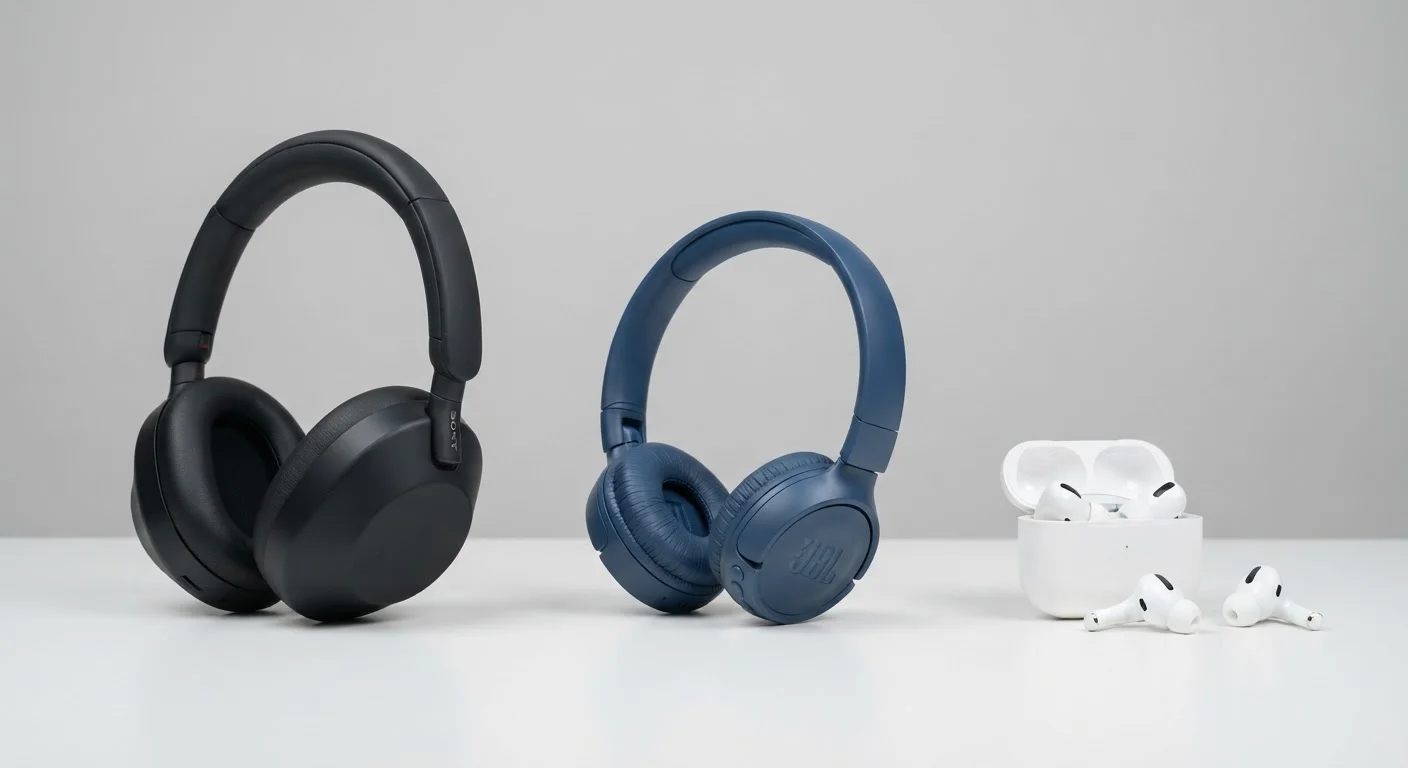
Key Takeaways
- Over-ear headphones fully enclose the ear, offering superior passive isolation and typically richer bass response.
- On-ear headphones rest on the outer ear, creating a lighter, more portable design with moderate sound isolation.
- In-ear headphones sit inside the ear canal, delivering strong isolation and portability at the cost of long-wear comfort.
- Driver size and ear coupling geometry directly influence how each style reproduces low, mid, and high frequencies.
- No single form factor is universally superior — the right choice depends on use case, anatomy, and listening priorities.
Our Verdict
Each headphone form factor makes a distinct set of acoustic and ergonomic trade-offs. Over-ear designs favor immersive listening and extended sessions; on-ear models balance portability with a fuller sound stage; in-ear options prioritize compactness and isolation. Understanding what each geometry does physically is the most reliable way to predict whether a style will work for you.
| Best for | Recommended |
|---|---|
| Focused listening, studio work, or long home sessions | Over-ear |
| Commuters who want portability without fully in-canal fit | On-ear |
| Runners, gym users, and frequent travelers | In-ear |
| Audiophiles prioritizing soundstage and driver size | Over-ear |
Why Geometry Is the Starting Point
When shoppers evaluate headphones, they often fixate on specs like frequency response curves or wireless codecs. But the physical relationship between driver and ear is what determines how those specs translate into actual sound. Form factor isn't cosmetic — it's acoustic architecture.
The three dominant styles — over-ear (circumaural), on-ear (supra-aural), and in-ear (intra-aural) — each create a different coupling geometry between the headphone's driver and your eardrum. That geometry shapes bass reproduction, soundstage width, background noise rejection, and comfort over time. If you're new to navigating audio hardware, this practical starting point for audio shoppers provides useful context before diving into specific specs.
Over-Ear: The Circumaural Advantage
Over-ear headphones use ear cups large enough to fully encircle the outer ear (the pinna), creating a sealed or semi-open chamber. This circumaural design has two immediate acoustic consequences: the driver is held at a consistent distance from the ear canal opening, and any passive seal traps a pocket of air that reinforces low-frequency waves.
The larger driver diameter — typically 40mm or above — allows longer excursion, which generally supports deeper, more controlled bass. The physical air pocket in front of the ear also allows the sound field to develop before it reaches the canal, which contributes to a wider perceived soundstage. Closed-back over-ear designs add a second chamber behind the driver, increasing passive isolation further. Open-back designs sacrifice isolation for a more natural, room-like presentation favored by many for critical listening.
The main trade-off is size and heat. Over-ear cups can cause ear fatigue from warmth after extended wear, and the headband clamping force required to maintain the acoustic seal can cause pressure over long sessions. Mass is also a genuine ergonomic factor — heavier designs shift more load to the crown of the head.
Match Ear Cup Depth to Your Ear Size
Before purchasing over-ear headphones, check the interior ear cup dimensions against your ear measurements. If your pinna doesn't fit fully inside the cup, the headphone functions acoustically like an on-ear design — with reduced isolation and altered bass response. Many manufacturers publish cup interior dimensions in product specifications, and it's worth seeking these out before deciding.
On-Ear: Compact Coupling, Different Compromises
On-ear headphones place smaller cups directly against the outer ear rather than around it. This supra-aural geometry makes the headphone lighter and more foldable, but it changes the acoustic relationship in meaningful ways.
Because the driver rests on soft cartilage tissue rather than creating a sealed chamber around it, the low-frequency seal is less consistent. Bass can sound thinner or more variable depending on clamping pressure and individual ear shape. On the other hand, the proximity to the ear can make the midrange feel more immediate and present. Many listeners describe on-ear sound as forward or intimate compared to the more expansive feel of over-ear designs.
Passive noise isolation sits between in-ear and over-ear: better than nothing, but dependent on how well the cup conforms to your ear shape. Clamping pressure is also a persistent comfort issue — to maintain acoustic contact, on-ear designs must press against the ear, which can cause soreness for wearers with sensitive cartilage after 60 to 90 minutes.
| On-Ear | Over-Ear | In-Ear | |
|---|---|---|---|
| Driver size (typical) | 30–40mm | 40–50mm+ | 6–14mm |
| Passive isolation | Moderate | Moderate to high | High (tip-dependent) |
| Bass response | Variable, pressure-dependent | Deep, consistent | Strong, canal-sealed |
| Soundstage | Intimate, forward | Wide, spatial | Narrow, in-head feel |
| Long-wear comfort | Cartilage pressure risk | Heat and clamping force | Canal fatigue risk |
| Portability | Good | Limited | Excellent |
| Use during activity | Moderate | Poor | Excellent |
In-Ear: Canal Coupling and Its Consequences
In-ear monitors (IEMs) and standard earbuds that seat inside the ear canal operate on a fundamentally different principle. Rather than projecting sound across a gap, the driver — typically 6mm to 14mm — sits millimeters from the eardrum, separated primarily by the canal itself. This creates an extremely short, sealed acoustic path.
The result is impressive passive isolation (silicone or foam ear tips block ambient sound physically) and a strong, focused bass response driven by that sealed canal volume. Because the listening volume is so small, less power is needed to drive the headphone to a given loudness — which is why in-ear designs tend to work well with low-output devices like smartphones. Sensitivity and impedance figures are particularly relevant for in-ear models for this reason.
Soundstage is the primary acoustic limitation. Without a physical chamber around the ear, the brain receives fewer spatial cues, and stereo separation can feel narrow or inside-the-head rather than expansive. Comfort varies significantly by tip material and canal anatomy — some listeners find a sealed in-ear fatiguing or pressure-inducing after extended use. For a deeper look at trade-offs specific to fully wireless in-ear designs, see the honest assessment of true wireless earbuds.
25–37 dB
Passive attenuation range for well-fitted in-ear tips
Attenuation figures vary based on tip material (foam vs. silicone) and how well the tip seals the individual's ear canal.
6–14mm
Typical in-ear driver diameter
Compared to 40–50mm+ drivers in over-ear designs, in-ear drivers must compensate for smaller excursion through close canal proximity.
Noise Isolation and Active Cancellation Across Form Factors
Passive isolation — the physical blocking of sound by materials and seal quality — differs significantly across the three styles. In-ear designs with a good tip seal consistently achieve the highest passive attenuation, often reducing ambient noise by 25–37 dB depending on tip fit. Over-ear closed-back designs follow, with on-ear models providing the least reliable passive block.
Active noise cancellation (ANC) can be added to any form factor, but its effectiveness is partly governed by geometry. Over-ear ANC systems have more physical space for microphones and processing components, and the larger cup provides a reference air chamber for algorithms to work against. In-ear ANC must achieve similar results in a far smaller housing. How ANC and passive isolation differ in practice is worth understanding before deciding how much to weight this feature.
Choosing by Use Case, Not Spec Sheet
No form factor is objectively superior. The right geometry is the one that matches how, where, and how long you listen. Over-ear designs reward seated, attentive listening and long sessions where swapping the headphone is inconvenient. On-ear models suit commuters and office workers who need a portable option that doesn't fully occlude the ear. In-ear formats are difficult to displace for physical activity, travel, or situations where bulk is a deal-breaker.
Ear anatomy also matters — tip size and shape consistency vary enough between individuals that the same in-ear model can sound dramatically different from one listener to the next. Whenever possible, physically trying a style before committing to a purchase remains the most reliable test of both fit and acoustic character. Spec sheets describe components; your ears confirm the result.