

| US regulation authority | Federal Trade Commission (FTC) (FTC Care Labeling Rule, 16 CFR Part 423) |
| Year permanent labels required | 1971 (FTC Care Labeling Rule (revised 2000)) |
| Symbol standard used | ASTM D5489 (American Society for Testing and Materials) |
| Core symbol categories | 5 (Wash, Bleach, Dry, Iron, Dry Clean) |
| X modifier meaning | Do not perform this care action (Universal across all five categories) |
| Dot modifier meaning | Temperature/heat level (1 = low, 2 = medium, 3 = high) (Applies to wash, dry, and iron symbols) |
Why Care Labels Exist — and What the Law Requires
In the United States, the Federal Trade Commission (FTC) requires garment manufacturers to attach permanent care labels listing laundering instructions. These labels aren't suggestions — they represent how the fabric and construction were tested. Following them consistently is one of the simplest ways to extend the life of your wardrobe, whether you're working with a carefully budgeted wardrobe or a closet full of investment pieces.
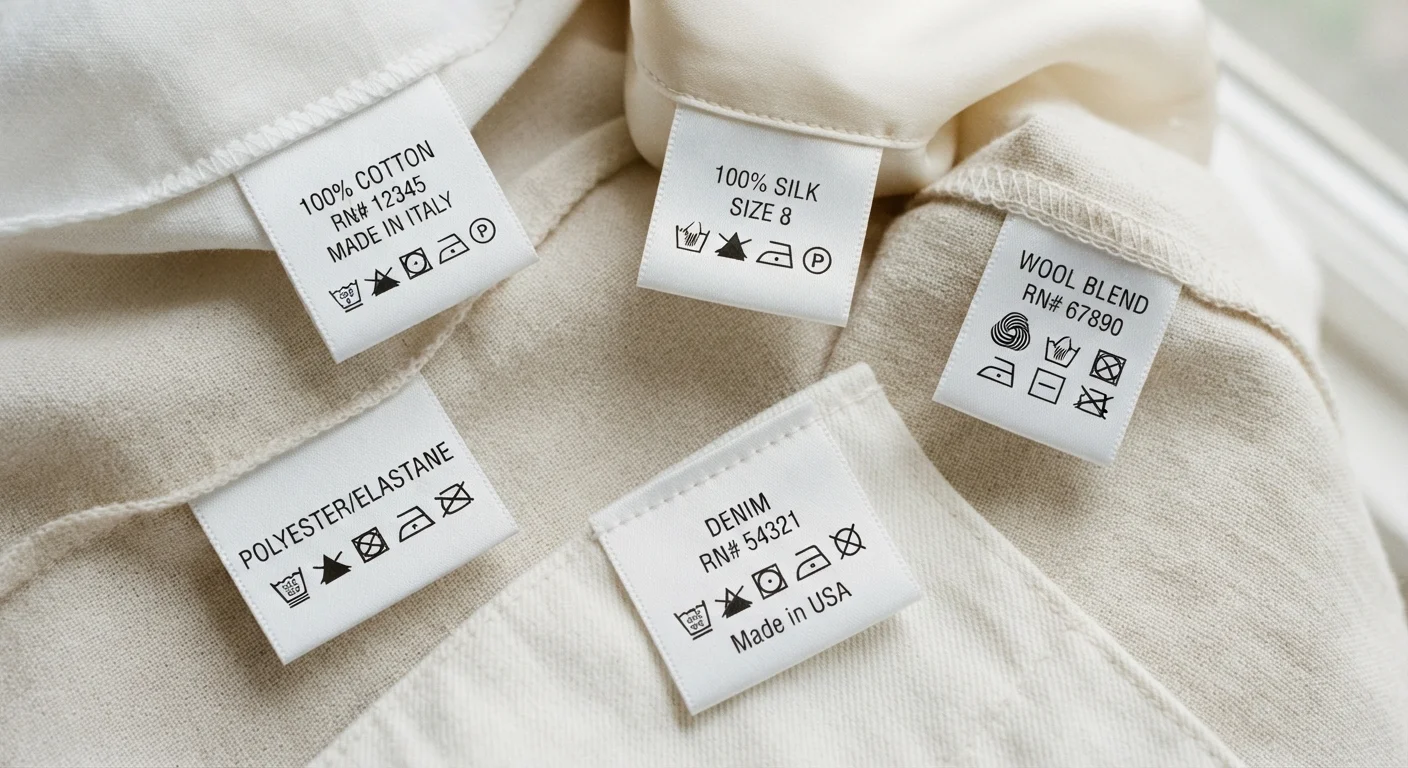
Care instructions appear as text, symbols, or both. Since 1971, standardized symbols have been used across most garments, aligned with the international ASTM D5489 standard. Once you know the five core symbol categories, you can decode virtually any tag without guesswork. And if you want to understand how washing choices affect your clothes over time, see our guide to why clothes lose their shape.
| US regulation authority | Federal Trade Commission (FTC) (FTC Care Labeling Rule, 16 CFR Part 423) |
| Year permanent labels required | 1971 (FTC Care Labeling Rule (revised 2000)) |
| Symbol standard used | ASTM D5489 (American Society for Testing and Materials) |
| Core symbol categories | 5 (Wash, Bleach, Dry, Iron, Dry Clean) |
| X modifier meaning | Do not perform this care action (Universal across all five categories) |
| Dot modifier meaning | Temperature/heat level (1 = low, 2 = medium, 3 = high) (Applies to wash, dry, and iron symbols) |
The Five Symbol Categories Explained
Every care label draws from five core symbol families. Understanding each one gives you complete fluency in garment care.
Wash tub symbol
A basin or bucket icon representing washing instructions. It may show a hand (hand wash only), dots for temperature, or lines for a gentle cycle.
Bleach triangle
A triangle symbol indicating bleach use. An empty triangle means any bleach is permitted; diagonal lines mean only non-chlorine bleach; an X means no bleach at all.
Drying square
A square symbol covering drying methods. A circle inside the square means tumble dry; no circle means air or line drying. Dots inside the circle indicate heat level.
Iron symbol
A silhouette of a clothes iron indicating pressing instructions. Dots specify temperature (one = low, two = medium, three = high); an X means do not iron.
Dry cleaning circle
A circle indicating professional dry cleaning. Letters inside (P, F, W) tell the cleaner which solvents are safe to use. An X means do not dry clean.
Felting
An irreversible process where wool or animal-fiber fabrics mat together due to heat, agitation, or moisture. Felted garments cannot be restored to their original size or texture.
Modifiers: Dots, Lines, and X Marks
Modifiers appear inside or beneath each base symbol and change its meaning. Dots indicate temperature or heat intensity — one dot means low, two means medium, three means high. Lines under a symbol (particularly for drying) indicate reduced or gentle treatment. An X drawn through any symbol means "do not" — do not wash, do not bleach, do not tumble dry, and so on. These three modifiers work across all five categories, so learning them unlocks the entire system.
Combining Symbols Correctly
A label rarely shows just one symbol. A typical delicate blouse tag might show a hand-wash basin symbol with one dot, a circle with an X (do not dry clean), and a square with a horizontal line (dry flat). Read the full set before deciding on a method — one ignored symbol is all it takes to ruin a garment. Just as reading a label fully matters in other contexts — like when reading a skincare product label — the same discipline applies to your clothes.
Common Combinations and What They Actually Mean
Knowing individual symbols is useful; knowing how they cluster in real life is more so. Here are the most frequent combinations you'll encounter:
- Tub + 30°C / one dot + square with circle: Machine wash cold, tumble dry low. Safe for most everyday knits and blended fabrics.
- Hand with water + horizontal line in square: Hand wash only, dry flat. Common on wool sweaters and structured knits where tumbling distorts shape.
- Tub with X + circle with P: Do not wash at home; dry clean with any solvent except trichloroethylene. Often seen on structured blazers and lined garments.
- All symbols with X: Extremely rare, but signals a novelty or heavily embellished piece requiring specialist care.
If a label is faded or missing entirely, check the manufacturer's website or contact their customer service — many brands publish full care guides online. Getting the fit right matters too; see our article on fit versus size to understand how garment construction affects care needs.
When the Label and the Fabric Seem to Conflict
Occasionally a label's instructions feel more conservative than necessary — for example, a "dry clean only" tag on what appears to be a simple cotton shell. Manufacturers often default to the most cautious instruction to protect garment construction (interfacing, padding, or stitching) rather than the outer fabric alone. When in doubt, following the label is safer than experimenting, especially with structured or lined garments.
Caring for Specific Fabric Types
Care symbols interact with fabric content. Even when symbols are identical, different fibers behave differently under the same conditions.
- Cotton: Generally durable, tolerates higher heat, but prone to shrinkage on first wash if not pre-shrunk. Wash cold to minimize this.
- Wool and cashmere: Protein fibers that felt (permanently mat together) in hot water or agitation. Always follow hand-wash or gentle cycle instructions precisely.
- Silk: Sensitive to alkaline detergents and heat. Cool water and a pH-neutral detergent are generally advised; check the label for dry-clean-only designation.
- Synthetics (polyester, nylon, acrylic): Heat-sensitive despite being durable; low-heat drying prevents pilling and warping. These fabrics also release microplastics in wash — a laundry bag rated for microfiber capture can help reduce that.
- Linen: Can be machine washed, but high heat causes significant shrinkage. Air drying preserves both size and texture.
This article is for informational purposes only. When in doubt about a specialty fabric or heirloom garment, consult a professional cleaner.