

Key Takeaways
- Cats are capable of learning recall cues when training is built around their natural motivation.
- Short, frequent sessions of two to five minutes produce better results than long, infrequent ones.
- A consistent cue word or sound paired with a high-value reward is the foundation of reliable recall.
- Never call your cat for something unpleasant — this quickly erodes the cue's effectiveness.
- Gradually increasing distance and adding real-world distractions is essential for a durable recall.
What you will need
Why Cats Can — and Will — Learn Recall
A persistent myth holds that cats are untrainable. The behavioral science tells a different story. Cats are highly capable of associative learning; they simply require training approaches calibrated to their motivational profile. Unlike dogs, cats were not selectively bred for human-directed responsiveness, so they respond best when the benefit to them is immediate and clear.
Positive reinforcement — rewarding the behavior you want, immediately after it occurs — is the method with the strongest evidence base for cats. When a cat learns that responding to a specific cue reliably produces something they value, the behavior strengthens. Understanding your cat's body language also accelerates progress; see our guide on feline signals every owner should know to recognize when your cat is receptive versus overstimulated.
What you will need
Tools and Setup
Effective recall training requires very little equipment, but the right choices make a meaningful difference. A distinct marker — either a clicker or a consistent verbal sound — bridges the gap between the moment your cat performs the correct behavior and the moment the treat arrives. For a thorough comparison of these approaches, see our article on clicker training versus verbal markers.
High-value treats
Serve as the primary reward that motivates your cat to respond to the recall cue.
Clicker or whistle
Provides a precise, consistent marker signal that bridges the moment of correct behavior and the delivery of the reward.
Treat pouch or small bowl
Keeps rewards accessible during sessions so there is no fumbling delay between cue and reinforcement.
Step-by-Step: Teaching the Recall Cue
Work through the steps below in order, progressing to the next only when your cat is responding reliably at the current stage. Patience during the early repetitions pays dividends in the form of a durable, generalized recall.
Choose and commit to a single recall cue
Select one word — "come" is common — or a distinct sound like a clicker or a specific whistle pattern. Everyone in the household must use the identical cue every time. Inconsistency at this stage is the most common reason recall training stalls.
Identify a genuinely motivating reward
Not all treats carry equal weight for every cat. Experiment with small pieces of cooked chicken, freeze-dried meat, or a favorite wet food to find what produces an immediate, enthusiastic reaction. The reward must be special enough to compete with whatever else your cat finds interesting.
Pair the cue with the reward at close range
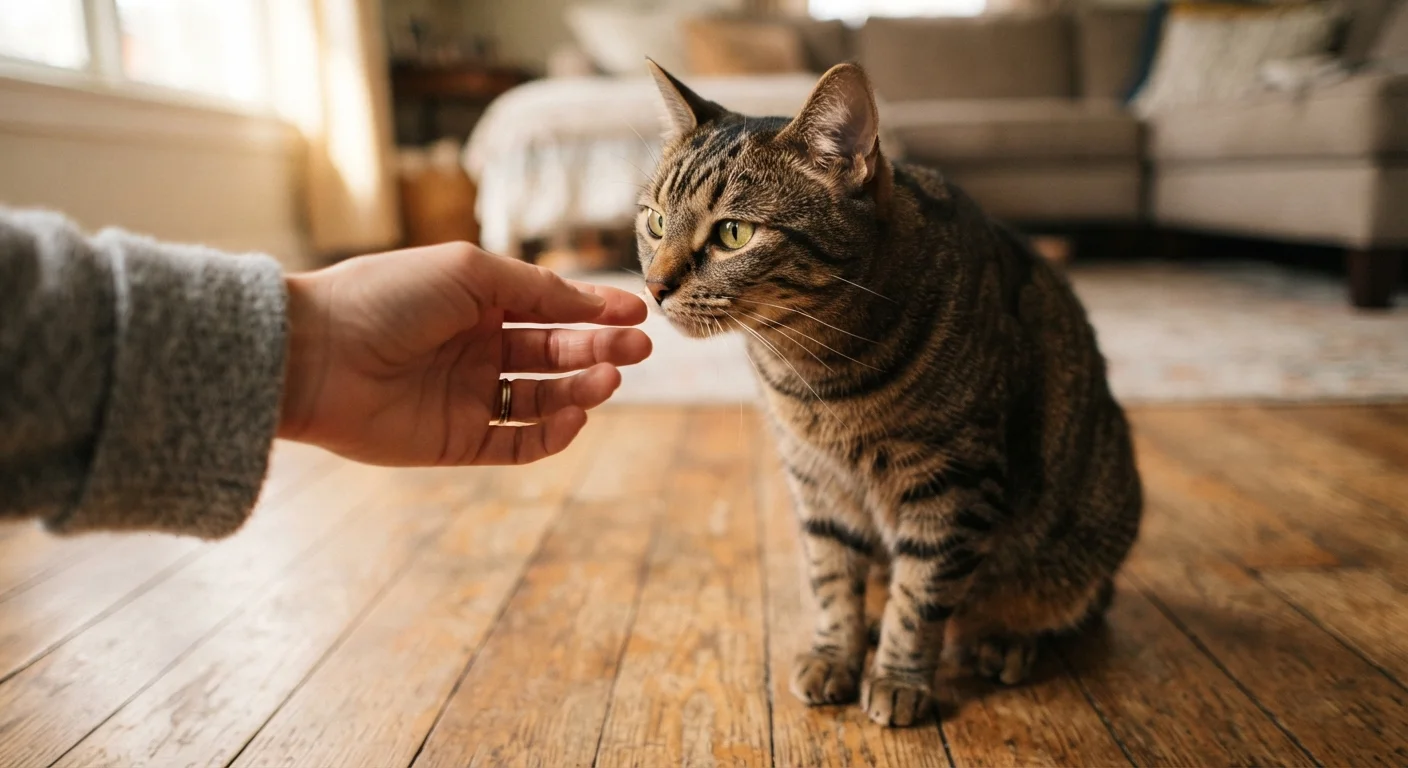
Begin with your cat just a step or two away. Say your cue word (or produce your chosen sound) once, clearly, and the moment your cat orients toward you or takes a step in your direction, immediately deliver the reward. Do not repeat the cue if your cat ignores it — simply wait, reset, and try again in a few seconds.
Build distance incrementally
Once your cat reliably responds at close range across multiple sessions, take one or two steps back before issuing the cue. Increase distance only when your cat succeeds at least eight out of ten trials at the current distance. Rushing this progression is a leading cause of training regression.
Introduce mild distractions
A recall cue that only works in a silent room has limited real-world value. Gradually practice when there is low-level background activity — another person moving around, the TV on quietly. Keep reward value high during distraction trials to help your cat learn that responding to the cue is always worth it.
Maintain the cue with ongoing reinforcement
Recall is a perishable skill. Continue to reward your cat with something positive — a treat, a brief play session, or affectionate petting (if your cat enjoys it) — every time they respond to the cue throughout their life. Intermittent reinforcement after the behavior is established actually strengthens response durability over time.
Keep Every Session Short
Two to five minutes per session is the effective range for most cats. Ending while your cat is still engaged — rather than after they have lost interest — keeps the experience positive and maintains their enthusiasm for the next session. Aim for two to three sessions per day during the initial learning phase.
Never Use the Recall Cue for Unpleasant Events
Calling your cat to come and then clipping their nails, administering medication, or placing them in a carrier will rapidly poison the cue. For anything your cat finds aversive, go to them rather than calling them to you. Protecting the positive association with the cue is essential for its long-term reliability.
Troubleshooting Common Challenges
Cat ignores the cue entirely: Return to step two and reassess reward value. The treat may not be motivating enough, or the cat may be too full, stressed, or distracted. Try training just before a scheduled mealtime.
Cat comes partway and stops: You may have increased distance too quickly. Drop back to the last successful distance and rebuild more gradually.
Inconsistent response across locations: Cats don't generalize learned behaviors as readily as dogs. Each new room or environment is, to some degree, a new context. Practice the recall cue in several locations within the home before expecting it to work everywhere.
Embedding recall practice into everyday life — before placing the food bowl, before an interactive play session — keeps the skill sharp without requiring formal sessions. For more ideas on integrating training into your daily routine, see how to make training part of daily life.
Reliable Recall Can Be a Safety Skill
For cats with any outdoor access, a solid recall cue can be a genuine safety tool — allowing you to call them inside before nightfall or away from a perceived hazard. However, no trained recall is foolproof. It should be one layer of a broader safety approach, not a substitute for secure enclosures or supervised outdoor time. See our article on indoor vs. outdoor living considerations for a fuller picture.
This article provides general pet care and training information. It is not a substitute for advice from a qualified veterinarian or certified animal behaviorist. If your cat shows signs of anxiety, fear, or behavioral challenges beyond recall training, consult a professional.