

Key Takeaways
- Slow blinking is a cat's way of expressing trust and is safe to mirror back.
- Tail position, ear set, and body posture together form a complete emotional picture.
- Behaviors like kneading and chirping carry distinct meanings rooted in feline development.
- Context matters: the same signal can mean different things in different situations.
- Persistent behavioral changes may indicate pain or stress and warrant a veterinary check.
Why Feline Communication Rewards Close Attention
Cats communicate through a rich, layered system of body language, vocalizations, and scent — much of it subtle enough to miss entirely without a trained eye. Unlike dogs, who have been selectively shaped over millennia to be legible to humans, cats retained a more independent communication style closer to their solitary wild ancestors. That makes learning to read them a skill worth actively developing.
Understanding what your cat is expressing — and responding in ways that match their signals — is one of the most evidence-supported ways to build a trusting relationship. For comparison, reading your dog's body language follows a similar principle but draws on a quite different set of cues. The seven signals below cover the behaviors US cat owners encounter most frequently, along with what each one actually means and how to respond constructively.
Read Signals as a Cluster, Not in Isolation
No single feline signal tells the whole story. A high tail combined with relaxed ears and a slow blink conveys a completely different message than a high tail with flat ears and dilated pupils. Train yourself to take in posture, tail, ears, and eyes simultaneously — context and combination are everything in feline communication.
Seven Signals and What They're Telling You
The Slow Blink: A Feline Expression of Trust
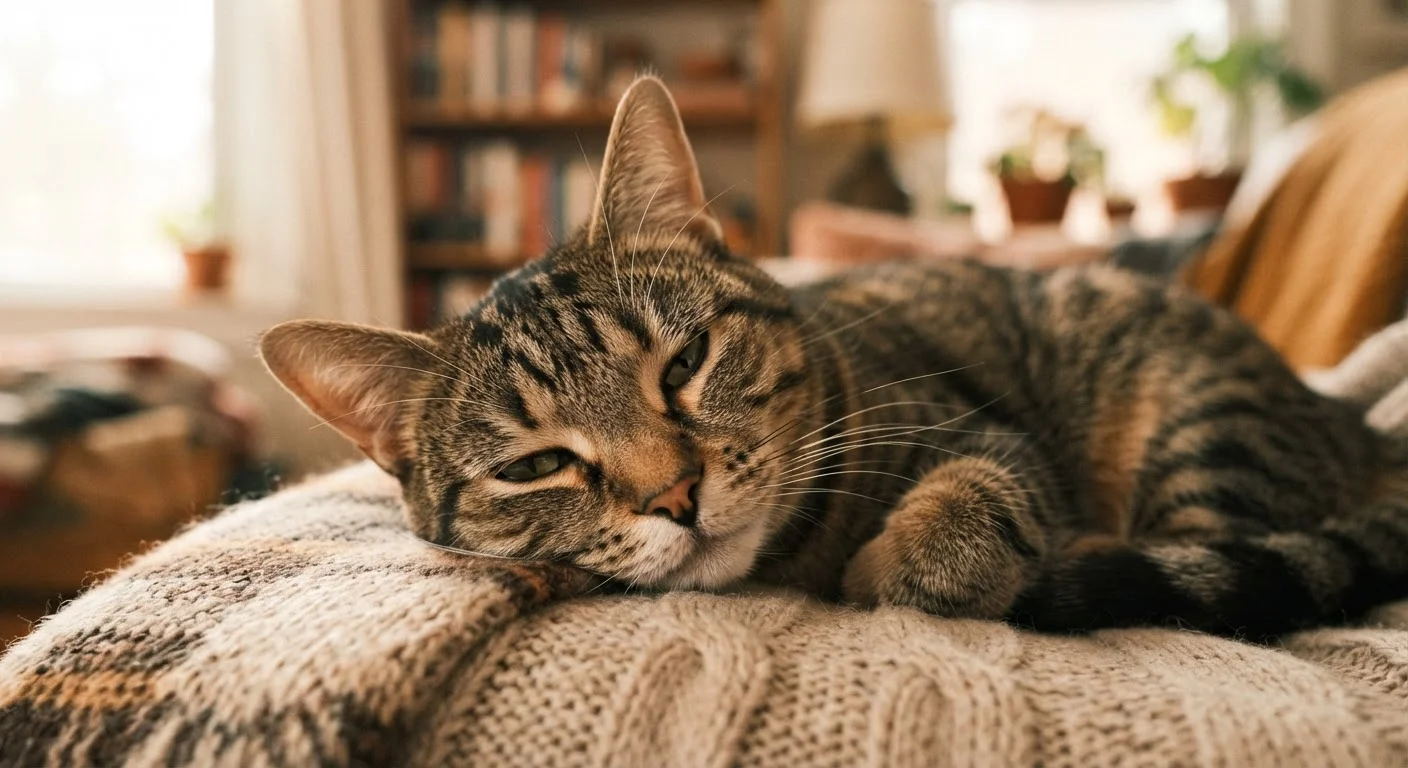
When your cat holds eye contact and then slowly closes and reopens their eyes, they are offering what animal behaviorists sometimes call a "cat kiss." Research published in Scientific Reports (2020) found that cats are more likely to slow-blink toward humans who slow-blink first, suggesting this gesture functions as a genuine social signal rather than coincidence.
To respond, hold a relaxed, neutral gaze and blink slowly yourself. Avoid staring directly without blinking — prolonged, unbroken eye contact reads as a threat in feline communication. A cat who slow-blinks at you from across the room is signaling that they feel safe and comfortable in your presence.
Mirroring a slow blink back to your cat actively reinforces the trust between you.
Tail Position: Your Cat's Emotional Barometer
A cat's tail communicates mood with remarkable precision. A tail held high and upright — sometimes with a slight curl at the tip — signals confidence and a friendly, greeting intention. This is commonly displayed when a cat approaches a familiar person.
A puffed or bottle-brush tail indicates fear or agitation; the cat is trying to appear larger. A low or tucked tail suggests submission or anxiety. A tail that lashes rapidly side to side is not playfulness — it signals irritation or overstimulation, and is a reliable warning to give your cat space. Understanding tail language in isolation is useful, but it works best alongside ear position and body posture.
A rapidly lashing tail is a warning sign, not an invitation to keep petting.
Ear Set: Tuning Into Alertness and Anxiety
Cat ears rotate up to 180 degrees and can act independently, making them highly expressive. Forward-facing, upright ears signal alertness and positive engagement — your cat is interested and comfortable. Ears rotated sideways (sometimes called "airplane ears") indicate growing discomfort or mild stress.
Flattened ears pressed tightly against the skull — often called "fear ears" — signal significant fear, defensiveness, or aggression. If you notice flattened ears paired with dilated pupils and a crouched posture, your cat is telling you loudly that they feel threatened. Reducing stimulation and giving them space is the appropriate response.
Flattened ears paired with dilated pupils signal that your cat feels seriously threatened.
Kneading: Comfort Behavior With Deep Roots
Kneading — the rhythmic pushing of paws against a soft surface — originates in kittenhood, when kittens press against their mother to stimulate milk flow. Adult cats retain this behavior as a self-soothing mechanism associated with contentment, relaxation, and bonding. When a cat kneads on you specifically, it reflects a deep sense of comfort in your presence.
Some cats retract their claws during kneading; others do not. If the pressure is uncomfortable, placing a folded blanket on your lap can protect you while preserving the moment. Discouraging kneading entirely may cause a cat to suppress a natural comfort behavior — redirection is generally preferable to correction.
Kneading on you specifically is one of the clearest signs a cat feels truly at ease with you.
Chirping and Chattering: Predatory Excitement
The distinctive clicking or chattering sound cats make while watching birds or insects through a window is called chattering. It is most commonly understood as a response to predatory arousal — the cat sees prey it cannot reach. Some researchers suggest it may also mimic prey vocalizations; the exact mechanism is still debated among behaviorists.
Chirping — a short, melodic trill — serves a different purpose. Mother cats use it to call kittens, and adult cats often direct it toward their owners as a friendly greeting or an attempt to initiate interaction. If your cat chirps when you enter a room, they are actively communicating a positive social intention.
Chirping toward you is an active greeting — your cat is deliberately initiating contact.
Bunting and Head Rubbing: Claiming and Connecting
Bunting — pressing the forehead, chin, or cheeks against a person or object — is how cats deposit scent from their facial glands. On objects, this is territorial marking. On people, behaviorists interpret it primarily as social bonding behavior, placing you within the cat's familiar, safe-scented environment.
When a cat rubs the full side of its body along your leg, this combines scent marking with tactile affection. Both behaviors are signs your cat views you as a trusted part of their social group. Returning gentle physical contact — a slow stroke along the cheek or chin — reinforces the exchange and supports a secure attachment.
When a cat bunts your face, they are including you in their inner circle of trust.
The Belly Exposure: Invitation or Warning?
A cat rolling onto its back and exposing its belly is often misread as an invitation to pet the abdomen — a mistake that regularly ends in scratches. In most cases, belly exposure signals deep relaxation and trust, not a request for belly rubs. The belly is a cat's most vulnerable area; showing it means they feel safe. It does not necessarily mean they want it touched.
Some cats do enjoy gentle belly contact — but this is individual variation, not a universal rule. The appropriate response to a belly display is often simply to acknowledge it warmly without reaching in. Over time, you will learn your specific cat's preference through gradual, careful exploration.
A belly display signals trust and relaxation — not necessarily an invitation to touch.
When Behavior Changes Warrant a Vet Visit
Sudden shifts in a cat's communication patterns — increased vocalization, withdrawal, or changes in posture and groom habits — can indicate underlying pain or illness rather than a behavioral issue. Cats are skilled at masking discomfort, so behavioral changes deserve veterinary attention. See our guide on recognizing suppressed pain in pets for a fuller picture of what to watch for.
Putting It Into Practice
Reading feline signals accurately is a cumulative skill — the more you observe your individual cat across different situations, the more reliably you will distinguish their baseline from a genuine change. Behavioral signals exist on a spectrum, and your cat's personality shapes how they express themselves.
If you notice persistent behavioral shifts alongside changes in appetite, coat quality, or litter box habits, those combinations may point to health or environmental stressors. Our guides on environmental stress signals in pets and what your pet's coat reveals about their health can help you interpret what you are seeing more completely. When in doubt, a veterinarian or certified animal behaviorist is the right resource — not guesswork.
This article is for general educational purposes only and is not a substitute for professional veterinary or behavioral advice. Consult a qualified veterinarian if you have concerns about your cat's health or behavior.