

Key Takeaways
- Environmental stressors — not just medical issues — can drive behavioral and physical changes in pets.
- Hiding, over-grooming, appetite shifts, and aggression are common stress signals that owners often misread.
- Identifying the specific trigger (noise, crowding, routine disruption) is the first step toward meaningful relief.
- Persistent or worsening symptoms warrant a veterinary evaluation to rule out underlying health conditions.
- Small, deliberate environmental changes can significantly reduce a pet's chronic stress load.
When the Home Becomes a Stressor
Pets are highly sensitive to their surroundings. Unlike humans, they cannot describe what's bothering them — but they communicate discomfort through behavior, body language, and physical changes. The challenge for owners is recognizing when a pet's actions reflect something in their environment rather than a passing mood or unrelated illness.
Environmental stressors can include loud or unpredictable noise, crowded or undersized living spaces, changes in routine, conflict with other animals, insufficient enrichment, or even shifts in lighting and temperature. Any of these can activate the same stress-response systems that affect physiological wellbeing. For a deeper look at how stress manifests physically, see how stress registers in the body.
The signs below represent the most commonly reported and clinically recognized indicators that a pet's environment may be causing chronic or acute stress. Use them as a starting checklist — not a diagnosis. If you observe multiple signs or notice worsening over time, consult a veterinarian or a certified animal behaviorist.
Increased hiding or withdrawal
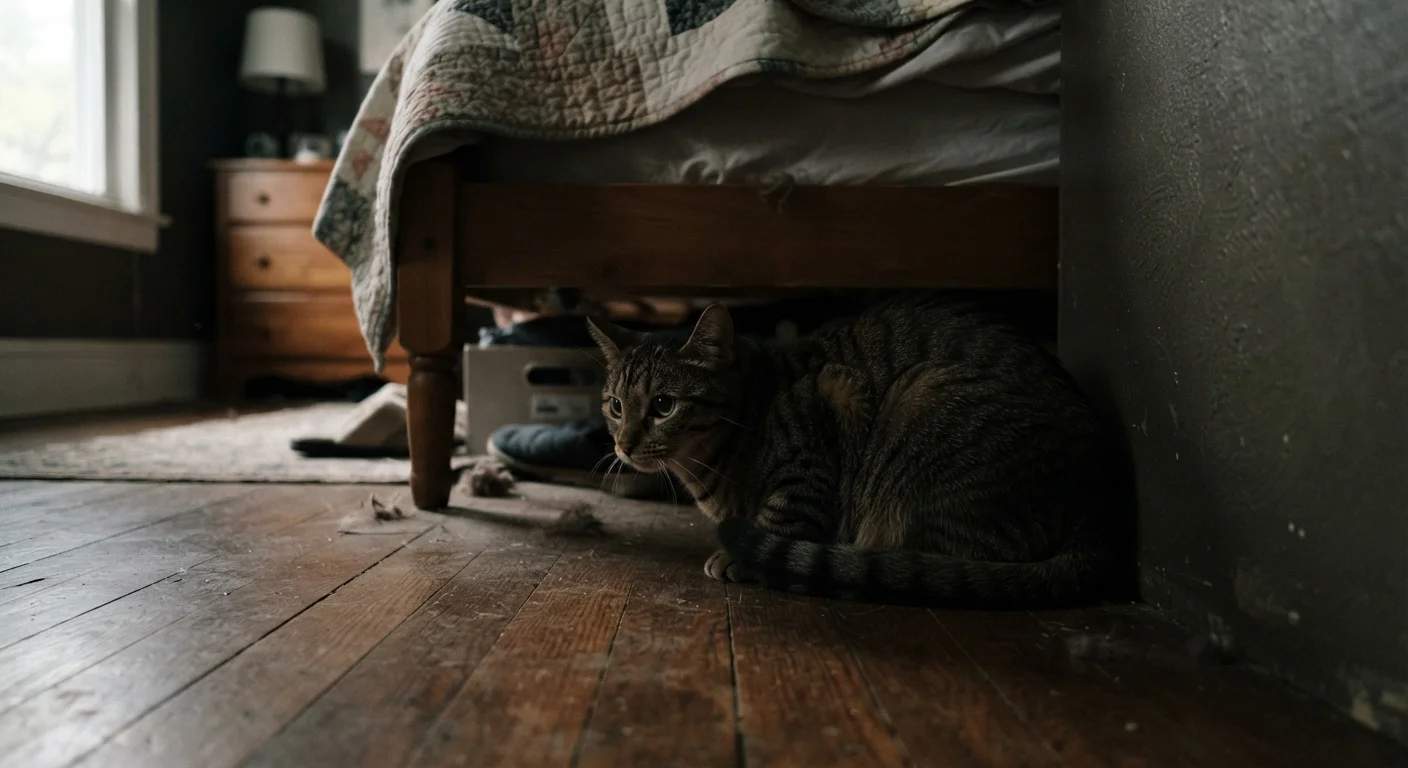
A pet that suddenly retreats to closets, under furniture, or isolated corners — especially when this is new behavior — is often signaling that something in their environment feels threatening or overwhelming. Cats in particular use spatial withdrawal as a primary coping mechanism. Dogs may seek out small, enclosed areas. While occasional retreating is normal, sustained or escalating hiding warrants attention. Consider whether a recent change (a new visitor, rearranged furniture, a new pet) preceded the shift. See common feline behavioral signals for context on how cats use space to communicate.
Sustained hiding is one of the clearest behavioral flags that a pet's environment feels unsafe.
Excessive grooming or self-directed behaviors
Over-grooming — licking, chewing, or scratching to the point of hair loss or skin irritation — is a recognized stress response in both cats and dogs. In cats, psychogenic alopecia (stress-driven hair loss) frequently develops along the belly, inner thighs, or flanks. Dogs may focus on their paws or tail base. Repetitive behaviors like tail chasing or flank sucking can also emerge. Always rule out skin conditions, parasites, or allergies with a vet first, since these share overlapping signs. If medical causes are excluded, explore environmental triggers. Our guide on what coat changes may indicate covers this in more depth.
Over-grooming to the point of skin damage is a recognized physical marker of chronic stress.
Changes in appetite or elimination habits
Stress reliably disrupts eating and elimination in pets. A dog or cat may eat less, skip meals entirely, or in some cases increase food-seeking as a self-soothing behavior. Equally telling are changes in litter box or housetraining habits — a previously reliable pet urinating or defecating in new locations is often experiencing anxiety, not defiance. In cats, stress-induced lower urinary tract disease (known as feline idiopathic cystitis) is a well-documented condition linked to environmental pressures. Any sudden change in elimination should be evaluated by a vet to rule out physical causes before attributing it to stress.
Housetraining lapses in a previously reliable pet are frequently rooted in anxiety, not disobedience.
Increased vocalization or restlessness
Stress-related vocalization — excessive barking, whining, meowing, or howling — often intensifies during specific triggers: loud events like storms or construction, when left alone, or when the household dynamic changes. Restlessness, pacing, panting without exertion, and an inability to settle are parallel physical expressions of the same arousal state. In dogs, these often accompany noise sensitivity or separation-related distress. The body language signals in dogs guide can help distinguish stress-driven vocalization from pain or attention-seeking.
Panting, pacing, or vocalizing without an obvious physical trigger often point to environmental anxiety.
Redirected or uncharacteristic aggression
A pet that suddenly snaps, hisses, or swipes at family members or other animals — especially one that is normally calm — may be experiencing redirected stress. In this pattern, a pet is aroused or threatened by an environmental stimulus (often something they can sense but cannot reach, like an outdoor animal or a sound through a wall) and redirects that arousal toward whoever is nearby. This is distinct from fear aggression and resource guarding, though all three can have environmental contributors. Tracking when and where aggression occurs helps identify whether it's triggered by a specific location, person, animal, or time of day. Consult a veterinary behaviorist if aggression escalates. For broader context on the training and behavior patterns involved, our hub offers additional resources.
Uncharacteristic aggression toward familiar family members is often a sign of redirected environmental stress.
Digestive upset without a clear dietary cause
Vomiting, diarrhea, or loose stools that recur without a change in diet or an identified illness can reflect chronic stress. The gut-brain connection is well established in veterinary medicine: sustained cortisol elevation affects gastrointestinal motility and immune function in companion animals similarly to how it does in humans. If a veterinarian has ruled out parasites, dietary intolerance, and infection, consider whether recent household stressors — construction noise, a new schedule, a new animal — align with the onset of symptoms. Seasonal transitions are another underappreciated trigger, particularly for pets sensitive to schedule and sensory changes.
Recurring digestive upset with no dietary cause may reflect the physical toll of chronic environmental stress.
What to Do When You Spot These Signs
Identifying a stress signal is only the first step. Once you suspect an environmental cause, observe the context carefully: When does the behavior occur? What changed recently — a new pet, a moved piece of furniture, a shift in your schedule? Narrowing the trigger makes intervention far more targeted and effective.
Start With a Stress Journal
Keep a simple log for one to two weeks, noting when concerning behaviors occur, what was happening in the environment at that time, and who was present. Patterns often emerge quickly — a specific trigger, time of day, or household event. This record is also genuinely useful to share with your veterinarian or a certified animal behaviorist, significantly shortening the diagnostic process.
For owners setting up new spaces or responding to a recent change, creating a low-stress environment from the start offers a practical framework applicable to most household adjustments. It's also worth reviewing separation anxiety signals in dogs if symptoms cluster around your departures.
When behavioral signs coincide with physical ones — coat changes, weight shifts, digestive upset — a veterinary visit is warranted before assuming the cause is purely environmental. As our guide to how pets hide pain explains, animals often mask discomfort until it becomes significant. Stress and pain can look nearly identical from the outside.
This article is for general informational purposes only and does not constitute veterinary or medical advice. Always consult a licensed veterinarian for concerns about your pet's health or behavior.