

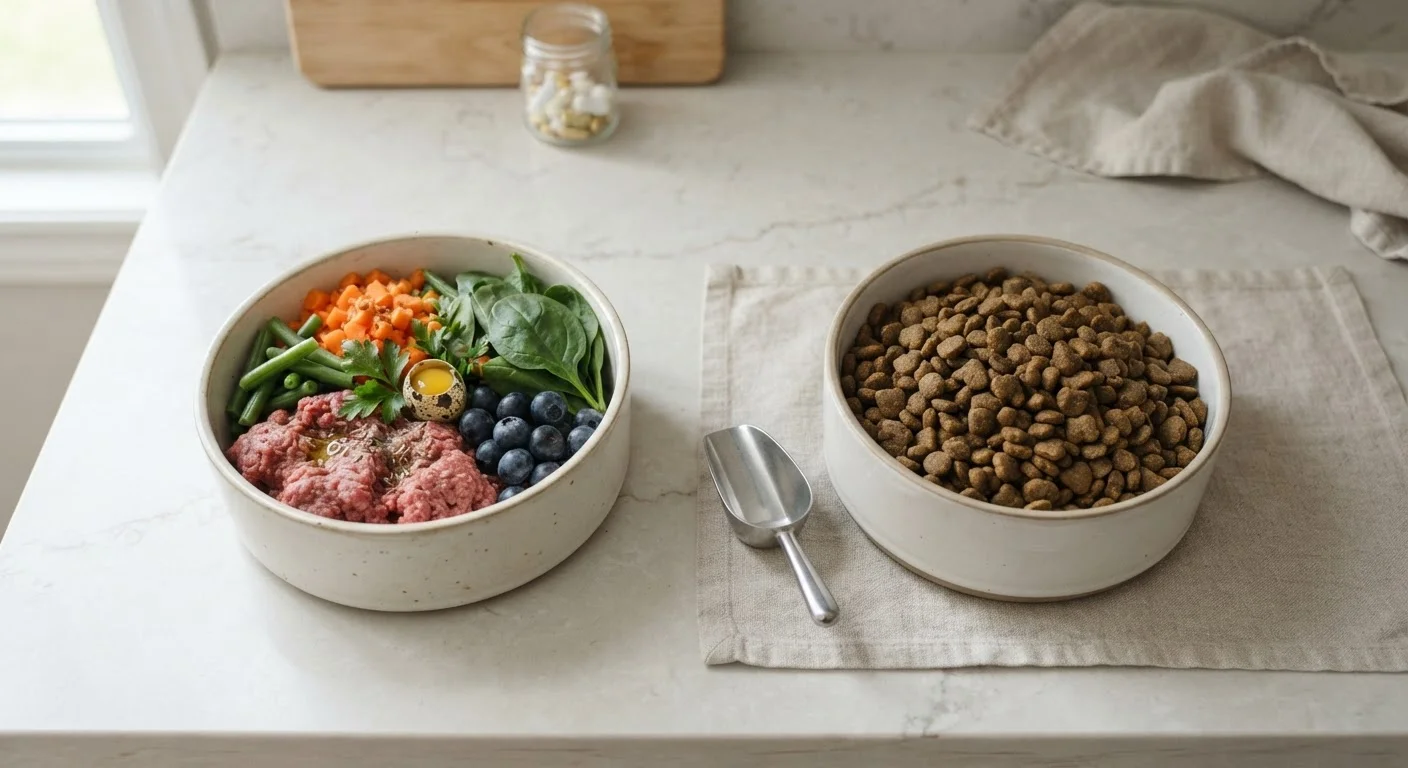
Key Takeaways
- Raw diets may offer digestibility benefits but carry documented pathogen risks for pets and humans.
- Commercial kibble is convenient and nutritionally standardized, but formulation quality varies widely.
- No single diet is universally superior — species, life stage, and household context all matter.
- Both approaches require careful attention to nutritional completeness and balance.
- Veterinary guidance should inform any significant dietary change for your pet.
Higher moisture content supports hydration
Raw diets naturally contain 60–70% moisture, which may benefit urinary tract health, particularly in cats who often drink insufficient water from a bowl.
Potentially improved digestibility in some animals
Some studies have reported higher apparent digestibility coefficients for protein and fat in raw diets compared to extruded kibble, though findings are not consistent across all research.
Greater palatability for picky eaters
Many pets, especially cats, show strong preference for fresh or minimally processed food, which can be useful when managing an animal with a poor appetite.
Minimal ultra-processing and fewer additives
Raw feeding avoids the high-heat extrusion process and eliminates artificial preservatives, colors, and flavor enhancers common in some commercial kibble formulations.
Documented pathogen risk for pets and humans
Raw meat frequently harbors Salmonella, Listeria, and E. coli. The AVMA has formally noted risks of transmission to household members, particularly children and immunocompromised individuals.
Nutritional imbalance is a common problem
Multiple studies have found that a large proportion of raw diets — both commercial and home-prepared — fail to meet established AAFCO nutrient profiles without careful supplementation.
Bone-feeding hazards are real
Whole or large bone pieces in raw diets carry risks of fractured teeth, gastrointestinal obstruction, or intestinal perforation, particularly in aggressive chewers.
Significantly higher cost and preparation time
Sourcing, preparing, and safely storing a balanced raw diet requires consistent effort and can cost considerably more per day than an equivalent commercial diet.
Limited long-term controlled research
Most available studies are short-term or observational; rigorous, long-term controlled trials comparing health outcomes between raw-fed and kibble-fed populations remain scarce.
Our Verdict
The evidence does not declare a clear winner between raw feeding and conventional kibble. Raw diets may offer certain digestibility and palatability advantages, but they carry meaningful food-safety risks that cannot be dismissed. Kibble provides convenience and standardized nutrition, though formulation quality varies. The right choice depends on your pet's individual health profile, your household circumstances, and your willingness to manage the additional handling demands of raw food.
Pet owners who want a research-grounded starting point for a conversation with their veterinarian about which feeding approach genuinely suits their specific animal.
Why This Debate Matters — and Why It's Genuinely Complex
Few topics in pet care generate more heat than what goes in the food bowl. Raw feeding advocates describe commercial kibble as over-processed and nutritionally compromised. Kibble defenders point to food-safety data and the rigorous formulation standards behind reputable commercial diets. The reality is more nuanced than either camp typically acknowledges.
Veterinary nutrition researchers have noted that the evidence base for raw feeding is still developing. Most existing studies involve small sample sizes or are funded by parties with commercial interests on one side or the other — a limitation worth keeping in mind when evaluating strong claims. For context on how to assess what's actually in any pet food product, see reading a pet food label.
A Note on Research Quality
Much of the published research on raw feeding involves small sample sizes, short durations, or potential conflicts of interest — either from pet food manufacturers or raw feeding advocacy groups. This doesn't mean the findings are without value, but it does mean they should be interpreted cautiously. Veterinary nutritionists recommend evaluating diet choices against your specific pet's health needs rather than broad population-level claims.
The Case for Raw Feeding
Proponents of raw diets — sometimes called BARF (Biologically Appropriate Raw Food) or prey-model diets — argue that minimally processed, fresh ingredients better reflect the ancestral diet of dogs and cats.
Higher moisture content supports hydration
Raw diets naturally contain 60–70% moisture, which may benefit urinary tract health, particularly in cats who often drink insufficient water from a bowl.
Potentially improved digestibility in some animals
Some studies have reported higher apparent digestibility coefficients for protein and fat in raw diets compared to extruded kibble, though findings are not consistent across all research.
Greater palatability for picky eaters
Many pets, especially cats, show strong preference for fresh or minimally processed food, which can be useful when managing an animal with a poor appetite.
Minimal ultra-processing and fewer additives
Raw feeding avoids the high-heat extrusion process and eliminates artificial preservatives, colors, and flavor enhancers common in some commercial kibble formulations.
Some peer-reviewed studies have found measurable differences in stool consistency and digestibility coefficients favoring raw diets, though researchers caution these don't automatically translate to better long-term health outcomes. It's also worth noting that dogs and cats have distinctly different nutritional requirements, meaning raw diet formulations should be species-specific — a point explored further in our look at dog vs. cat nutritional needs.
The Risks and Limitations of Raw Feeding
The concerns around raw feeding are well-documented in veterinary literature and are not simply the product of industry bias.
Documented pathogen risk for pets and humans
Raw meat frequently harbors Salmonella, Listeria, and E. coli. The AVMA has formally noted risks of transmission to household members, particularly children and immunocompromised individuals.
Nutritional imbalance is a common problem
Multiple studies have found that a large proportion of raw diets — both commercial and home-prepared — fail to meet established AAFCO nutrient profiles without careful supplementation.
Bone-feeding hazards are real
Whole or large bone pieces in raw diets carry risks of fractured teeth, gastrointestinal obstruction, or intestinal perforation, particularly in aggressive chewers.
Significantly higher cost and preparation time
Sourcing, preparing, and safely storing a balanced raw diet requires consistent effort and can cost considerably more per day than an equivalent commercial diet.
Limited long-term controlled research
Most available studies are short-term or observational; rigorous, long-term controlled trials comparing health outcomes between raw-fed and kibble-fed populations remain scarce.
The American Veterinary Medical Association (AVMA) has published a formal policy discouraging raw protein diets due to the risk of pathogen transmission — to both animals and the humans handling their food. Households with immunocompromised individuals, young children, or elderly adults face a higher risk profile. Nutritional imbalance is another documented concern: studies have found that a significant proportion of commercially available and home-prepared raw diets do not meet AAFCO (Association of American Feed Control Officials) nutrient profiles without careful supplementation.
~60%
Raw diets failing AAFCO nutrient standards
A peer-reviewed analysis of commercial and homemade raw dog food formulations found a majority did not meet AAFCO minimum nutrient requirements without supplementation.
4x
Higher Salmonella detection in raw vs. kibble
FDA sampling data has consistently found Salmonella contamination rates significantly higher in raw pet food products compared to conventional dry diets.
What Conventional Kibble Actually Offers
High-temperature processing in kibble manufacturing does reduce certain nutrients, but it also eliminates pathogens and extends shelf life without refrigeration. Well-formulated kibble — particularly those meeting AAFCO feeding trial standards rather than just nutrient profiles — provides a convenient, consistent nutritional baseline.
The variability within the kibble category is substantial, however. Ingredient sourcing, protein quality, carbohydrate load, and the presence of artificial additives differ considerably across products. One claim worth examining critically: the idea that dry food mechanically cleans teeth. Veterinary dental specialists note this is largely a myth — a topic addressed in more detail in our article on pet dental health misconceptions.
Making an Informed Decision for Your Pet
Rather than defaulting to either camp's talking points, consider these practical principles when evaluating your pet's diet:
- Life stage and health status matter. Puppies, kittens, pregnant animals, and immunocompromised pets have specific nutritional requirements and vulnerabilities that affect which diet types are appropriate.
- Look for nutritional completeness. Regardless of format, a diet should meet AAFCO nutrient profiles or have passed feeding trials for your pet's life stage.
- Assess your household risk factors. If anyone in your home is immunocompromised, the pathogen risks associated with raw feeding deserve serious weight.
- Involve your veterinarian. A vet familiar with your pet's individual health history is the appropriate guide for any significant dietary change.
This article is for general informational purposes only and does not constitute veterinary or medical advice. Always consult a licensed veterinarian before making significant changes to your pet's diet.