

Key Takeaways
- Pet food labels in the US must follow AAFCO and FDA formatting rules, giving them a consistent structure you can learn to read.
- Ingredient lists are ordered by pre-cooking weight — context matters when interpreting where meat or grain appears.
- The guaranteed analysis shows minimum or maximum nutrient percentages, not exact amounts in your pet's bowl.
- The AAFCO nutritional adequacy statement tells you whether a food is complete and balanced for your pet's life stage.
- Marketing language on the front panel ('natural', 'premium') carries little regulatory weight — the back panel is what counts.
- When in doubt about a food's suitability, a veterinarian or board-certified veterinary nutritionist is the right resource.
What you will need
Why Pet Food Labels Follow Rules You Can Learn
In the United States, pet food is regulated at both federal and state levels. The FDA sets baseline rules under the Federal Food, Drug, and Cosmetic Act, while the Association of American Feed Control Officials (AAFCO) publishes model regulations — including nutrient profiles and labeling standards — that most states adopt. This framework means every commercially sold pet food label shares a predictable anatomy, once you know what to look for.
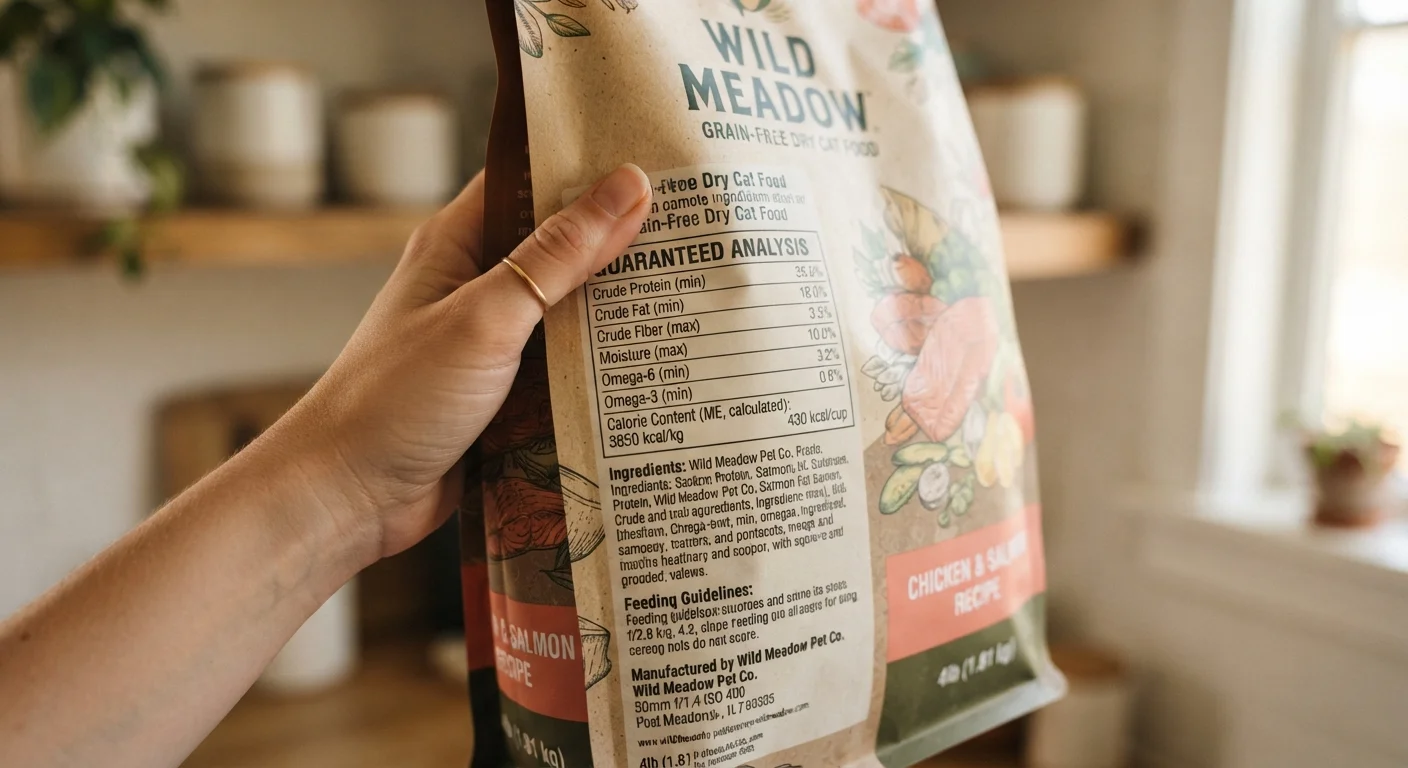
The label's information panel — typically the side or back of the package — must include the product name, net quantity, ingredient list, guaranteed analysis, nutritional adequacy statement, feeding directions, and manufacturer information. The front panel is largely marketing territory; the information panel is where the regulated, interpretable data lives.
Learning this structure is useful precisely because it applies across brands, formats (kibble, canned, freeze-dried), and species. The same framework you use to evaluate your dog's food applies to your cat's, with species-specific nutritional thresholds in mind. For a deeper look at why those species differences matter, see our guide on dog versus cat nutritional needs.
Labels Are Not Medical Advice
This article explains how to interpret pet food label information for general educational purposes. It is not a substitute for veterinary guidance. If your pet has a health condition, allergy, or specific nutritional need, consult a licensed veterinarian or board-certified veterinary nutritionist before changing their diet.
What You Need Before You Start
What you will need
AAFCO Official Publication or Website
Provides the official nutrient profiles and definitions that underpin adequacy statements on US pet food labels.
Veterinarian or Veterinary Nutritionist
Can interpret label information in the context of your specific pet's health, weight, and life stage.
Front-Panel Claims Are Largely Unregulated
Terms like 'premium,' 'holistic,' 'natural,' and 'human-grade' have no standardized legal definition in US pet food regulations and cannot be relied upon as quality indicators. Always turn the bag over and evaluate the ingredient list, guaranteed analysis, and AAFCO statement before drawing conclusions about a food's nutritional merit.
Step-by-Step: Reading the Label
Find the Product Name and Check the Naming Rules
The product name is governed by AAFCO naming rules that directly reflect ingredient content. A food called "Chicken Dog Food" must contain at least 95% chicken (excluding water). "Chicken Dinner," "Chicken Entrée," or "Chicken Formula" requires only 25%. A food that is "with Chicken" needs just 3%, and "Chicken Flavor" requires only a detectable amount. These percentages are calculated on a dry-matter basis, so the name alone tells you a great deal about ingredient emphasis before you read a single line of the back panel.
Locate the AAFCO Nutritional Adequacy Statement
This is one of the most important lines on any pet food label. It appears as a short paragraph — often in small print — typically near the bottom of the information panel. Look for one of three structures:
- Complete and balanced for a specific life stage (e.g., adult maintenance, growth, all life stages)
- Formulated to meet AAFCO nutrient profiles — meaning the recipe was calculated against a standard, but not feeding-trial tested
- Substantiated by feeding trials conducted according to AAFCO procedures — a higher bar of real-world testing
- Supplemental or intermittent feeding only — meaning this food should not be the sole diet
Match the stated life stage to your pet's actual life stage. A food labeled for adult maintenance may not supply adequate calcium for a growing puppy.
Read the Ingredient List in Context
Ingredients are listed in descending order by pre-cooking weight, not by their contribution to finished nutrition. This means a whole meat listed first (e.g., chicken) is largely water weight; after processing, its actual dry-matter contribution may be smaller than a later-listed meat meal. Neither placement is inherently better — what matters is the overall ingredient pattern.
Scan for:
- Identified protein sources (chicken, salmon, beef) versus vague ones ('meat,' 'poultry')
- Splitting — a manufacturer may list corn flour, corn gluten meal, ground corn separately to push each lower on the list; added together, corn could outrank the protein source
- Preservatives: mixed tocopherols (vitamin E) and ascorbic acid are naturally derived; BHA, BHT, and ethoxyquin are synthetic and subject to ongoing research scrutiny
Interpret the Guaranteed Analysis Panel
The guaranteed analysis lists four mandatory nutrients: crude protein (minimum), crude fat (minimum), crude fiber (maximum), and moisture (maximum). Additional nutrients may be listed voluntarily. Key points to understand:
- These are guarantees, not exact values — actual content may differ from batch to batch within regulatory tolerance
- Moisture skews comparisons — a canned food with 78% moisture and a kibble with 10% moisture cannot be compared directly on as-fed percentages; you need to convert both to a dry-matter basis to compare fairly
- To convert: subtract moisture percentage from 100, then divide the nutrient percentage by that number. Example: 8% protein in a canned food with 78% moisture = 8 ÷ 22 = ~36% protein on a dry-matter basis
This matters especially if you're comparing foods across formats for different pets in your household.
Check the Feeding Guidelines and Calorie Statement
Feeding guidelines are starting points, not prescriptions. They represent average needs for a healthy animal at a given weight, but your pet's actual requirement depends on activity level, metabolism, reproductive status, and health conditions. Since the FDA Modernization Act requirements for pet food calorie labeling, most products now display a metabolizable energy (ME) statement expressed as kcal per kilogram and per common household unit (per cup or per can). This figure is more useful for portion control than the guaranteed analysis alone.
Pair the calorie statement with your veterinarian's body condition score assessment to calibrate portions accurately. Overfeeding by even 10% daily adds up meaningfully over months — a dynamic explored in depth in our article on how excess weight affects pet health.
Evaluate the Manufacturer Contact Information
US regulations require every pet food label to include the name and address of the manufacturer, packer, or distributor. This is your pathway to accountability. Reputable manufacturers can typically answer questions about their quality-control protocols, where ingredients are sourced, and whether they employ a full-time veterinary nutritionist. Contacting the company before a purchase is entirely reasonable and often revealing.
Also check whether the product is made in the US, Canada, or a country with rigorous regulatory oversight, or co-manufactured at a facility used by multiple brands — information that won't appear on the label itself but can be obtained from the company directly.
Use the AAFCO Statement as Your First Filter
Before reading anything else on a label, find the AAFCO nutritional adequacy statement. If it says 'for supplemental or intermittent feeding only,' the food is not designed to be your pet's sole diet. This single line can save you from unintentional nutritional gaps, especially in puppies, kittens, or pregnant animals.
Putting It All Together
No single element of a pet food label tells the complete story. The product name gives you a first signal about ingredient emphasis. The AAFCO statement confirms whether the food is nutritionally complete for your pet's life stage. The ingredient list reveals the ingredient hierarchy and preservation approach. The guaranteed analysis, converted to dry-matter basis, allows fair cross-format comparisons. The calorie statement grounds your portioning decisions in actual energy content.
Reading labels critically is one part of responsible feeding — but it works best alongside awareness of broader feeding habits. Our article on common feeding mistakes covers patterns like free-feeding and supplement overload that can undermine even a well-chosen diet. And if coat condition is your motivation for reassessing your pet's food, what your pet's coat signals can help you connect nutrition to visible health markers.
When a label raises more questions than it answers, a veterinarian or board-certified veterinary nutritionist is the appropriate next step — not online forums or marketing materials. Label literacy empowers you to ask better questions; professional guidance helps you act on the answers.
This article is for general informational and educational purposes only and does not constitute veterinary or nutritional advice. Always consult a licensed veterinarian for guidance specific to your pet's health and dietary needs.