

Key Takeaways
- Refining strips a grain of its bran and germ, removing most fiber, B vitamins, and minerals in the process.
- Whole grains have a lower glycemic impact than refined grains, meaning a slower, more gradual rise in blood sugar.
- Enrichment adds back a handful of nutrients but cannot fully replicate the nutritional complexity of an intact grain.
- Most US dietary guidelines recommend making at least half of daily grain servings whole grains.
- Reading a nutrition label carefully is the most reliable way to distinguish a truly whole grain product from one that merely appears to be.
Option A
Whole Grains
The nutritionally complete, minimally processed option.
Best for: Anyone prioritizing fiber intake, steady energy levels, and a broader micronutrient profile in their daily diet.
Option B
Refined Grains
The palatable, longer-shelf-life staple of modern food systems.
Best for: Contexts where texture, shelf stability, or palatability is prioritized — though enrichment restores some lost nutrients.
If your goal is maximizing daily fiber intake
Whole Grains
Whole grains retain the bran layer, which is the primary source of dietary fiber. Refined grains lose most of this fiber during milling.
If you need long shelf life and versatile baking texture
Refined Grains
Removing the oil-rich germ significantly extends shelf life, and fine-milled refined flour produces lighter, more consistent baked textures.
If you want steadier energy without sharp blood sugar spikes
Whole Grains
Intact fiber slows digestion and moderates glucose absorption, supporting more sustained energy compared to refined grain counterparts.
If you are managing a condition affected by dietary fiber
Consult a healthcare provider
Fiber needs vary significantly depending on individual health status. A registered dietitian can tailor grain recommendations to your specific situation.
The Three-Part Structure of a Grain Kernel
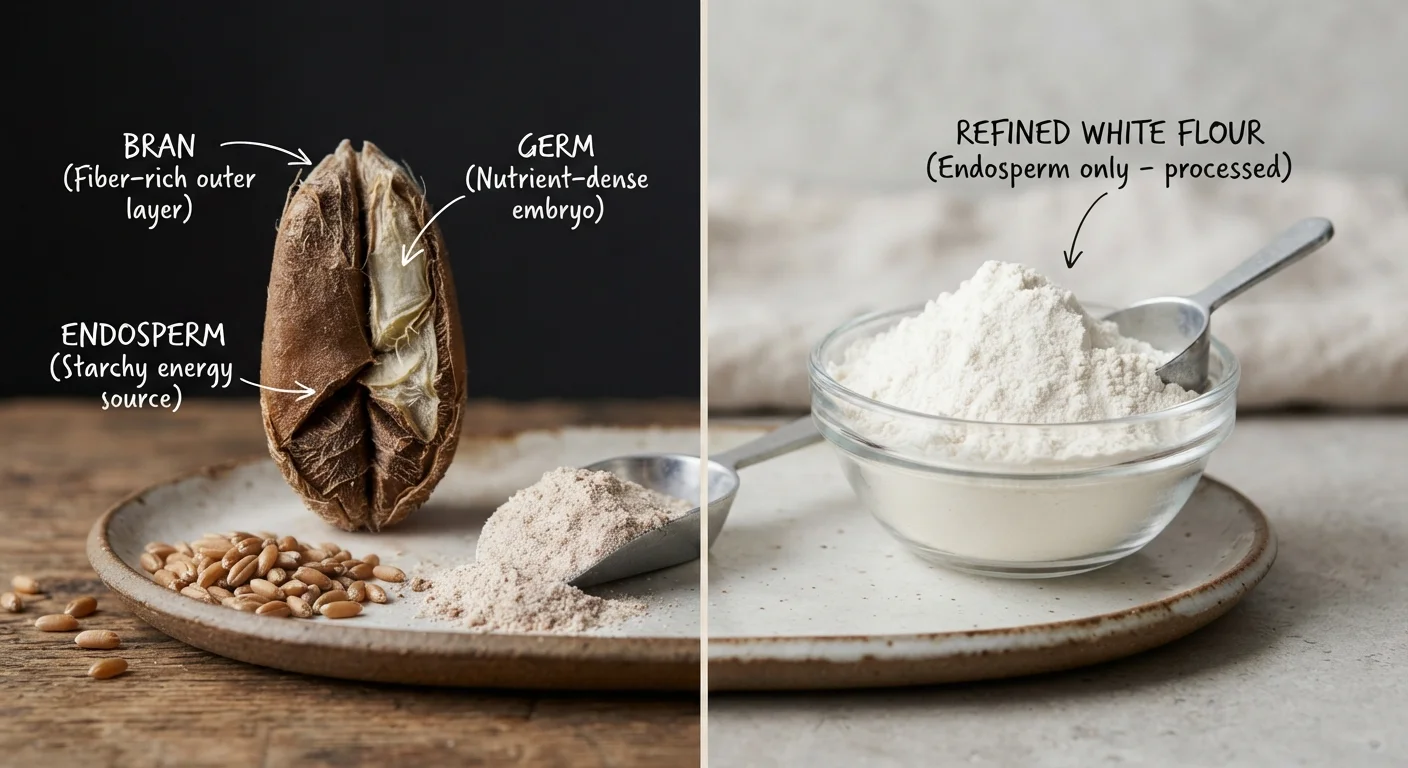
Every grain — whether wheat, oats, rye, or brown rice — starts as a kernel made up of three distinct layers: the bran, the germ, and the endosperm. Understanding what each layer contains explains almost everything about why whole and refined grains behave so differently in your body.
The bran is the tough outer shell. It is rich in dietary fiber, B vitamins (including thiamine, niacin, and folate), and trace minerals such as iron, magnesium, and zinc. The germ is the embryo of the seed — packed with healthy fats, vitamin E, antioxidants, and additional B vitamins. The endosperm, which makes up roughly 83% of the kernel by weight, is primarily starch with a small amount of protein and very little fiber or micronutrients.
When a grain is milled into refined flour, the bran and germ are mechanically separated and discarded, leaving only the endosperm. What remains is a fine, shelf-stable powder — but one that has shed the vast majority of the kernel's nutritional complexity. For more on how to spot these distinctions on packaging, see our guide to reading a nutrition label.
How Refining Changes the Nutritional Profile
The milling process is not subtle in its nutritional impact. Research published by the USDA and reviewed in mainstream nutrition literature consistently shows that refining removes approximately 25% of a grain's protein and more than half of its B vitamins, along with most of its fiber and a significant portion of its minerals.
~25%
Protein lost during grain refining
USDA analyses of wheat milling consistently show roughly one-quarter of protein is removed along with the bran and germ.
~70%
Reduction in dietary fiber after milling
Because fiber is concentrated in the bran layer, its removal during refining accounts for the majority of the fiber loss in white flour.
~50%
Of US grain servings should be whole grain
The 2020–2025 Dietary Guidelines for Americans recommend at least half of daily grain servings come from whole grain sources.
To partially offset this loss, the US government mandated enrichment for refined grain products sold domestically. Enriched flour has thiamine, riboflavin, niacin, folic acid, and iron added back after milling. While enrichment successfully restored certain deficiency-related public health outcomes — folate enrichment, for example, is associated with reduced neural tube defect risk — it does not restore fiber, vitamin E, magnesium, zinc, or the full spectrum of phytochemicals present in the original kernel.
This distinction matters because fiber and these micronutrients work together in ways that isolated enrichment cannot fully replicate. For a deeper look at why fiber specifically is so important, our article on dietary fiber and why most Americans fall short provides useful context.
Glycemic Impact: Why Intact Structure Matters for Blood Sugar
One of the most practically significant differences between whole and refined grains is their effect on blood glucose. The glycemic index (GI) — a measure of how quickly a food raises blood sugar relative to pure glucose — is generally much higher for refined grain products than for their whole grain counterparts.
| Criterion | Whole Grains | Refined Grains |
|---|---|---|
| Kernel layers retained | All three (bran, germ, endosperm) | Endosperm only |
| Dietary fiber | High (bran intact) | Very low (bran removed) |
| B vitamins | Naturally rich | Partially restored via enrichment |
| Vitamin E & antioxidants | Present (from germ) | Largely absent |
| Glycemic impact | Lower (fiber slows digestion) | Higher (rapid glucose absorption) |
| Shelf life | Shorter (germ oils can oxidize) | Longer (germ removed) |
| Texture in baking | Denser, earthier | Lighter, more uniform |
This difference arises because fiber physically slows the digestive process. In a whole grain, the intact bran matrix requires more time and enzymatic work to break down, which moderates the rate at which glucose enters the bloodstream. Refined grains, stripped of this buffering structure, are digested and absorbed more rapidly, producing a faster and larger blood sugar response.
Sustained consumption of high-GI foods has been associated in observational research with increased risk of type 2 diabetes and cardiovascular disease, though causation is complex and influenced by overall diet patterns, activity level, and individual metabolic factors. This is general nutritional information, not medical advice — anyone managing blood sugar should consult a qualified healthcare provider before making dietary changes.
Making Practical Whole Grain Choices Every Day
The 2020–2025 Dietary Guidelines for Americans recommend that at least half of daily grain servings come from whole grain sources. In practice, identifying genuine whole grain products requires some label literacy. The word "whole" must appear before the grain name in the ingredient list — "whole wheat flour," not simply "wheat flour" — for a product to qualify.
Common reliable whole grain foods include oats (rolled or steel-cut), brown and wild rice, whole wheat bread and pasta, quinoa, barley, farro, and popcorn. Many products marketed with terms like "multigrain," "stone-ground," or "made with whole wheat" may still contain primarily refined flour, so checking the ingredient list remains the most reliable approach. Our breakdown of common nutrition myths addresses several related misconceptions worth reviewing.
A Note on Fortification vs. Enrichment
"Enrichment" refers specifically to restoring nutrients lost during processing, while "fortification" means adding nutrients not originally present in significant amounts. Both practices apply to grain products in the US. Neither approach fully reproduces the natural nutrient matrix of an intact whole grain, but both have meaningfully contributed to reducing certain nutritional deficiencies at the population level. Reading labels carefully helps distinguish products that rely heavily on added nutrients from those that retain them naturally.
Transitioning toward more whole grains does not require an all-or-nothing approach. Swapping refined grain options for whole grain versions in familiar meals — breakfast cereals, sandwich bread, pasta, or side dishes — is a practical incremental strategy most people can sustain. Understanding where grains fit within broader food processing categories is also useful; our explainer on processed vs. ultra-processed foods provides helpful framing.
This article is for informational and educational purposes only and is not a substitute for personalized medical or dietary advice. Consult a registered dietitian or qualified healthcare professional for guidance specific to your health needs.