

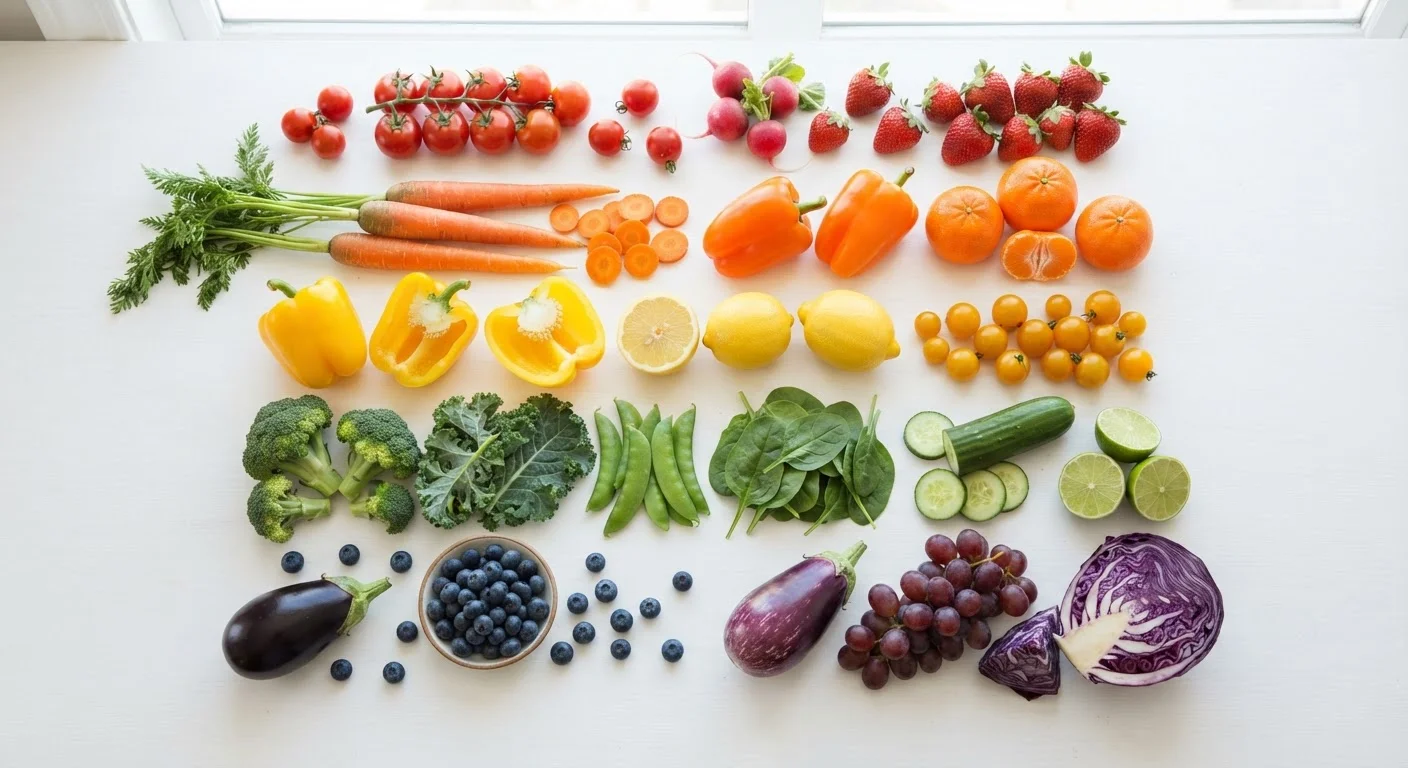
Key Takeaways
- Each produce color family contains distinct phytonutrients with different biological roles.
- No single color provides everything — variety across the spectrum is the point.
- Phytonutrients are not vitamins or minerals but still contribute meaningfully to a health-supporting diet.
- Cooking methods affect phytonutrient availability — some compounds increase with heat, others decrease.
- Whole foods deliver phytonutrients in complex combinations that supplements do not replicate.
Phytonutrients
Phytonutrients (also called phytochemicals) are naturally occurring compounds produced by plants that give fruits and vegetables their colors, flavors, and aromas. They are not classified as essential nutrients the way vitamins and minerals are, but research consistently associates them with health-supporting roles — including antioxidant activity, anti-inflammatory effects, and support for cellular function. "Eating the rainbow" is a practical shorthand for consuming a wide variety of differently colored produce in order to take in a broad spectrum of these compounds.
Phytonutrients are a broad category encompassing thousands of distinct molecules, including flavonoids, carotenoids, glucosinolates, and polyphenols. Each subclass acts through different biological pathways, which is why color diversity — not just volume — matters.
Why Color Is a Nutritional Signal
The vivid colors of fruits and vegetables aren't incidental — they are the visible expression of specific chemical compounds the plant produces for its own survival. These compounds repel pests, attract pollinators, and protect the plant from UV damage. In the human diet, they translate into a diverse toolkit of molecules that interact with our cells in measurable ways.
This is the core logic behind "eating the rainbow": because different colors correspond to different phytonutrient families, a diet limited to a narrow color range is also limited in the variety of compounds it delivers. Research on plant-forward eating consistently points to diversity — not just quantity — as a meaningful variable in long-term dietary patterns.
9+
Color-distinct phytonutrient families in common produce
Nutrition researchers have catalogued thousands of individual phytonutrients organized into major families differentiated partly by color and chemical structure.
~10%
US adults meeting vegetable variety recommendations
CDC dietary data consistently shows the majority of American adults fall short of recommended vegetable intake, with variety being an even greater gap than volume.
2x
Increased lycopene absorption with dietary fat
Research published in nutritional biochemistry journals shows that fat-soluble carotenoids like lycopene absorb significantly better when consumed alongside a small amount of fat.
Breaking Down the Color Families
Red
Red produce — tomatoes, watermelon, red bell peppers, pink grapefruit — is strongly associated with lycopene, a carotenoid linked in observational research to cardiovascular and cellular health. Lycopene is fat-soluble, meaning it absorbs better when consumed with a small amount of dietary fat, such as olive oil on a tomato salad. Red produce also contains anthocyanins and vitamin C.
Orange and Yellow
These colors signal beta-carotene and other carotenoids, which the body converts to vitamin A as needed. Carrots, sweet potatoes, mangoes, yellow squash, and cantaloupe fall into this family. Carotenoids support eye health and immune function according to established nutritional science. Like lycopene, they are fat-soluble.
Green
Green vegetables are among the most nutritionally dense foods available. Dark leafy greens contain chlorophyll, lutein, and zeaxanthin — compounds associated with eye health — alongside folate, vitamin K, and iron. Cruciferous greens like broccoli, Brussels sprouts, and kale also contain glucosinolates, sulfur-containing compounds that have been studied extensively for their role in cellular defense pathways. See our no-jargon guide to vitamins and minerals for more on what these nutrients do.
Blue and Purple
Blueberries, blackberries, red cabbage, eggplant, and purple grapes get their color from anthocyanins, a subclass of flavonoids. Anthocyanins are among the most studied phytonutrients, with research exploring their antioxidant activity and potential roles in cardiovascular and cognitive health. These compounds are water-soluble and sensitive to heat, so raw preparation preserves more of them.
White and Beige
Often left out of rainbow conversations, white produce is worth including. Garlic and onions are rich in allicin and quercetin, compounds with well-documented anti-inflammatory properties. Cauliflower contains glucosinolates similar to its green cruciferous relatives. Mushrooms are a rare non-animal source of vitamin D when exposed to UV light.
Putting It Into Practice
Understanding phytonutrients doesn't require tracking individual compounds — the color framework handles that abstraction for you. A practical approach is to assess your plate visually: if most of your produce is one or two colors over the course of a day, consider what's missing.
Use the "Two New Colors" Weekly Goal
Rather than overhauling your entire diet, try adding two produce colors you didn't eat the previous week. This incremental approach builds variety over time without requiring a meal plan overhaul. Rotating seasonal produce naturally encourages this kind of diversity.
It's also worth noting that phytonutrients work alongside — not instead of — fiber, vitamins, and minerals. A produce-rich diet naturally delivers most of these together. For a deeper look at one underconsumed nutrient that travels with plant foods, see our explainer on dietary fiber.
Frozen fruits and vegetables retain most of their phytonutrients and are a practical, lower-cost option. Variety over a week matters more than perfection at each meal. And if you've encountered claims about "detox" regimens that supposedly amplify phytonutrient benefits, the evidence on those approaches is considerably less compelling than the evidence for simply eating a wider range of whole produce.
“The more variety in your plant foods, the broader the spectrum of beneficial compounds you're likely consuming. No single superfood covers the whole spectrum — that's the point of diversity.”
— Walter Willett, Professor of Epidemiology and Nutrition, Harvard T.H. Chan School of Public Health
This article is for general informational and educational purposes only and is not a substitute for professional medical or dietary advice. Consult a qualified healthcare provider or registered dietitian for guidance tailored to your individual health needs.