

Key Takeaways
- The human brain is wired to adapt to speed, making it easy to feel slower than you actually are.
- Road design, traffic density, and vehicle comfort all distort a driver's perception of speed.
- Relying on feel alone is unreliable — regular speedometer checks are a critical habit.
- Transitions between road types, such as highway to residential, are especially high-risk moments.
- Building deliberate speed-awareness habits can meaningfully reduce unintentional speeding.
Why Your Brain Is Poor at Estimating Speed
Most drivers consider themselves competent judges of their own speed. Research and accident data suggest otherwise. Speed perception is not a reliable sense — it is a rough estimate assembled from visual cues, road feel, engine sound, and habit. When any of those inputs are reduced or distorted, the estimate drifts.
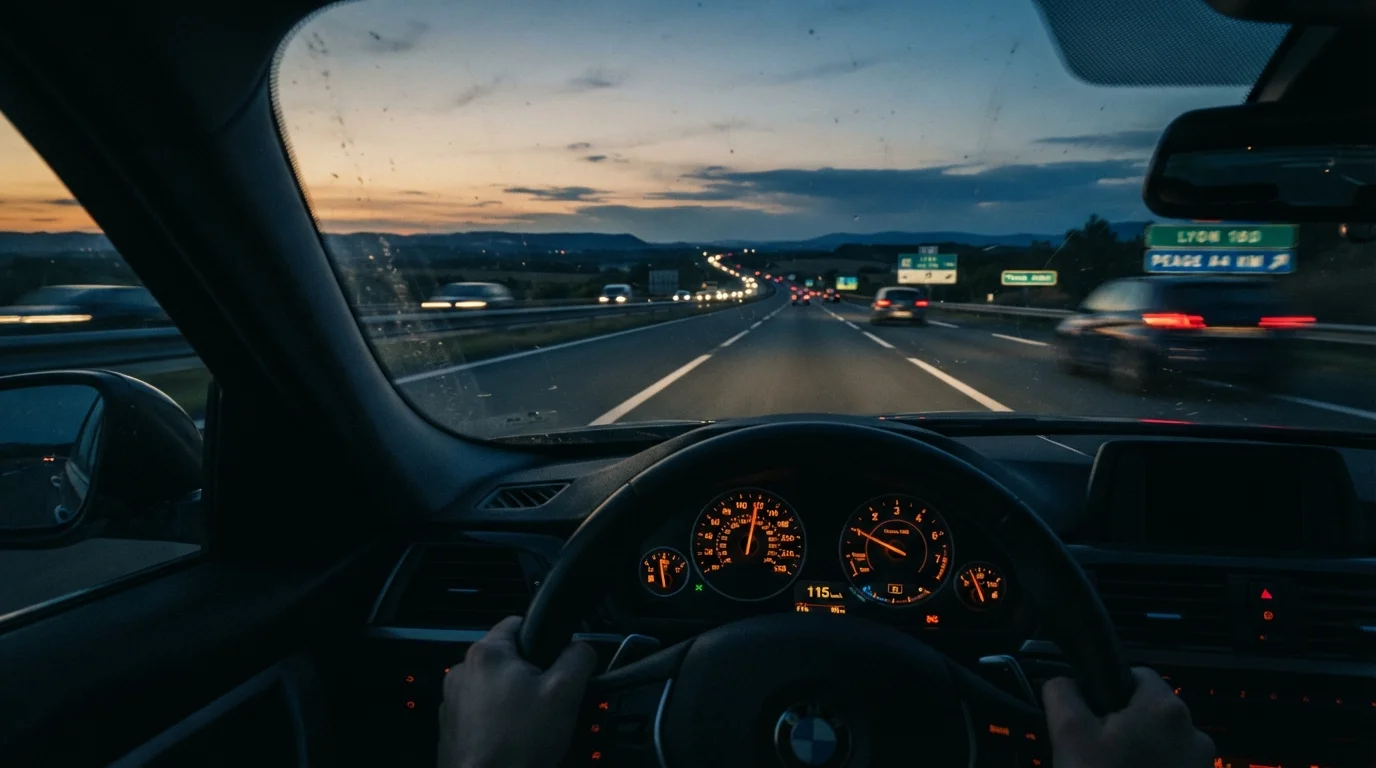
The core mechanism is called perceptual adaptation. After sustained exposure to a stimulus — in this case, high speed — the nervous system treats it as a new baseline. What once felt fast becomes ordinary. This is why a driver who has spent 40 minutes on the interstate may genuinely feel they are crawling at 40 mph when they exit.
Road geometry compounds the problem. Visual speed perception depends heavily on how quickly nearby objects pass in peripheral vision. On a wide, open road with minimal roadside features, that visual flow is reduced — and estimated speed drops accordingly. The posted limit has not changed; only the perception has.
Understanding these mechanisms is the first step toward compensating for them. For a deeper look at how reaction time also suffers under these same perceptual limitations, see the science behind reaction time.
~29%
Of traffic fatalities linked to speeding
According to NHTSA data, speeding is consistently implicated in roughly 29% of all US traffic fatalities each year.
2x
Stopping distance increase from 30 to 60 mph
Physics dictates that doubling speed roughly quadruples stopping distance, dramatically shrinking a driver's margin for error.
The Most Common Speed Misjudgment Mistakes — and How to Correct Them
Speed misjudgment is not random — it follows predictable patterns. Most drivers make the same perceptual errors in the same kinds of situations. Recognizing these patterns is what allows you to build habits that compensate before a mistake becomes a collision.
Relying on body feel rather than the speedometer to gauge current speed.
Why it happens: The brain uses visual flow and vibration cues to estimate speed. On smooth, modern roads with good sound insulation, those cues are dampened, making higher speeds feel normal.
Failing to account for speed adaptation after extended highway driving.
Why it happens: After 20 or more minutes at highway speeds, the nervous system recalibrates so that lower speeds feel unnaturally slow. Drivers unconsciously accelerate back toward what feels comfortable.
Speeding up to match surrounding traffic without checking posted limits.
Why it happens: Social conformity is a powerful driver. When surrounding vehicles move faster than the posted limit, drivers instinctively match pace to feel part of the traffic flow and avoid standing out.
Misjudging speed on wide, straight roads with few visual reference points.
Why it happens: Perceived speed is partly a function of how quickly the environment passes by. Wide lanes, open landscapes, and minimal roadside features reduce that visual flow, making speed feel lower than it is.
Ignoring how vehicle design suppresses speed awareness.
Why it happens: Modern vehicles — especially larger SUVs and sedans with quiet cabins, smooth suspension, and powerful engines — are engineered to minimize noise, vibration, and harshness. That comfort removes many of the sensory cues drivers rely on to feel speed.
Speed Misjudgment Is a Leading Crash Factor
The National Highway Traffic Safety Administration (NHTSA) consistently identifies speeding as a major contributor to traffic fatalities in the United States. Critically, many speeding drivers do not realize they are exceeding the limit — the problem is perceptual, not purely intentional. Understanding why your brain misjudges speed is a genuine safety issue, not just a traffic-law concern.
Conditions also play a significant role. Rain, reduced visibility, and unfamiliar roads all shift what feels like an appropriate speed. Our guide on adjusting your habits for rain, snow, ice, and fog covers how to recalibrate for adverse weather specifically.
For a practical reference on stopping distances at various speeds — a direct consequence of how fast you are actually traveling — see stopping distances, speed limits, and safe gaps by condition.
Highway-to-Residential Transitions Are Especially Dangerous
After extended highway driving, your nervous system recalibrates to higher speeds — meaning 35 mph can feel like 15 mph when you exit. This perceptual lag is responsible for a disproportionate share of residential speeding incidents. Always check your speedometer immediately after transitioning off a highway or expressway, not just when you first notice a lower speed limit sign.
Building stronger speed awareness is part of a broader set of habits that driver education rarely covers explicitly. Safe driving habits that new drivers are never explicitly taught explores the real-world judgment skills that separate cautious drivers from confident ones.
This article is for general informational purposes only. Always follow posted speed limits, local traffic laws, and the guidance of qualified road safety authorities in your area.