

Key Takeaways
- Wired systems offer more stable, interference-free connections but require professional installation and structural work.
- Wireless systems are easier to install and relocate but depend on battery life and network reliability.
- Upfront costs favor wireless, while long-term reliability and tamper resistance often favor wired.
- Your home's age, layout, and ownership status are the most important factors in choosing between the two.
Our Verdict
Neither wired nor wireless home security is universally superior — the right choice depends on your home's structure, your technical comfort level, and how long you plan to stay. Wired systems reward those who want set-it-and-forget-it dependability in a permanent home, while wireless systems suit renters, frequent movers, or anyone prioritizing fast setup and flexibility.
| Best for | Recommended |
|---|---|
| Homeowners in permanent residences who prioritize long-term reliability | Wired systems |
| Renters or those who move frequently and need portable setups | Wireless systems |
| Older homes where running new cables is impractical or cost-prohibitive | Wireless systems |
| New construction or major renovations where wiring can be planned in advance | Wired systems |
How Each System Works
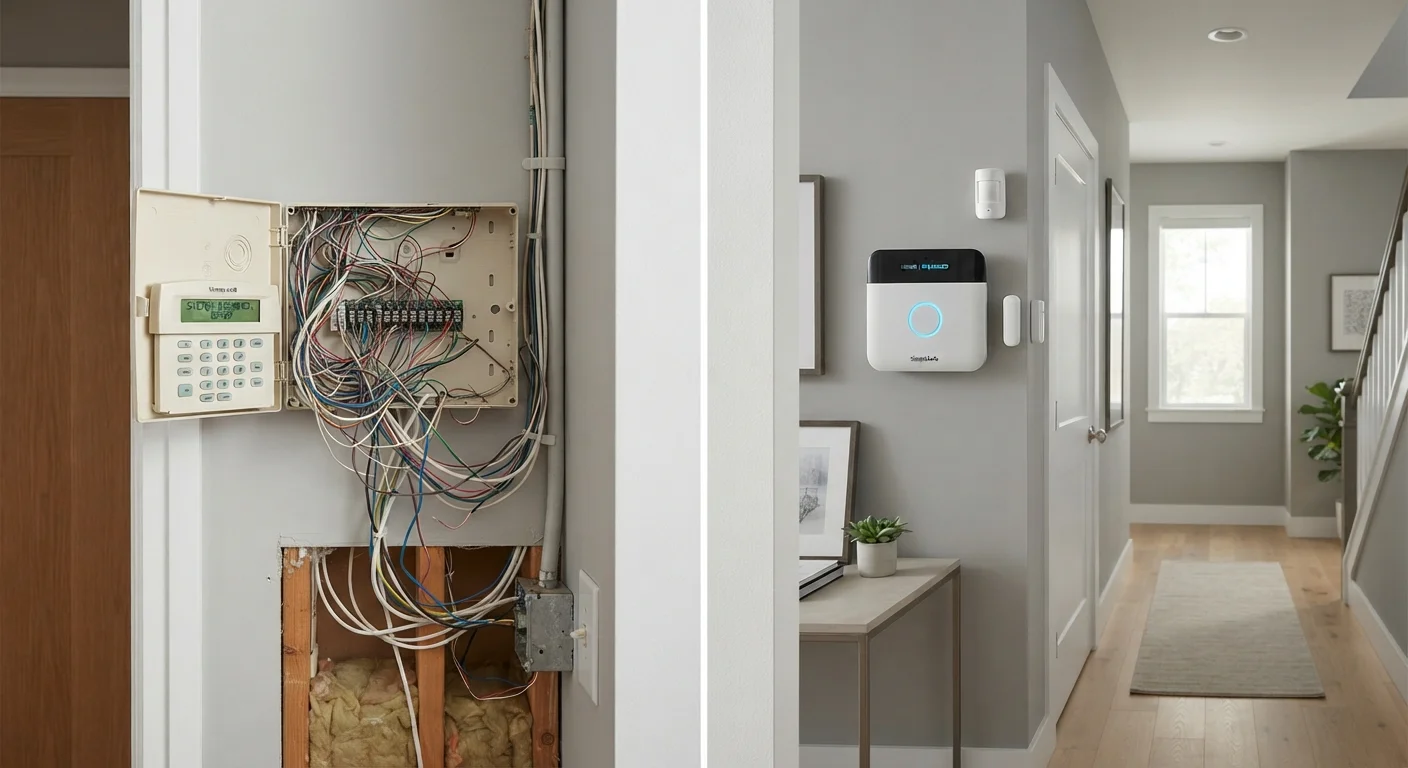
Wired home security systems connect every sensor, camera, and detector to a central control panel using physical cables — typically low-voltage wire routed through walls, ceilings, and crawl spaces. Each component has a dedicated, hardwired connection, which means communication between devices doesn't rely on radio signals or a home network.
Wireless systems use radio frequency (RF) protocols — commonly Z-Wave, Zigbee, or Wi-Fi — to communicate between sensors and a central hub. Some hybrid systems combine a wired backbone with wireless peripherals, offering a middle ground. Understanding your home's network infrastructure matters here; for a deeper look at how different connection types interact, see how to manage a home network with many smart devices.
Installation: Effort, Cost, and Flexibility
Wired installation is labor-intensive. Running cables through finished walls typically requires a licensed electrician or a specialized security installer. For an existing home, that can mean drilling, fishing wire through wall cavities, and patching drywall afterward. The upside: once installed, the infrastructure is permanent and requires no ongoing attention.
Wireless systems, by contrast, can often be self-installed in a single afternoon. Sensors mount with adhesive or a few screws, and the hub plugs into a power outlet. This makes wireless setups genuinely practical for renters who can't alter walls, or for homeowners who want a working system without a multi-day installation project.
Plan Wiring During Construction
If you're building a new home or undertaking a significant renovation, wiring for security during construction costs a fraction of what retrofitting later would require. Discuss conduit routing with your contractor early — it's far easier to plan ahead than to fish cables through finished walls afterward.
If you're building a new home or undertaking a significant renovation, wiring for security during construction costs a fraction of what retrofitting later would require — a worthwhile conversation to have with your contractor.
Reliability, Vulnerabilities, and Maintenance
Wired systems have a clear reliability advantage: they don't depend on battery power or wireless signal quality. A sensor hardwired to a control panel will keep functioning even during a Wi-Fi outage, and there's no signal interference from neighboring networks or household appliances.
Wireless systems introduce two key vulnerabilities. First, battery-powered sensors need periodic replacement — typically every one to three years per device, depending on the technology used. Second, they can theoretically be disrupted by RF jamming, though modern systems increasingly include jam-detection alerts to flag this behavior. The strength of your home's wireless environment also matters; understanding router vs. mesh network trade-offs can help you assess whether your current setup can reliably support wireless security devices.
| Wired Systems | Wireless Systems | |
|---|---|---|
| Installation complexity | High — requires professional or skilled DIY | Low — typically self-installable |
| Upfront cost | Higher (labor-intensive) | Lower (minimal installation effort) |
| Ongoing maintenance | Very low — no batteries or frequent updates | Moderate — battery replacements, firmware updates |
| Signal reliability | Very high — no interference risk | Moderate — depends on Wi-Fi/RF environment |
| Portability | None — fixed infrastructure | High — sensors easily relocated or repurposed |
| Best home type | New construction or major renovation | Existing homes, rentals, older builds |
| Tamper resistance | High — concealed cabling is harder to defeat | Lower — RF jamming is a theoretical risk |
Before adding cameras to any system, it's worth reviewing privacy considerations for home security cameras, particularly around data storage and local vs. cloud footage.
Long-Term Cost Structure
Wired systems carry higher upfront costs — installation labor is the dominant expense, not the hardware itself. However, once installed, ongoing costs are minimal: no batteries to replace, no subscription required for basic local monitoring, and components that can last 15–20 years with little maintenance.
Wireless systems cost less to get started but can accumulate ongoing expenses. Many wireless platforms charge monthly fees for professional monitoring, cloud storage, or full feature access. Battery replacements add up across a multi-sensor home. Over a five- to ten-year horizon, total cost of ownership for wireless systems can approach or exceed that of a wired installation, depending on the monitoring plan chosen.
15–20 yrs
Typical lifespan of wired security hardware
Industry guidance from security installers generally places hardwired component lifespans well above those of battery-dependent wireless devices.
1–3 yrs
Average wireless sensor battery life
Battery longevity varies by sensor type and usage frequency; motion detectors typically drain faster than door/window contact sensors.