
Group Classes, Private Sessions, and Self-Guided Training: What Each Approach Offers

Key Takeaways
- Group classes build real-world social skills but may not suit reactive or easily distracted dogs.
- Private sessions offer tailored guidance and are often the fastest path to resolving specific behavior issues.
- Self-guided training requires owner discipline but provides maximum scheduling flexibility.
- Many owners benefit most from combining two or more formats at different stages of training.
- A dog's age, temperament, and history should shape which format you start with.
Affordable compared to one-on-one professional sessions
Group classes distribute instructor costs across multiple participants, making structured, professional-led training more accessible for owners on a budget.
Controlled socialization with other dogs and people
A well-run group class provides supervised exposure to novel stimuli, helping dogs generalize calm, appropriate behavior in the presence of distractions.
Peer learning benefits owners, not just dogs
Observing how an instructor corrects other handlers' timing and technique is a surprisingly efficient way to improve your own handling skills.
Built-in accountability keeps owners consistent
Scheduled weekly sessions create a routine that helps owners practice between classes, a key factor in how quickly dogs retain new behaviors.
Not suitable for reactive or fearful dogs
Dogs who are easily overwhelmed by other animals or people may spend most of a group class over their stress threshold, making learning physiologically difficult.
Instructor attention is divided among all participants
In a class of six to ten dogs, each handler-dog pair receives limited individual feedback, which can allow small technique errors to go uncorrected for weeks.
Fixed schedule may not fit every owner's life
Group classes run on set days and times, and missing sessions disrupts the progression for both dog and handler in ways that are harder to recover from.
Class pace set by the group, not your dog
Faster or slower learners may find the curriculum moves at the wrong speed, leading to frustration or boredom that affects engagement.
Our Verdict
No single training format is universally superior — each serves a distinct purpose and learner profile. Group classes offer socialization and structure at a lower cost; private sessions deliver targeted, expert attention for complex or individual needs; and self-guided training empowers owners who are motivated and well-resourced with quality materials. The most effective approach is often a deliberate combination, evolving as your dog's skills and your confidence grow.
Owners who take time to honestly assess their dog's temperament, their own schedule, and their specific training goals will get the most from whichever format — or blend of formats — they choose.
Why the Format You Choose Matters
Training a dog is less about finding the perfect method and more about finding the right context in which learning can happen. The format — group class, private session, or self-guided — shapes how feedback is delivered, how quickly a dog generalizes skills, and how consistently owners follow through. Choosing the wrong setting for your dog's temperament or your life circumstances can stall progress even when the underlying techniques are sound.
Before selecting a format, consider three things: your dog's current socialization level, the specific behavior goals you're working toward, and how much time and support you realistically need. See our training session readiness checklist for a practical way to assess both you and your pet before any session begins.
Group Classes: Structure, Socialization, and Shared Learning
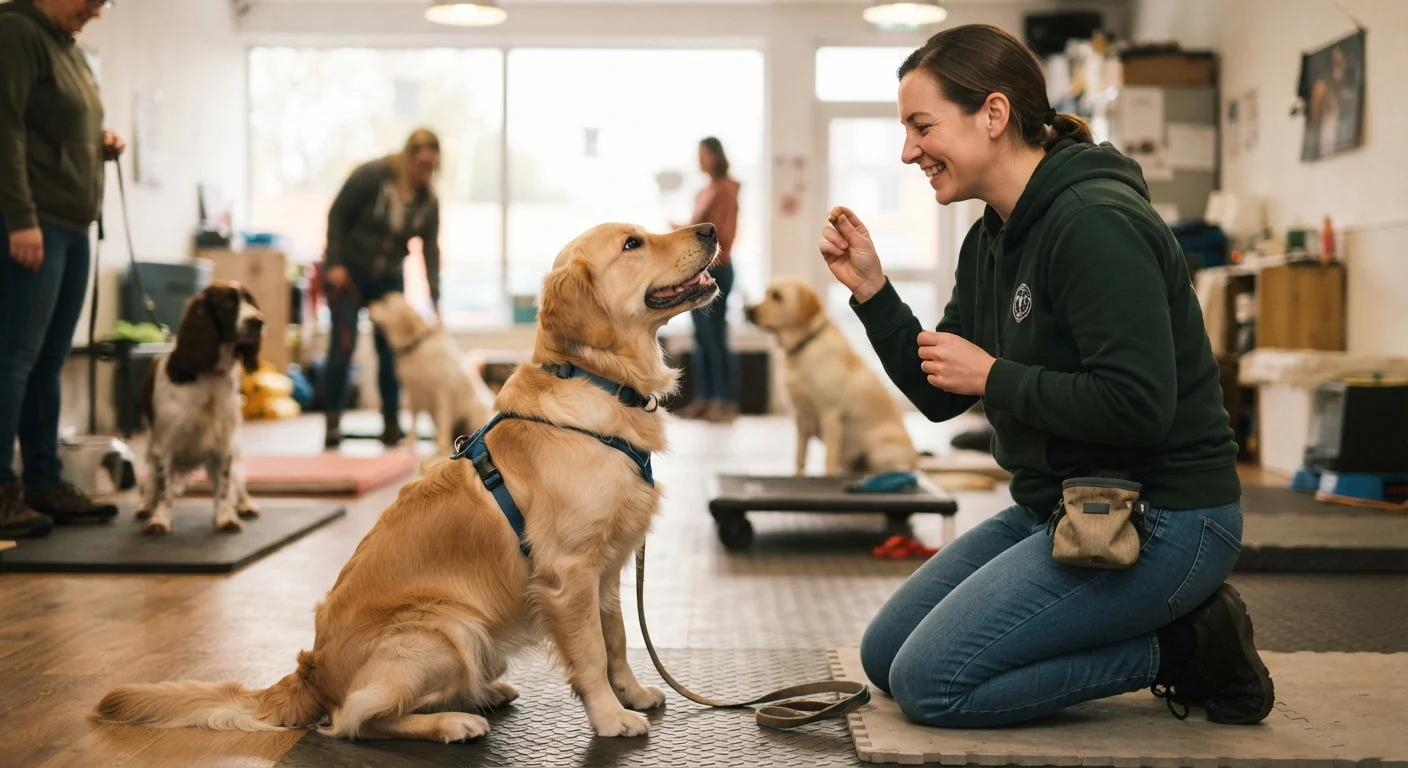
Group obedience classes place your dog in a managed environment alongside other dogs and handlers. This format is particularly well-suited to puppies and newly adopted dogs who need controlled exposure to other animals and people as part of a broader socialization plan.
Affordable compared to one-on-one professional sessions
Group classes distribute instructor costs across multiple participants, making structured, professional-led training more accessible for owners on a budget.
Controlled socialization with other dogs and people
A well-run group class provides supervised exposure to novel stimuli, helping dogs generalize calm, appropriate behavior in the presence of distractions.
Peer learning benefits owners, not just dogs
Observing how an instructor corrects other handlers' timing and technique is a surprisingly efficient way to improve your own handling skills.
Built-in accountability keeps owners consistent
Scheduled weekly sessions create a routine that helps owners practice between classes, a key factor in how quickly dogs retain new behaviors.
The shared setting also benefits owners: watching how an instructor coaches other handlers — and seeing common mistakes corrected in real time — provides learning that's harder to replicate alone. Many owners report that group accountability keeps them practicing more consistently between sessions.
That said, group classes are not the right fit for every dog. Reactive dogs (those who bark, lunge, or fixate on other dogs or people) can find the environment overwhelming rather than educational, and the instructor's attention is necessarily divided. Dogs with specific behavior problems — resource guarding, separation anxiety, significant fear responses — typically need more individualized support than a group setting can provide.
Not suitable for reactive or fearful dogs
Dogs who are easily overwhelmed by other animals or people may spend most of a group class over their stress threshold, making learning physiologically difficult.
Instructor attention is divided among all participants
In a class of six to ten dogs, each handler-dog pair receives limited individual feedback, which can allow small technique errors to go uncorrected for weeks.
Fixed schedule may not fit every owner's life
Group classes run on set days and times, and missing sessions disrupts the progression for both dog and handler in ways that are harder to recover from.
Class pace set by the group, not your dog
Faster or slower learners may find the curriculum moves at the wrong speed, leading to frustration or boredom that affects engagement.
Private Sessions: Targeted Help for Complex Needs
One-on-one sessions with a professional trainer or certified animal behaviorist direct 100% of expert attention toward your dog's specific challenges. This format is widely recommended when a dog displays fear-based behaviors, aggression toward people or other animals, or has a training history that requires careful unpacking before new skills can be built.
~1 in 5
Dogs showing fear or anxiety-based behaviors
Research published in Scientific Reports (2020) found that approximately 72% of dogs exhibited at least one anxiety-related behavior, highlighting how common the need for individualized behavioral support is.
6–8 weeks
Typical puppy socialization window
Veterinary behaviorists generally recognize the primary socialization period for puppies as closing around 12–16 weeks of age, making early group exposure particularly time-sensitive.
Private trainers can also work directly in your home, which matters when behavior problems are context-dependent — separation anxiety, for example, almost always needs to be addressed in the environment where it occurs. The instruction is also owner-focused: a skilled private trainer teaches you how to read your dog's body language and adjust your timing, not just what cues to practice.
The primary trade-off is cost. Private sessions typically run significantly higher per hour than group classes, and resolving complex issues may require multiple appointments. For owners whose dogs have layered behavioral challenges, however, this investment often proves more efficient than cycling through group formats that aren't designed for those needs. To explore how your communication choices interact with training outcomes, see our guide on clicker versus verbal marker training.
Self-Guided Training: Flexibility With a Responsibility Trade-Off
Self-guided training — using books, video courses, or app-based programs to design and run your own sessions — offers maximum scheduling flexibility and can be highly effective for motivated owners working with dogs who have no significant behavioral concerns. It is particularly common among experienced dog owners who are already familiar with reward-based training principles.
Choosing Quality Self-Guided Resources
Not all training apps, videos, or books are grounded in current behavioral science. Look for materials developed by certified professional dog trainers (CPDT-KA) or veterinary behaviorists (DACVB). Resources that rely on dominance theory or punishment-based methods are inconsistent with the consensus of contemporary animal behavior research and may worsen fear or aggression in some dogs.
The limitation is feedback. Without an experienced eye observing your sessions, timing errors and unintentional reinforcement of unwanted behaviors can go unnoticed for weeks. Dogs don't generalize skills automatically; a sit learned in the kitchen may not transfer to the sidewalk without deliberate practice across many environments. Self-guided learners need to be proactive about building this variety into their routine.
Combining self-guided practice with periodic check-in sessions — even once a month with a qualified trainer — helps catch drift before it becomes a setback. Once formal training goals are achieved, self-guided methods are also an excellent way to weave training into daily life so skills stay sharp long term.
Choosing the Right Fit — or the Right Combination
Most dogs benefit from more than one format across their training life. A common progression: group puppy classes for early socialization and foundational cues, a private session or two to address a specific challenge that emerges, then self-guided daily practice to maintain and extend skills. The formats aren't mutually exclusive, and treating them as a toolkit — rather than competing options — gives owners the most flexibility.
Age and life stage also matter. Puppies under four months have a critical socialization window during which group exposure is particularly valuable. Senior dogs or those recovering from illness may do better with shorter, lower-stimulation private or home-based sessions. For a broader look at how activity and learning needs shift with age, see our resource on exercise needs across pet life stages.
If your dog has a history of trauma, fear, or aggression, always consult a certified professional before beginning any structured training program. A qualified trainer or veterinary behaviorist can help you determine not just which format is appropriate, but whether any behavioral health considerations should be addressed alongside training. For general guidance on everyday pet care alongside training, the Pet Care Essentials hub is a useful starting point.
This article is for general informational purposes only and is not a substitute for professional veterinary or behavioral advice. Always consult a qualified trainer or veterinary behaviorist for dogs with significant behavioral concerns.