

Key Takeaways
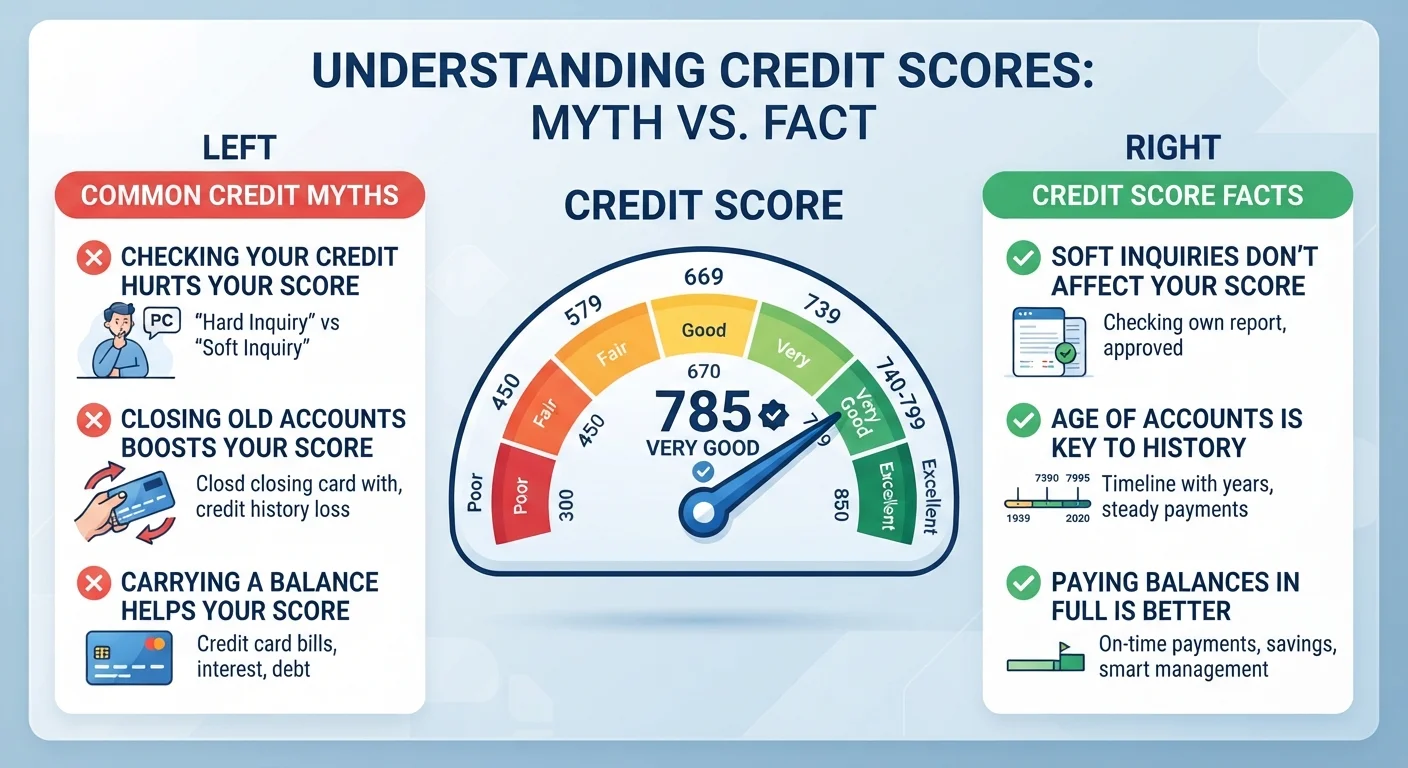
- Checking your own credit score is a soft inquiry and never lowers your score.
- Carrying a credit card balance from month to month does not improve your credit score.
- Closing old accounts can actually hurt your score by reducing available credit history.
- Income is not a factor in any standard credit score calculation.
- A single late payment can stay on your credit report for up to seven years.
Why Credit Score Myths Spread So Easily
Credit scores sit at the center of nearly every major financial decision — mortgages, auto loans, apartment applications — yet the way they actually work remains poorly understood by most consumers. That gap between importance and comprehension is fertile ground for myths. Well-meaning friends, outdated advice, and oversimplified summaries all contribute to misconceptions that can lead people to make decisions that quietly damage their credit standing.
The goal here is simple: replace the most persistent myths with accurate, practical information. Understanding how your score is actually calculated is the first step toward managing it effectively. For a deeper look at the mechanics, see our guide to what credit scores actually measure.
Myth
Checking your own credit score will lower it.
Fact
Checking your own score is a soft inquiry and has zero effect on your credit score.
Credit inquiries come in two forms: hard inquiries (triggered when a lender checks your credit to make a lending decision) and soft inquiries (triggered when you check your own score, or when a company checks for pre-approval purposes). Only hard inquiries can temporarily lower your score — typically by a few points — and only when a lender initiates them. Checking your own credit through any monitoring service or credit bureau portal is always a soft inquiry. Consumers should feel encouraged to review their scores regularly, not discouraged by a myth that checking is harmful.
Myth
Carrying a small balance on your credit card helps build your credit score.
Fact
Paying your balance in full each month is better for your score than carrying a balance — and it saves you interest.
This myth likely stems from a misunderstanding of how lenders want to see active credit use. It's true that using your card and making payments demonstrates responsible behavior. But the scoring models don't reward carrying a balance — they measure your credit utilization ratio, which is simply the percentage of available credit you're currently using. A lower ratio is better. Carrying a balance increases your utilization and costs you interest with no scoring benefit whatsoever. Pay in full by the due date to keep utilization low and avoid interest charges entirely.
Myth
Closing a credit card you no longer use will help your score.
Fact
Closing an old account can actually lower your score by reducing your available credit and shortening your credit history.
When you close a credit card, two things happen that can hurt your score. First, your total available credit drops, which increases your overall utilization ratio if you carry any balances on other cards. Second, if the closed card was one of your older accounts, closing it can eventually reduce the average age of your credit accounts — a factor that scoring models consider. There are legitimate reasons to close an account (high annual fees, fraud risk), but doing it simply to "clean up" your credit profile often backfires. If a card has no annual fee, keeping it open and occasionally using it for a small purchase can be the simpler, score-neutral choice.
Myth
Your income affects your credit score.
Fact
Income is not a factor in any standard credit score model, including FICO and VantageScore.
Standard credit scores — the ones lenders use to evaluate creditworthiness — are calculated entirely from information in your credit report: payment history, amounts owed, length of credit history, credit mix, and new credit inquiries. Income does not appear on your credit report and plays no part in your score. Lenders may separately consider your income when deciding how much credit to extend or whether to approve a specific loan, but that's a different calculation entirely from your score. A high earner with poor payment habits will have a lower score than a modest earner with a spotless payment record.
Myth
Missing one payment won't really matter if your overall history is good.
Fact
A single missed payment can remain on your credit report for up to seven years and meaningfully lower your score.
Payment history is the single largest factor in most credit score models, typically accounting for around 35% of a standard FICO score. A payment that is 30 or more days past due is reported to the credit bureaus and can cause a significant score drop — even for consumers who previously had strong scores. The damage is also not temporary: the negative mark remains on your report for seven years, though its impact on your score generally lessens over time as the account ages and you build a more recent positive history. If you've missed a payment, catching up as quickly as possible is the most important next step.
What These Corrections Mean for Your Credit Habits
Clearing up myths is only useful if it translates into better day-to-day habits. The corrections above point toward a handful of straightforward principles: pay on time, keep balances low relative to your credit limits, and think twice before closing accounts you've held for years.
35%
Payment history's weight in a standard FICO score
According to FICO, payment history is the single largest component of a standard FICO credit score calculation.
7 years
How long a late payment stays on your credit report
Under the Fair Credit Reporting Act, most negative items, including late payments, can remain on a consumer's credit report for up to seven years.
30%
Recommended maximum credit utilization ratio
Financial educators broadly suggest keeping your overall credit utilization below 30% to avoid a negative impact on most credit score models.
One area that trips up even financially engaged consumers is credit utilization — the ratio of your current balances to your total available credit limits. It's the second most influential factor in most credit score models, yet many borrowers underestimate how fast a high balance can move the needle downward. Our article on credit utilization walks through how the calculation works and what range to aim for.
Equally important is knowing what's actually on your credit report, since your score is derived directly from that data. Errors on a report — an account that isn't yours, a payment incorrectly marked late — can suppress your score through no fault of your own. Learn how to read every section of your report with our plain-language credit report walkthrough, and consider running through our annual credit health checklist at least once a year.
Dispute Errors Before They Cost You
If you find inaccurate information on your credit report — such as a payment marked late that you made on time — you have the right to dispute it directly with the credit bureau that reported it. Under the Fair Credit Reporting Act, bureaus are generally required to investigate disputes within 30 days. Correcting even one significant error can produce a meaningful score improvement. Don't assume the information on your report is automatically accurate.
If any of the terminology in this article felt unfamiliar, our credit and debt glossary defines terms like APR, charge-off, and hard inquiry in plain language. And if everyday financial behaviors are quietly working against your score without obvious warning signs, our piece on habits that erode credit health is worth a read.
This article provides general financial education and is not personalized financial or credit advice. Consult a licensed financial professional for guidance specific to your situation.