

Key Takeaways
- A new car can lose roughly 20% of its value in the first year of ownership.
- Depreciation is typically the single largest annual cost of owning a vehicle.
- Factors like mileage, condition, brand reputation, and market demand all influence how fast a car loses value.
- Buying a lightly used vehicle can help you avoid the steepest part of the depreciation curve.
- Keeping a car well-maintained can slow the rate of value loss over time.
Vehicle Depreciation
Vehicle depreciation is the decline in a car's market value over time. It begins the moment a new vehicle is purchased and continues throughout its life. Depreciation is not a fee you pay directly — it's the difference between what you paid for a car and what it's worth when you sell or trade it in.
In accounting terms, depreciation is an amortization of an asset's value. For personal vehicles, it's tracked as the gap between original purchase price and current fair market value, often referenced against tools like wholesale auction data or established vehicle valuation guides.
Why Depreciation Is the Biggest Cost Most Drivers Overlook
When drivers think about car costs, fuel and insurance usually come to mind first. But depreciation — the ongoing loss of a vehicle's market value — consistently outweighs both for most owners. Industry data has long placed depreciation as the top annual expense of vehicle ownership, often accounting for more than a third of total yearly costs.
The challenge is that depreciation doesn't show up as a monthly bill. There's no invoice, no payment due date. It quietly erodes your asset's worth in the background, only becoming visible when you try to sell or trade in. That invisibility is exactly why so many drivers fail to budget for it. For a fuller picture of what you're actually spending, see the true cost of owning a car in the US.
~20%
Typical first-year new car value loss
Industry analysis consistently places first-year depreciation for new vehicles in the 15–25% range, varying by segment and market conditions.
40–60%
Average value lost over five years
Most consumer vehicles lose between 40% and 60% of their original purchase price within five years, according to widely cited automotive valuation research.
#1
Depreciation's rank among annual ownership costs
Depreciation is consistently cited as the largest single component of annual vehicle ownership cost in automotive industry cost-of-ownership analyses.
What Drives the Rate of Depreciation
Not all vehicles depreciate at the same pace. Several key factors determine how quickly a car sheds value:
- Age: The first year carries the steepest drop, as a car transitions from new to used. Losses typically moderate after year three but continue steadily.
- Mileage: Higher annual mileage accelerates depreciation. Vehicles driven well above average miles per year lose value faster because higher mileage signals more wear.
- Condition: Dents, interior damage, and mechanical issues all suppress resale value. A clean, well-maintained vehicle consistently commands more at sale.
- Market demand: Popular body styles, fuel-efficient vehicles, and models with strong reliability track records hold value better than niche or heavily discounted segments.
- Brand perception: Vehicles from manufacturers with strong quality reputations tend to retain value more effectively than those with weaker consumer confidence.
- Trim and options: Factory-installed features — particularly popular technology and safety packages — can support resale value. Unusual color choices or rare configurations may limit your buyer pool.
Protect Resale Value With Consistent Maintenance
Keeping up with scheduled service intervals — oil changes, tire rotations, brake inspections — does more than preserve reliability. It creates a documented maintenance history that reassures future buyers and supports a stronger resale price. Retain service receipts throughout ownership, as these records can make a tangible difference when negotiating a private sale or trade-in.
The Depreciation Curve: When Value Loss Is Steepest
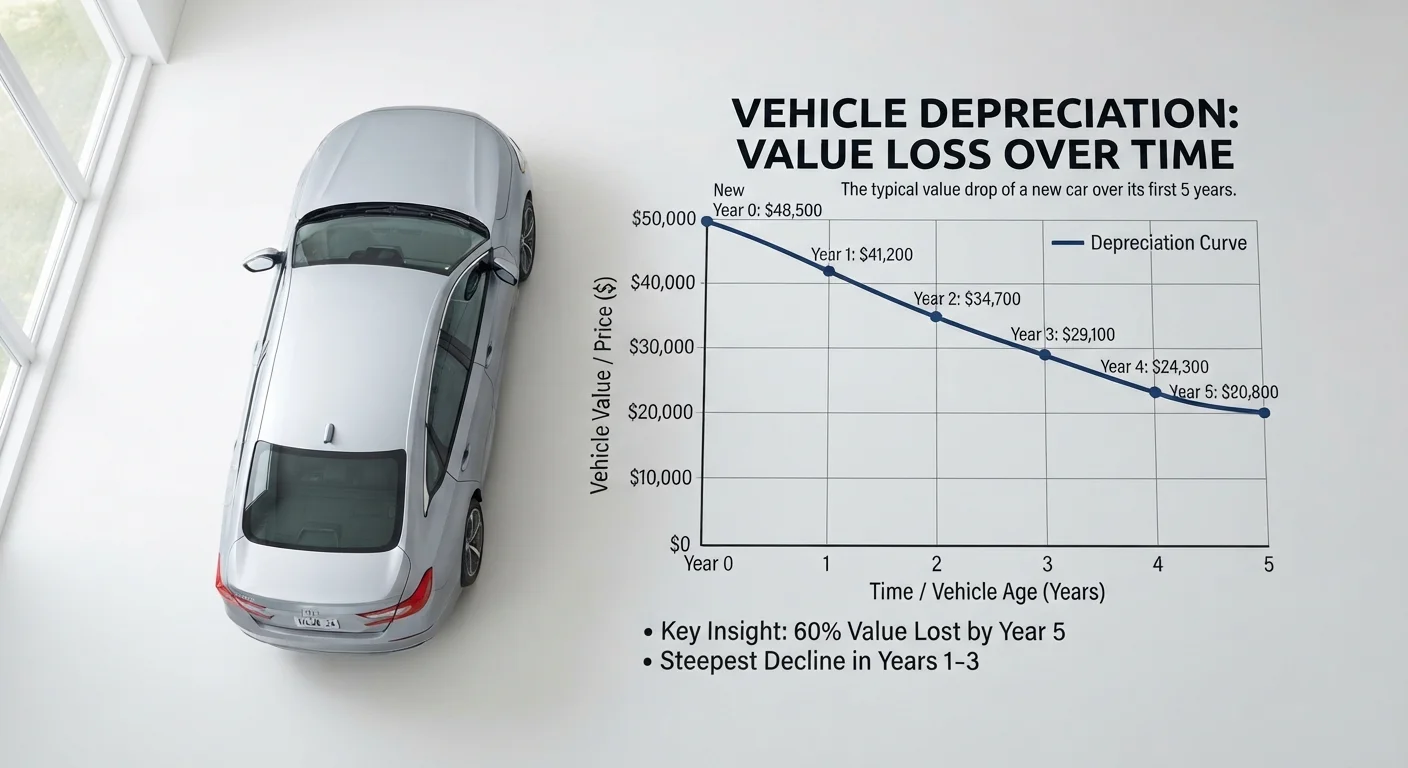
Depreciation is not linear. The loss curve is sharpest in the first few years of ownership and gradually flattens as the vehicle ages. A car that loses 20% of its value in year one might lose only 10–12% in year two, and progressively less each subsequent year.
This pattern has a practical implication: buying a vehicle that is two to three years old allows a buyer to sidestep the most aggressive phase of value loss while still getting a relatively modern vehicle. The original owner absorbs the steepest depreciation; subsequent buyers benefit from a slower-declining curve.
Understanding where a specific vehicle sits on this curve is useful when deciding how long to keep it. A long-term cost planning framework can help you time ownership decisions around depreciation cycles.
Building Depreciation Into Your Budget
Because depreciation is a real economic cost — even if it's invisible month to month — financially savvy owners account for it in their planning. One practical approach is to estimate the vehicle's likely value at a future point (say, three or five years from now) and treat the difference from purchase price as a cost spread across that ownership period.
For example, if a vehicle purchased for $35,000 is expected to be worth approximately $20,000 in five years, the depreciation cost is roughly $3,000 per year, or about $250 per month. That figure belongs alongside fuel, insurance, and maintenance in any honest monthly budget. Depreciation is a fixed cost in the sense that it accrues regardless of how much you drive — see how fixed and variable car costs differ for context.
Typical annual cost ranges by expense category can serve as a useful benchmark when running these estimates. And if you're working to build a broader household budget that absorbs vehicle costs, budgeting basics offers structured guidance. Regular upkeep also plays a supporting role — proper car maintenance helps preserve the condition that sustains resale value.
Depreciation Estimates Are Approximations
No formula can precisely predict a vehicle's future resale value. Market shifts, fuel price changes, new model introductions, and broader economic conditions all influence demand — and demand drives price. Treat depreciation estimates as planning tools, not guarantees, and revisit your assumptions periodically throughout ownership.