

Key Takeaways
- Crate training leverages dogs' natural denning instincts but requires gradual, positive introduction.
- Used correctly, a crate aids house-training and provides a safe retreat during stressful events.
- Misuse — including excessive confinement — can cause anxiety, frustration, and behavioral problems.
- Crate training is a tool, not a universal solution; some dogs adapt readily while others do not.
- Always pair crate use with sufficient exercise, socialization, and positive reinforcement.
Supports faster, more consistent house-training
A properly sized crate uses a dog's instinct to keep its sleeping area clean, helping puppies develop bladder control between outdoor trips. Most trainers consider it one of the most reliable house-training aids available.
Provides a safe space during stressful events
Thunderstorms, fireworks, and household visitors can overwhelm some dogs. A familiar crate offers a predictable retreat where a well-conditioned dog can self-regulate and decompress.
Prevents unsupervised access to household hazards
Young or newly adopted dogs may chew electrical cords, ingest toxic substances, or cause structural damage when left alone. A crate limits access to these risks during the training period.
Simplifies veterinary care and travel
Crate-comfortable dogs handle veterinary stays, post-surgical rest requirements, and airline or vehicle travel with considerably less distress than those with no prior crate exposure.
Can reduce anxiety for some dogs
Enclosed spaces naturally appeal to dogs with denning tendencies. For these individuals, a crate may lower arousal levels and provide a sense of security that open spaces don't offer.
Misuse can cause or worsen anxiety
Dogs confined for excessive periods, or introduced to crates through force or punishment, frequently develop anxiety-related behaviors. The crate becomes associated with distress rather than safety.
Not suitable for all individual temperaments
Dogs with pre-existing separation anxiety or claustrophobic tendencies often struggle with crate training regardless of how gradually it is introduced. Pushing the process can make behavioral problems worse.
Duration limits are frequently underestimated
Adult dogs should generally not be crated for more than four to five consecutive hours during the day. Owners with full-time work schedules may find this incompatible with crate use as a daytime management tool.
Can mask behavioral issues rather than resolve them
Using a crate to contain a dog with destructive or anxious behavior prevents damage but does not address the root cause. Without complementary training, the behavior typically persists whenever the dog is outside the crate.
Requires consistent owner commitment
Effective crate conditioning demands a gradual, structured introduction that may take days to weeks. Owners who skip steps or use the crate inconsistently often see poor results and may attribute the failure to the method rather than the implementation.
Our Verdict
Crate training is a well-established and humane practice when implemented thoughtfully, with attention to duration, comfort, and the individual dog's temperament. It offers genuine advantages for house-training, safe transport, and post-surgical recovery, but it demands patience and should never substitute for adequate exercise or companionship. Dogs confined too long or introduced to crates through force are likely to experience distress rather than benefit.
Crate training is best suited to new puppy owners pursuing house-training, owners whose dogs need a structured safe space, or those managing a dog's recovery from injury — provided the owner commits to a gradual, reward-based introduction.
What Crate Training Actually Involves
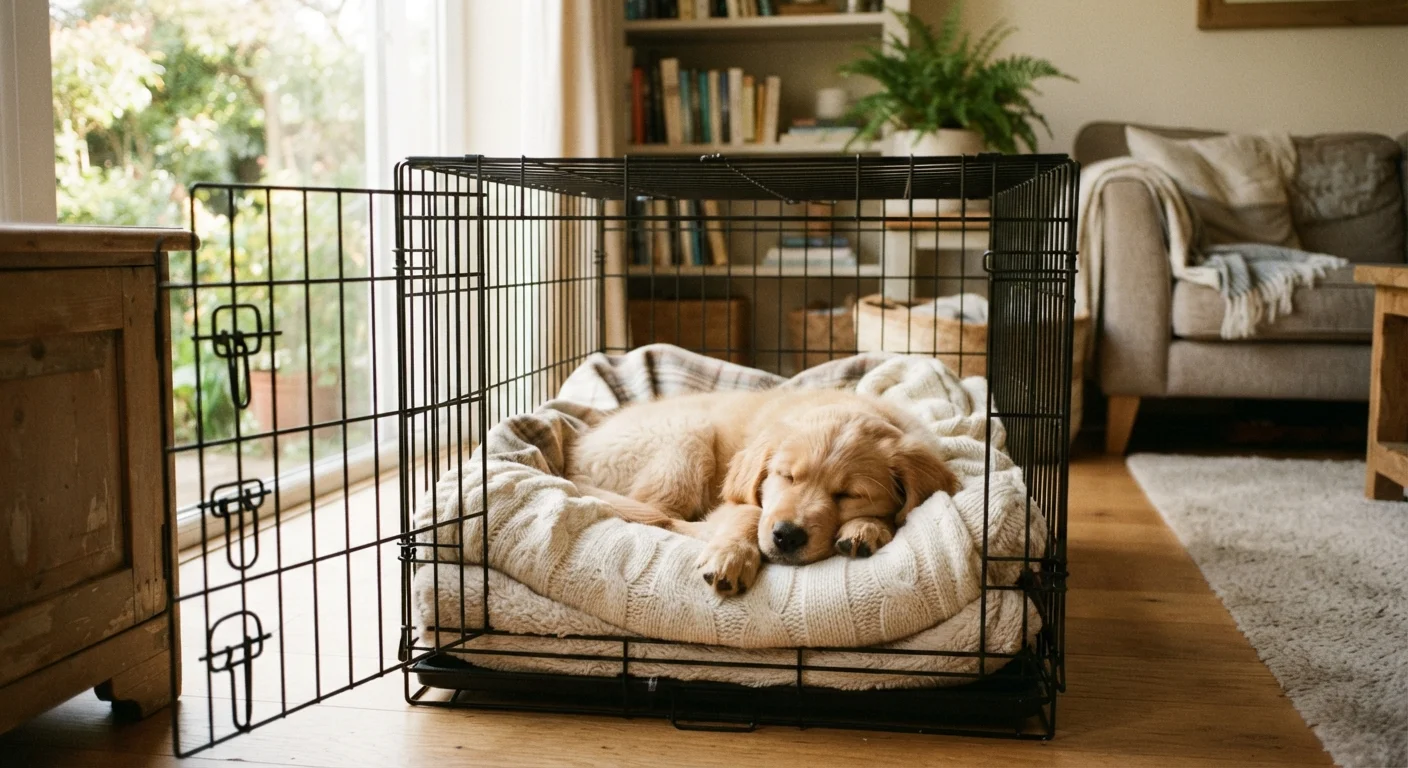
Crate training is the practice of teaching a dog to view an enclosed space — typically a wire, plastic, or fabric crate — as a comfortable, secure resting area. The goal is voluntary acceptance, not forced containment. A properly trained dog enters the crate willingly, settles calmly, and can be left there for appropriate periods without distress.
The process generally unfolds in stages: first introducing the crate with the door open, then encouraging the dog to enter using treats or meals, then briefly closing the door while remaining nearby, and finally extending duration incrementally. Rushing any stage tends to undermine the entire process. For a broader look at how positive reinforcement underpins this kind of training, see the Pet Training & Behavior hub, which covers core methods and behavioral concepts.
It's worth noting that crate training is distinct from simply placing a dog in a crate when it's inconvenient. The former is a structured behavioral process; the latter is confinement, and the two produce very different outcomes.
The Case For Crate Training
Proponents of crate training — including many veterinary behaviorists — point to several well-supported advantages.
Supports faster, more consistent house-training
A properly sized crate uses a dog's instinct to keep its sleeping area clean, helping puppies develop bladder control between outdoor trips. Most trainers consider it one of the most reliable house-training aids available.
Provides a safe space during stressful events
Thunderstorms, fireworks, and household visitors can overwhelm some dogs. A familiar crate offers a predictable retreat where a well-conditioned dog can self-regulate and decompress.
Prevents unsupervised access to household hazards
Young or newly adopted dogs may chew electrical cords, ingest toxic substances, or cause structural damage when left alone. A crate limits access to these risks during the training period.
Simplifies veterinary care and travel
Crate-comfortable dogs handle veterinary stays, post-surgical rest requirements, and airline or vehicle travel with considerably less distress than those with no prior crate exposure.
Can reduce anxiety for some dogs
Enclosed spaces naturally appeal to dogs with denning tendencies. For these individuals, a crate may lower arousal levels and provide a sense of security that open spaces don't offer.
4–5 hrs
Maximum recommended daily crate time for adult dogs
Veterinary behaviorists and certified trainers commonly cite four to five hours as the upper limit for daytime crating of adult dogs, with shorter limits for puppies based on age.
~1 hr/month
Puppy bladder control guideline by age
A widely used trainer guideline holds that puppies can hold their bladder for approximately one hour per month of age, informing how long crate sessions should last during house-training.
Beyond house-training, crates provide practical safety. Dogs left unsupervised in a home can ingest toxic substances, chew electrical cords, or injure themselves. A crate eliminates many of these risks during the period before a dog has learned reliable household manners. Crates are also essential for safe vehicle travel and are required for air transport, making early familiarization genuinely useful.
For dogs recovering from surgery or injury, a crate enforces the rest that veterinarians prescribe — something that's otherwise very difficult to achieve with an energetic dog. And for some dogs, particularly those prone to anxiety, a crate functions as a genuine retreat: a predictable, enclosed space that reduces environmental overstimulation.
The Case Against Crate Training
Critics — including some animal welfare researchers and certified applied animal behaviorists — raise concerns that deserve serious consideration.
Misuse can cause or worsen anxiety
Dogs confined for excessive periods, or introduced to crates through force or punishment, frequently develop anxiety-related behaviors. The crate becomes associated with distress rather than safety.
Not suitable for all individual temperaments
Dogs with pre-existing separation anxiety or claustrophobic tendencies often struggle with crate training regardless of how gradually it is introduced. Pushing the process can make behavioral problems worse.
Duration limits are frequently underestimated
Adult dogs should generally not be crated for more than four to five consecutive hours during the day. Owners with full-time work schedules may find this incompatible with crate use as a daytime management tool.
Can mask behavioral issues rather than resolve them
Using a crate to contain a dog with destructive or anxious behavior prevents damage but does not address the root cause. Without complementary training, the behavior typically persists whenever the dog is outside the crate.
Requires consistent owner commitment
Effective crate conditioning demands a gradual, structured introduction that may take days to weeks. Owners who skip steps or use the crate inconsistently often see poor results and may attribute the failure to the method rather than the implementation.
Duration is central to most criticisms. Adult dogs should generally not be crated for more than four to five hours during the day; puppies have even shorter limits tied to their bladder capacity. When crates are used as a substitute for proper supervision, exercise, or companionship, the welfare implications become significant. Dogs are highly social animals, and prolonged isolation in a confined space — regardless of whether it's a crate — can produce or worsen anxiety and stress-related behaviors.
Individual temperament also matters considerably. Some dogs never become comfortable in a crate despite patient, positive introduction, particularly those with pre-existing separation anxiety or claustrophobic tendencies. Forcing the process on a dog that consistently shows distress is unlikely to produce the calm acceptance that makes crate training worthwhile. Owners dealing with persistent anxiety issues may benefit from guidance covered in common training myths, including the mistaken idea that distress in a crate simply requires more time to resolve on its own.
Signs a Dog Is Not Adjusting to the Crate
Persistent whining, barking, or attempts to escape after the introductory period has been followed correctly are meaningful signals — not behaviors to wait out. Excessive salivation, panting, or self-injury in the crate indicate significant distress. If these signs appear, pause the process and consult a certified professional dog trainer (CPDT) or veterinary behaviorist before continuing. Continuing to confine a dog showing these responses is likely to worsen the problem.
Crate Training and House-Training: A Practical Connection
One of the strongest practical arguments for crate training is its role in house-training puppies. Dogs generally avoid soiling their sleeping area, so a correctly sized crate — large enough to stand, turn around, and lie down, but not so large that one end becomes a bathroom — helps puppies develop bladder and bowel control between scheduled outdoor trips.
This approach only works when the puppy is taken outside immediately after crate time, and when the crate is not used to confine a puppy beyond what its age and bladder allow. A general guideline used by many trainers: a puppy can hold its bladder for roughly one hour per month of age, up to a practical ceiling. For a detailed walkthrough of the full house-training process, including scheduling and accident handling, see house-training a puppy without frustration.
The crate is one component of house-training, not a replacement for consistent scheduling, supervision, and positive reinforcement when the puppy eliminates in the correct location. Owners who rely solely on the crate without the complementary elements often find progress slower and more frustrating.
How to Decide Whether Crate Training Is Right for Your Dog
There is no single answer that applies to every dog or household. The decision involves the dog's age and temperament, the owner's schedule, living situation, and specific training goals.
Puppies and newly adopted dogs with no established house-training history are typically the strongest candidates. Dogs with a history of destructive behavior during unsupervised periods may also benefit, provided the crate is used as a temporary management tool while training addresses the underlying behavior — not as a permanent solution. The training methods you use alongside crate introduction matter too; see clicker training vs. verbal markers for a comparison of communication styles that pair well with crate conditioning.
Dogs that already show significant separation anxiety, dogs in households where they would routinely be crated for long stretches, or dogs that have had repeated distressing experiences in enclosed spaces are generally poor candidates without professional behavioral support. If you're uncertain, a consultation with a certified professional dog trainer or a veterinary behaviorist can help assess whether crate training is appropriate and how to approach it safely.
This article is for general informational purposes only and does not constitute veterinary or behavioral advice. Consult a qualified veterinarian or certified animal behaviorist for guidance specific to your dog's health and behavior.