

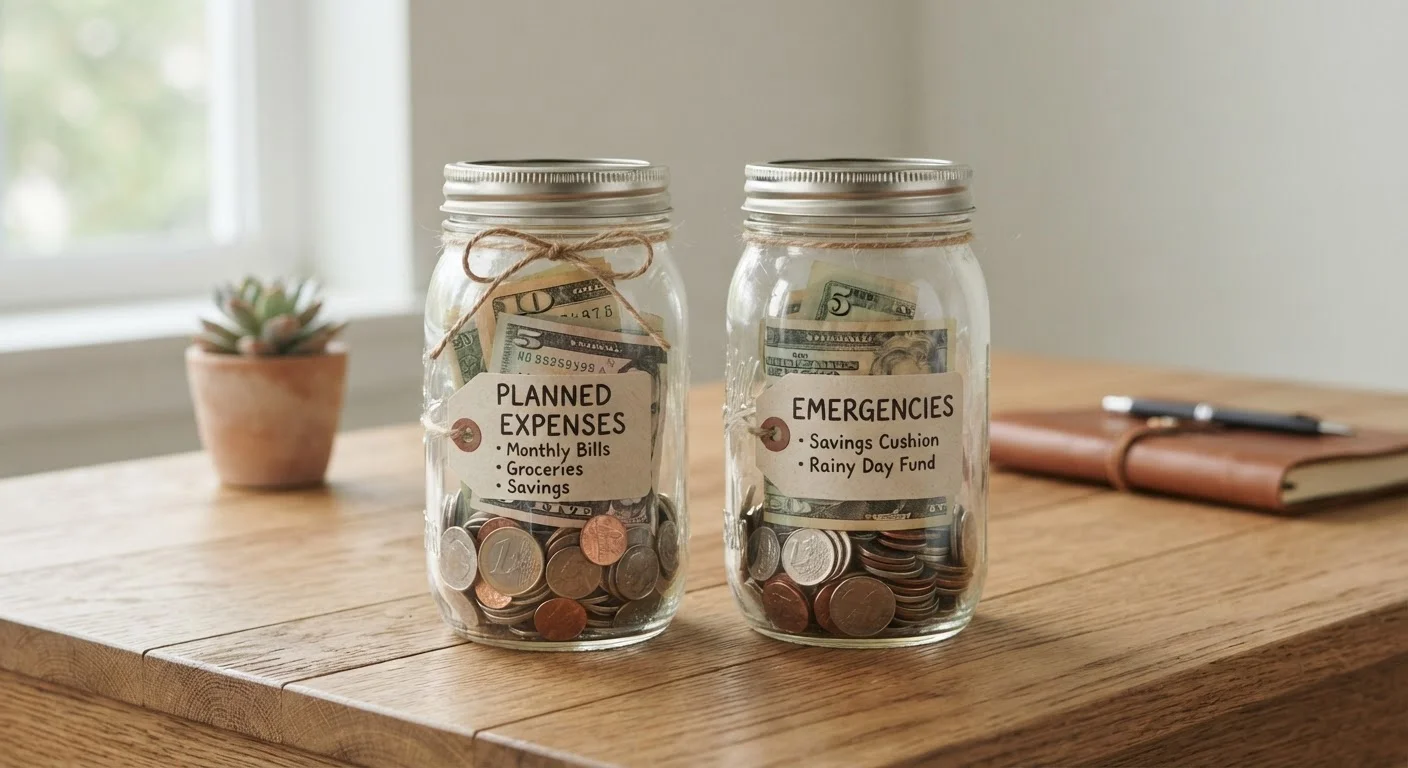
Key Takeaways
- A sinking fund targets known, upcoming expenses; an emergency fund covers unpredictable financial shocks.
- Both accounts belong in a sound personal budget — they complement, not replace, each other.
- Sinking funds have a defined target and end date; emergency funds are open-ended and replenished after use.
- Most financial guidance suggests three to six months of expenses as an emergency fund baseline.
- Keeping these funds in separate accounts reduces the temptation to misuse either one.
Option A
Sinking Fund
The proactive, planned-expense account.
Best for: Saving toward known, predictable future costs like car registration, annual subscriptions, or holiday gifts.
Option B
Emergency Fund
The reactive, safety-net account.
Best for: Covering sudden, unplanned financial shocks such as job loss, medical bills, or urgent home repairs.
If you have a vacation, car repair, or tax bill coming up in a few months
Sinking Fund
These are predictable costs with a known timeline. A sinking fund lets you divide the total into manageable monthly contributions so the bill doesn't ambush your budget.
If you have no financial cushion for unexpected events like job loss or medical emergencies
Emergency Fund
Without a buffer for true surprises, a single unexpected expense can push you into debt. Building this baseline should come before most other savings goals.
If you already have an emergency fund and want to stop going into debt for irregular bills
Sinking Fund
Once your emergency baseline is secure, sinking funds help you pre-fund recurring but non-monthly costs, smoothing cash flow year-round.
If you are rebuilding savings after a financial setback
Emergency Fund
Restoring your emergency cushion first re-establishes the safety net that keeps future surprises from spiraling into larger problems.
What Each Account Actually Does
Both a sinking fund and an emergency fund are savings buckets — money set aside in advance. The similarity ends there. Their purpose, funding logic, and withdrawal rules are fundamentally different.
A sinking fund is a dedicated pool of money built toward a specific, predictable expense. You know roughly what you'll spend and roughly when. Common examples include annual car insurance premiums, holiday gifts, a planned vacation, or a home appliance you know needs replacing. You divide the target amount by the number of months until the expense, contribute that slice each month, and spend the fund when the bill arrives. Once spent, the cycle restarts — or the fund closes if the goal was one-time.
An emergency fund is your financial safety net for events you cannot predict: a sudden job loss, an unexpected medical cost, a furnace failure in January. It has no fixed end date and no fixed target expense — only a target balance, typically expressed as a multiple of your monthly essential expenses. It sits untouched until a genuine emergency strikes, then gets replenished as quickly as possible afterward.
Think of it this way: sinking funds handle the expected unexpected — expenses you know are coming but that don't fit neatly into a monthly budget. Emergency funds handle the truly unexpected — events that arrive without warning and without a price tag you could have calculated in advance. For more foundational vocabulary, see the budgeting terms glossary.
How to Size and Build Each One
Sizing these two accounts requires different thinking.
Sizing a Sinking Fund
Start by listing every irregular, non-monthly expense you can anticipate over the next 12 months — vehicle registration, dental co-pays, back-to-school shopping, holiday spending, subscription renewals. Estimate the total cost for each, then divide by the number of months until each is due. That monthly figure goes into your budget as a fixed line item, just like rent. You can run multiple sinking funds simultaneously, either in separate sub-accounts or tracked as labeled buckets in a single savings account.
Sizing an Emergency Fund
A commonly cited benchmark is three to six months of essential living expenses — housing, utilities, groceries, insurance, and minimum debt payments. Lower-risk situations (stable two-income household, secure employment) may lean toward three months; higher-risk situations (variable income, single earner, health considerations) may lean toward six or more. There is no universally correct number, and building the fund gradually over time is entirely reasonable.
3–6 months
Commonly recommended emergency fund size
This range is widely cited by financial educators and consumer finance organizations as a baseline for most households, though individual needs vary.
~40%
US adults who could not cover a $400 emergency with cash
The Federal Reserve's Report on the Economic Well-Being of US Households has consistently found a large share of Americans lack a basic financial buffer.
Where you keep each fund matters, too. Many people keep emergency funds in a high-yield savings account that is separate from their checking account — accessible in a crisis but not so frictionless that it invites casual withdrawals. Sinking funds can live in the same high-yield account if your bank supports named sub-accounts, or in a dedicated savings account you label clearly. For a deeper look at the tradeoffs of separating accounts, see separating savings into multiple accounts.
Using Both Together in Your Budget
These two accounts are not in competition — they fill genuinely different roles in a complete personal finance plan. The practical question is sequencing: which do you build first?
Most financial educators suggest establishing at least a modest emergency fund (often cited as $1,000 as a starting milestone) before aggressively funding sinking funds. A small buffer prevents a minor surprise from derailing your budget entirely while you work toward your larger emergency target. Once that baseline exists, layering in sinking funds makes your month-to-month cash flow far more predictable.
What Counts as a True Emergency?
A common mistake is raiding an emergency fund for expenses that are actually predictable — like car maintenance or holiday spending. A true emergency is an event that is both unexpected and necessary to address immediately, such as sudden unemployment or an unplanned medical bill. Predictable irregular costs belong in a sinking fund, not your emergency reserve. Drawing a clear mental line between the two helps both accounts serve their intended purpose.
Within a budget framework — whether you use zero-based budgeting, the 50/30/20 rule, or another approach — both funds typically fall under the "savings" category. Sinking fund contributions behave like fixed monthly expenses (you know the amount and the timing), while emergency fund contributions can be treated similarly until you reach your target balance. For a broader look at how each framework handles savings goals, see budgeting methods compared.
If you're also managing debt, the decision of how much to allocate to savings versus debt paydown adds another layer. The paying off debt vs. saving tradeoff guide walks through key factors like interest rates and risk tolerance to help you find the right balance for your situation.
| Criterion | Sinking Fund | Emergency Fund |
|---|---|---|
| Purpose | Fund known, planned expenses | Cover unexpected financial shocks |
| Target amount | Specific dollar goal per expense | 3–6 months of essential expenses |
| Timeline | Fixed end date per goal | Ongoing; no set end date |
| When to withdraw | When the planned expense arrives | Only during a genuine emergency |
| After withdrawal | Restart or close the fund | Replenish back to target balance |
| Predictability | High — expense is anticipated | Low — event is unpredictable |
| Priority order | Build after basic emergency buffer | Build first, before most other goals |
This article is for general informational and educational purposes only and does not constitute personalized financial advice. Please consult a qualified financial professional for guidance specific to your circumstances.