

Key Takeaways
- No single savings strategy works for everyone — the best approach depends on your income, goals, and habits.
- Automating savings removes the friction of decision-making and helps contributions happen consistently.
- The 50/30/20 rule, pay-yourself-first, and goal-based saving each solve a different problem.
- Combining elements from multiple frameworks is common and often more effective than rigid adherence to one.
- Even a small, fixed savings amount beats an undefined intention to save whatever is left over.
Why Strategy Matters More Than Willpower
Most people intend to save. The gap between intention and follow-through rarely comes down to motivation — it comes down to structure. Without a clear framework, savings tend to happen last, after every other expense has already claimed its share of the paycheck. The strategies below address that problem in different ways, each with its own logic and best-fit scenario.
This is general financial information, not personalised advice. Your income, debt load, expenses, and goals all shape which approach makes sense for you. For decisions specific to your situation, consider speaking with a licensed financial professional. If you're still in the stage of defining what you're saving for, turning vague intentions into concrete milestones is a useful place to start.
The 50/30/20 Rule
This percentage-based framework divides after-tax income into three broad categories: roughly 50% toward needs (housing, utilities, groceries, minimum debt payments), 30% toward wants (dining, entertainment, subscriptions), and 20% toward savings and extra debt repayment.
Its appeal is simplicity. You don't need to track dozens of spending categories — just three. It works best for people with stable, predictable income who want a quick sanity check on whether their spending is broadly balanced. The 20% savings target is a starting point, not a ceiling; higher earners or those with aggressive goals may aim beyond it.
The limitation: the 50/30/20 split can feel awkward in high cost-of-living areas where needs alone may consume well above 50% of take-home pay. In those cases, the percentages are better treated as directional guides than hard rules. For a side-by-side comparison with another popular method, see the 50/30/20 rule vs. zero-based budgeting.
The 50/30/20 rule works best as a directional guide, not a rigid formula.
Pay-Yourself-First
Pay-yourself-first flips the typical savings sequence. Instead of spending first and saving whatever remains, you move a fixed amount into savings at the start of each pay period — before bills, groceries, or discretionary spending. The rest of your budget is then built around what's left.
This approach is often automated: a scheduled transfer to a savings account goes out on payday, so savings happen without requiring a repeated decision. Research in behavioral economics consistently finds that automation reduces the likelihood that savings are skipped when money feels tight.
It suits people who find they never have anything left to save at the end of the month, or who want to build an emergency fund quickly. The challenge is calibrating the amount — too aggressive a transfer can leave the checking account short for real expenses. Starting conservatively and increasing gradually is the common recommendation. Comparing major budgeting frameworks can help you see how pay-yourself-first fits alongside other methods.
Automating savings before spending removes the decision — and the temptation — entirely.
Goal-Based Saving
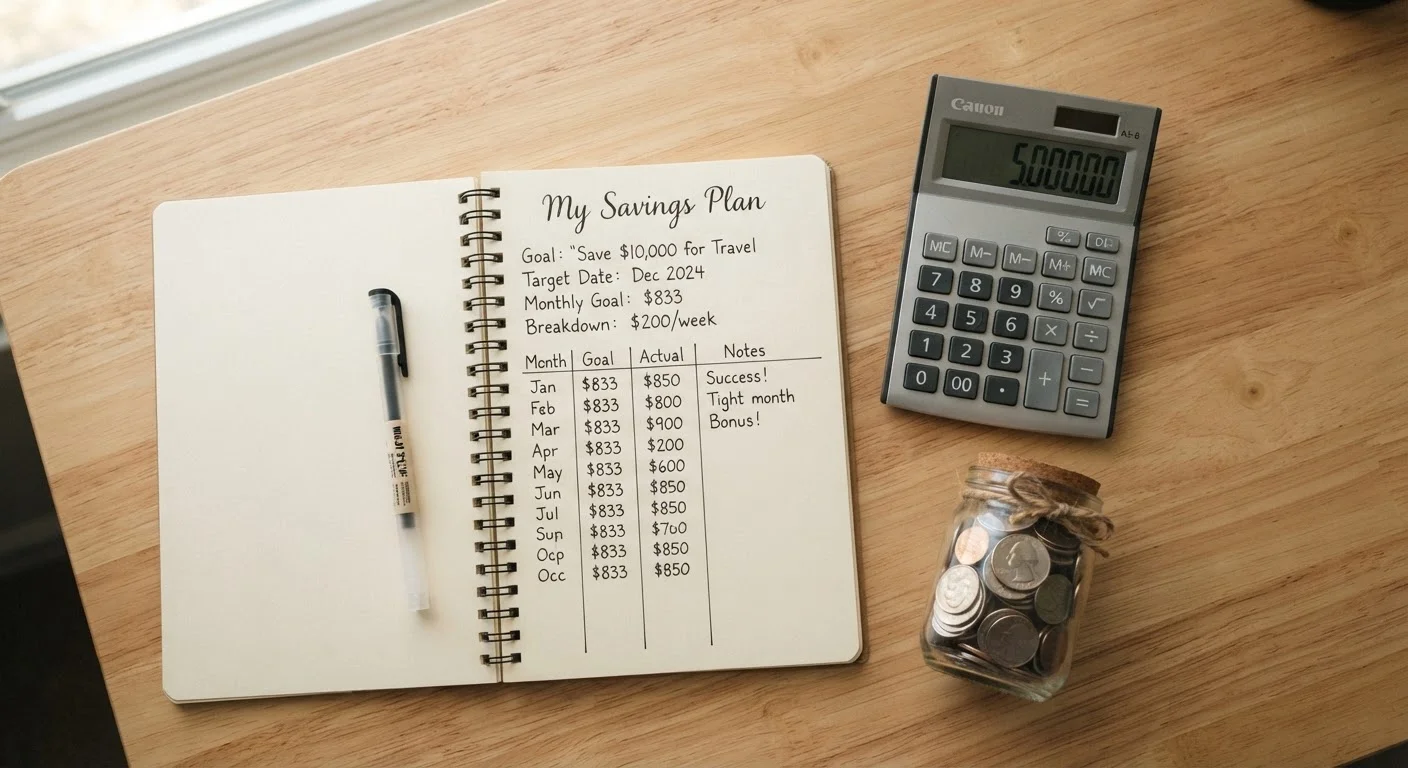
Rather than saving a fixed percentage of income, goal-based saving works backward from a specific target. You identify what you're saving for (an emergency fund, a car, a home down payment), set a dollar amount and a target date, then divide to find the required monthly contribution.
This approach makes abstract intentions concrete. A goal of saving $6,000 for an emergency fund in 12 months becomes a $500-per-month commitment — specific and trackable. The SMART goal framework (Specific, Measurable, Achievable, Relevant, Time-bound) is frequently used to structure these targets.
Goal-based saving also helps with prioritization. Most people are saving for more than one thing simultaneously — short-term needs, mid-term purchases, and long-term security all compete for the same dollars. A breakdown of savings goal timeframes can help you understand which goals to fund first and in what proportion.
Working backward from a specific target turns a vague intention into a monthly number.
Zero-Based Budgeting
Zero-based budgeting assigns every dollar of income a specific job — expenses, savings, or debt repayment — until the budget reaches zero. It's not about spending everything; savings and investments are line items with their own allocations, just like rent or groceries.
This method rewards detail-oriented people who want full visibility into where every dollar goes. It's particularly effective for those paying down debt alongside saving, because it forces explicit trade-offs: money directed toward a debt payment is money not available for discretionary spending. The debt vs. savings tradeoff becomes visible in the budget itself.
The downside is effort. Zero-based budgeting requires more active tracking than percentage rules, and irregular income can complicate the math. Some people use it for a defined period to reset spending habits, then shift to a lighter-touch method once patterns are established.
Zero-based budgeting makes every dollar's purpose explicit — including savings and debt payments.
The Savings Rate Approach
The savings rate approach focuses on one metric: what percentage of gross (pre-tax) or net (after-tax) income goes toward savings and investments. Rather than following a prescriptive budget, you track and try to increase this single number over time.
This method is common among people focused on long-term financial independence or early retirement, where a higher savings rate can meaningfully shorten the time to reach a target portfolio. It's less prescriptive about how you manage the spending side — only the savings output is tracked.
It works best when paired with a broader sense of goals and progress-tracking practices that keep motivation alive over years. On its own, a savings rate target without a clear destination can feel abstract. Connecting the rate to a specific goal — retirement by a certain age, financial independence at a certain net worth — gives it more direction and staying power.
Tracking a single savings rate number is simple; connecting it to a concrete goal gives it meaning.
Choosing a Starting Point and Sticking With It
The most effective savings strategy is the one you can actually sustain. If the 50/30/20 rule feels too rigid for a variable income, a goal-based approach may serve you better. If you struggle with spending before saving, automating a fixed transfer on payday removes the temptation entirely.
Start With One Method, Adjust as You Go
You don't need to find the perfect strategy before starting. Pick the approach that addresses your biggest current obstacle — whether that's spending before saving, lacking a target, or having no visibility into spending. A workable system in place today will accomplish more than the ideal system you haven't started yet. Revisit your method after three to six months and adjust based on what's working.
Once you've chosen an approach, build in a regular review. Income changes, goals shift, and a strategy that fit your life two years ago may need adjustment. An annual savings check-up gives you a structured way to revisit your targets and contributions. For a broader look at how saving habits develop over time, a complete framework for consistent saving walks through the full cycle from goal-setting to long-term maintenance.
This article is for general informational and educational purposes only and does not constitute personalised financial, investment, tax, or legal advice. Consult a qualified financial professional before making decisions specific to your circumstances.