

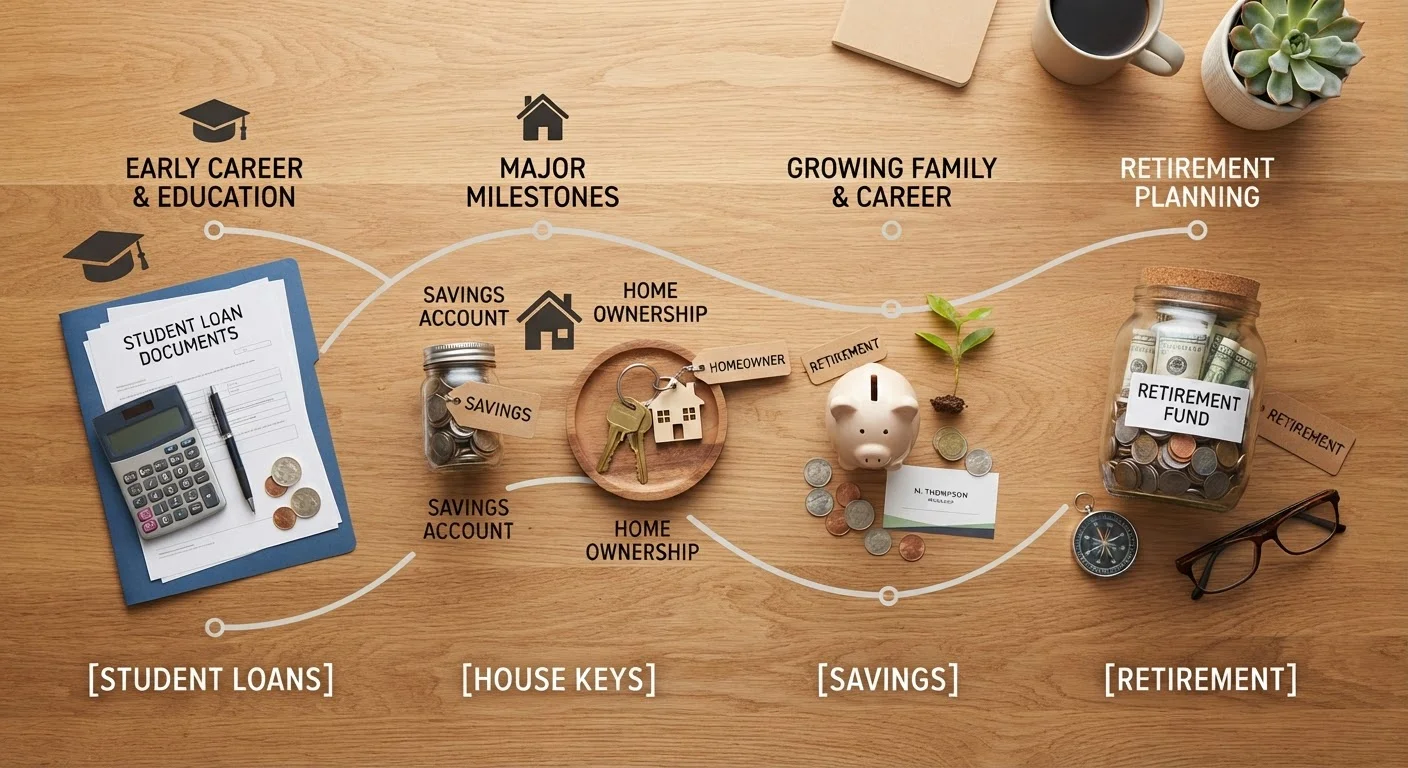
Key Takeaways
- Debt is not uniformly bad — its impact depends heavily on your life stage and the type of debt involved.
- Early adulthood often centers on student loans and credit building; mid-life on mortgages and family expenses.
- Reducing high-interest debt becomes especially critical as retirement approaches and earned income shrinks.
- Carrying significant debt into retirement on a fixed income amplifies financial risk considerably.
- Core principles — borrow purposefully, keep payments manageable, track interest costs — apply at every age.
Why Debt Changes as You Age
Debt is not a single, static problem. The type of debt you carry, the income you use to service it, and the time horizon you have to pay it off all shift as your life evolves. A student loan at 22 and a mortgage at 40 are both forms of debt, but they carry different risks, different purposes, and different strategies for managing them wisely.
Understanding where you are in your financial life — and what debt typically looks like at that stage — helps you make more deliberate choices rather than reactive ones. For a foundational overview of how borrowing and credit work in the first place, see our complete financial primer for credit newcomers.
$59,580
Average student loan debt per borrower
According to the Education Data Initiative's analysis of federal student loan data.
~$12,000
Median credit card debt among US households carrying a balance
Based on Federal Reserve Survey of Consumer Finances data on revolving debt balances.
Over 40%
Adults aged 65+ still carrying mortgage debt
According to the Consumer Financial Protection Bureau's analysis of older Americans and housing debt.
Early Adulthood: Building Credit While Managing Student Debt
For many people, the first significant debt they carry is a student loan. This type of debt is often called investment debt — borrowed to fund education that may increase earning potential over time. That framing has merit, but it doesn't eliminate the real burden of monthly payments on an entry-level salary.
Key priorities in this stage typically include:
- Understanding your loan terms: Fixed vs. variable rates, grace periods, and income-driven repayment options differ significantly between federal and private loans.
- Building a credit history responsibly: Opening a credit card and paying it in full each month establishes positive payment history without accumulating interest charges.
- Avoiding high-interest consumer debt: Credit card balances carried month-to-month can compound quickly and undermine early financial progress.
When you're just starting out, treat your credit card like a debit card — spend only what you can pay in full each month. This builds credit history without paying a dollar in interest.
Payment history is the single largest factor in most credit scoring models, and avoiding interest charges in early adulthood preserves cash flow for other financial goals.
In your pre-retirement decade, run a simple calculation: take your projected monthly retirement income and subtract your projected debt payments. If the remainder doesn't cover basic living expenses comfortably, accelerate debt payoff now rather than later.
This forward-looking stress test is a practical way to surface debt risk before it becomes a retirement income crisis, giving you time to adjust.
For a deeper look at the principles behind responsible borrowing, our guide on responsible borrowing principles lays out approaches that support long-term stability.
Mid-Life: Mortgages, Family Costs, and Competing Priorities
The middle decades of working life often bring the largest debts most people will ever carry — primarily a home mortgage. A mortgage is generally considered structured debt: long-term, secured by an asset, and with a predictable payoff timeline. Understanding the distinction between secured and unsecured borrowing matters here; see our explanation of how collateral changes borrowing terms for context.
Mid-life also tends to introduce competing financial demands: education costs for children, healthcare, and retirement saving — all occurring simultaneously. This is when the question of whether to pay down debt aggressively or redirect money toward savings becomes genuinely complex. Our comparison of paying off debt versus saving can help frame that tradeoff clearly.
Track All Debt in One Place
Mid-life is when many households accumulate debts across multiple accounts and creditors. Keeping a simple running list — creditor, balance, interest rate, monthly payment — takes minutes to build and makes prioritization far clearer. Without this overview, it's easy to underestimate total obligations or miss the highest-cost debt to target first.
If multiple debts have accumulated — auto loans, a mortgage, lingering student loans, credit cards — it may be worth examining whether consolidation makes sense. Our article on debt consolidation trade-offs covers both the potential benefits and the real risks involved.
Pre-Retirement: Reducing Debt Before Income Shifts
The decade or so before retirement is often described by financial educators as a critical window for debt reduction. The core reason is straightforward: once earned income slows or stops, servicing debt becomes harder. Payments that felt manageable on a full salary can strain a fixed income significantly.
Common goals during this stage include:
- Eliminating or substantially reducing high-interest unsecured debt (credit cards, personal loans).
- Reassessing whether a remaining mortgage balance is manageable on projected retirement income.
- Avoiding taking on new installment debt — such as auto loans with long terms — that would extend into retirement years.
Don't Trade Home Equity for Comfort
Home equity loans and cash-out refinancing are sometimes used in pre-retirement to consolidate debt or cover expenses. This converts unsecured debt into debt secured by your home, which raises the stakes if repayment becomes difficult. Consult a qualified financial adviser before using home equity this way, and understand that your home is at risk if you cannot meet the repayment obligations.
It's also worth reviewing your credit report during this period to catch any errors or unexpected accounts. Errors on credit reports are more common than many people realize and can affect borrowing costs if a loan is needed in retirement.
Retirement: Managing Debt on a Fixed Income
Retirement doesn't automatically mean debt-free. Many retirees carry mortgage balances, medical debt, or credit card balances into their retirement years. On a fixed income — typically Social Security, pension payments, and retirement account withdrawals — interest charges can erode purchasing power substantially over time.
General principles for this stage include prioritizing the elimination of any variable-rate or high-interest debt, since those balances are most sensitive to rate changes and least predictable in cost. If debt has gone unmanaged and reached collections, understanding your rights matters — our article on what happens when debt goes to collections explains the process and consumer protections that apply.
This article is for general informational and educational purposes only and does not constitute personalized financial, tax, or legal advice. Consult a licensed financial adviser or other qualified professional before making decisions specific to your circumstances.
Principles That Carry Across Every Stage
Regardless of age or income level, a few debt management principles remain consistently useful:
- Borrow with a clear purpose.
- Debt taken on for appreciating assets or income-generating education differs meaningfully from debt accumulated through everyday spending.
- Keep total debt payments proportionate to income.
- Many financial educators suggest keeping total monthly debt obligations — excluding a mortgage — well below a quarter of gross monthly income, though individual circumstances vary.
- Understand your interest costs.
- The total interest paid over the life of a loan is often far more than borrowers initially expect. Knowing this number shapes smarter payoff decisions.
- Build a budget that accounts for debt.
- Debt payments are fixed obligations that must fit within a realistic monthly plan. Our budgeting basics hub offers practical frameworks for doing this.
“Debt is not inherently destructive — but debt without a plan almost always is. The goal isn't to avoid borrowing entirely; it's to borrow in ways that align with where you're going, not just where you are.”
— Personal Finance Editorial Team, Editorial perspective on debt across the lifespan
For those still working toward broader financial goals alongside debt, our saving and goals hub connects debt management to the bigger picture of building financial security over time.