

Key Takeaways
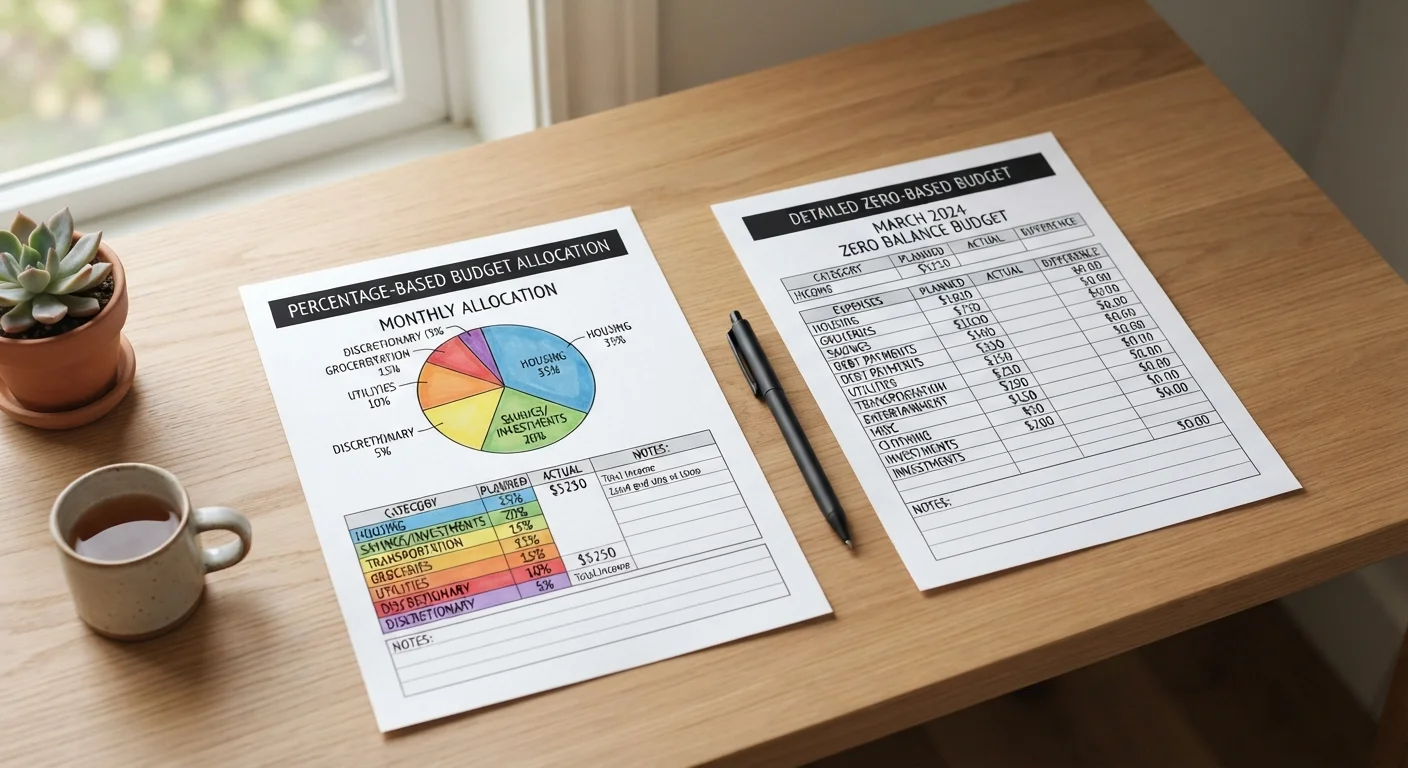
- The 50/30/20 rule divides after-tax income into needs, wants, and savings using broad percentage buckets.
- Zero-based budgeting assigns every dollar a specific job so income minus expenses always equals zero.
- The 50/30/20 rule demands less time but offers less precision; zero-based budgeting is more granular but more demanding.
- Neither method guarantees financial outcomes — results depend on consistency and personal circumstances.
- Your income stability, financial goals, and tolerance for detail are key factors in choosing the right method.
Option A
The 50/30/20 Rule
The flexible, low-effort percentage framework.
Best for: People who want a simple structure without tracking every dollar.
Option B
Zero-Based Budgeting
The detailed, intentional dollar-by-dollar method.
Best for: People who want full control and visibility over every spending category.
If you're new to budgeting and want a quick starting framework
The 50/30/20 Rule
Its three-category structure is easy to grasp and requires minimal setup, making it a practical entry point for first-time budgeters.
If you have irregular income or tight finances and need precise control
Zero-Based Budgeting
Assigning every dollar a purpose helps you spot waste, prioritize essentials, and adapt spending when income fluctuates month to month.
If you have stable income and already meet basic savings goals
The 50/30/20 Rule
When your finances are on track, the 50/30/20 rule's flexibility lets you maintain discipline without micromanaging every transaction.
If you're aggressively paying down debt or saving for a large goal
Zero-Based Budgeting
Line-by-line planning makes it easier to redirect money toward debt payoff or a savings target with maximum intentionality.
How Each Method Works
If you're building your first financial plan, understanding the mechanics of each approach is the essential starting point. For a broader foundation, see our comprehensive budgeting introduction.
The 50/30/20 Rule
Popularized by Senator Elizabeth Warren and her daughter Amelia Warren Tyagi in their 2005 book All Your Worth, the 50/30/20 rule divides your after-tax income into three categories:
- 50% — Needs: Rent or mortgage, utilities, groceries, minimum debt payments, insurance.
- 30% — Wants: Dining out, subscriptions, travel, entertainment.
- 20% — Savings and debt repayment: Emergency fund, retirement contributions, extra debt payments.
The appeal is simplicity. You don't track individual purchases — you monitor whether broad spending categories stay within their percentage targets.
Zero-Based Budgeting
Zero-based budgeting (ZBB) operates on a different premise: every dollar of income is assigned to a specific category before the month begins, so that income minus all assigned expenses equals zero. Nothing is unaccounted for. Categories might include rent, groceries, gas, haircuts, savings, and even a fun-money line. At month's end, you review actual vs. planned spending and adjust the next month's plan accordingly.
| Criterion | 50/30/20 Rule | Zero-Based Budgeting |
|---|---|---|
| Core concept | Split income into 3 broad percentage buckets | Assign every dollar a specific category |
| Setup time | Low — quick to start | High — requires detailed planning |
| Ongoing effort | Low — monitor broad categories | High — review and adjust monthly |
| Precision | Moderate — broad buckets only | High — line-by-line visibility |
| Best income type | Stable, predictable income | Any income, including variable |
| Flexibility | High — wide spending latitude | Lower — spending pre-committed |
| Ideal for debt payoff | Moderate — 20% bucket may not suffice | Strong — dollars directed intentionally |
Where Each Method Falls Short
No budgeting framework is universally perfect. Understanding each method's limitations helps you choose — or adapt — wisely.
Limitations of the 50/30/20 Rule
- The percentages may not fit your reality. In high cost-of-living cities, housing alone can consume far more than 50% of take-home pay, leaving the model structurally broken before you start.
- The want/need boundary is blurry. Is a car payment a need or a want? Reasonable people disagree, and inconsistent categorization can undermine accuracy.
- Low precision for tight budgets. If you're paying down significant debt or have a very modest income, broad buckets may obscure overspending in critical areas.
Limitations of Zero-Based Budgeting
- Time-intensive setup. Building and maintaining a line-by-line budget each month requires sustained effort and discipline that not everyone can sustain.
- Variable income complicates planning. Freelancers and gig workers may struggle to assign dollars they haven't yet earned.
- Risk of over-restriction. Highly granular budgets can feel punishing, which may lead some people to abandon the method altogether. For a balanced take on this trade-off, see the upsides and downsides of strict budgeting.
Variable Income and Zero-Based Budgeting
If your income changes month to month — as it does for freelancers, contractors, or tipped workers — zero-based budgeting still works, but requires a modified approach. A common strategy is to budget based on your lowest expected monthly income, then allocate any surplus as it arrives. This prevents overspending during lean months while giving you a clear plan for windfalls.
Choosing the Right Framework for Your Situation
The right budgeting method is the one you'll actually maintain. Both frameworks share the same goal — giving your money direction — but they suit different financial situations and personal habits.
~75%
Americans living paycheck to paycheck at some point
Research from various financial surveys consistently shows a significant share of US households report difficulty covering expenses between pay periods, underscoring the importance of structured budgeting.
20%
Income earmarked for savings under 50/30/20
The 50/30/20 rule reserves one-fifth of after-tax income for savings and debt repayment — a target that aligns broadly with guidance from many personal finance frameworks.
Consider the 50/30/20 rule if your income is stable and predictable, you're meeting your savings goals, and you prefer a light-touch system with minimal record-keeping. It works well as a sanity-check tool rather than a minute-by-minute guide.
Consider zero-based budgeting if you're working through a period of financial stress, aggressively saving for a goal, managing variable income, or simply want to understand exactly where every dollar goes. It also pairs well with dedicated budgeting apps or spreadsheets — for a comparison of those tools, see spreadsheet vs. app-based budgeting.
Some people find a hybrid approach useful: using 50/30/20 percentages as high-level guardrails while zero-basing the categories within each bucket. For a wider look at how these and other methods compare, explore budgeting methods compared. Whatever framework you choose, the complete personal budgeting framework can help you put it into practice end to end.
This article is for general informational purposes only and does not constitute personalised financial advice. For guidance tailored to your circumstances, consider consulting a qualified financial adviser.