

Key Takeaways
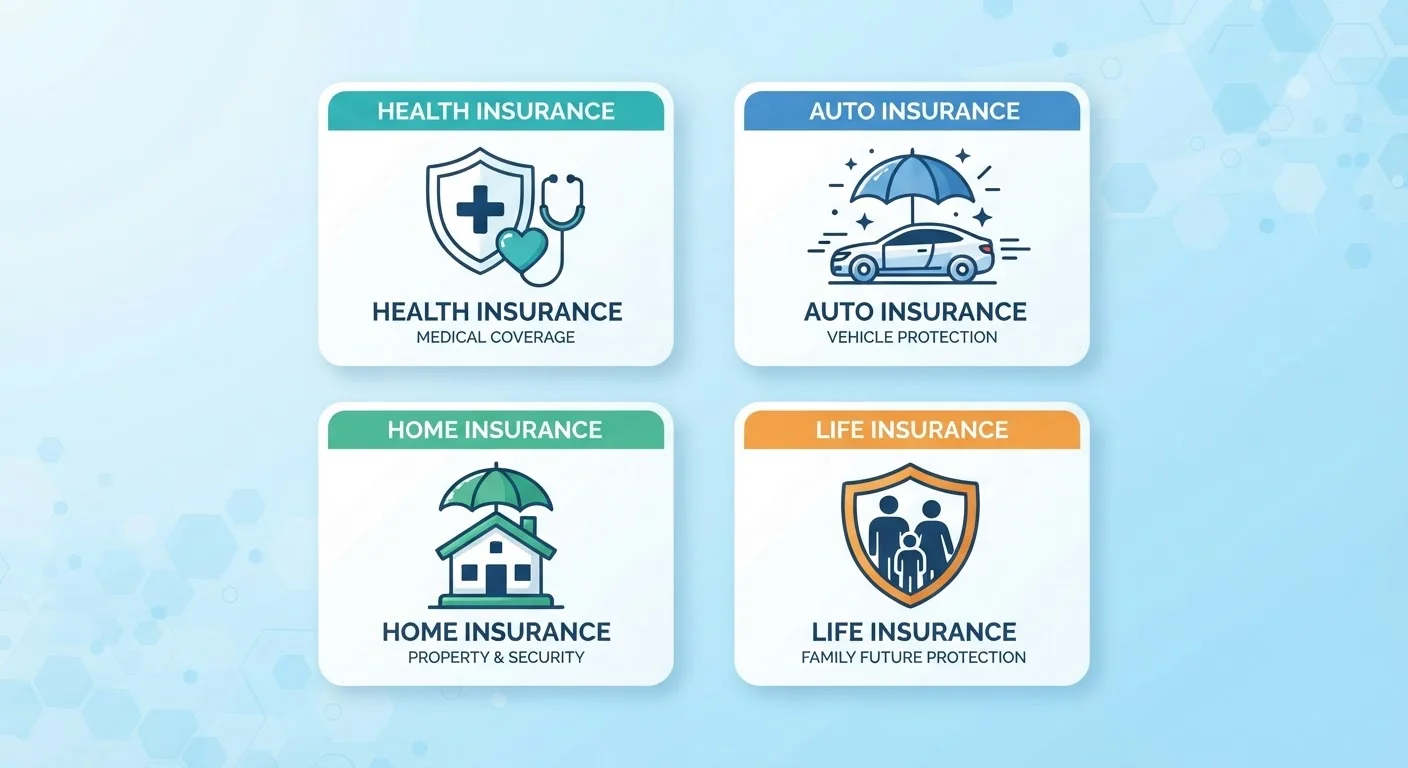
- Health, auto, home, and life insurance each protect a distinct and critical area of your financial life.
- Most US adults need at least three of the four pillars; many need all four.
- Each insurance type has its own structure of premiums, deductibles, and coverage limits.
- Gaps between these four types are where financial risk most commonly hides.
- Understanding what each policy covers — and excludes — is as important as having the policy at all.
Start here
Why These Four Types Matter
Build knowledge
Health Insurance: Protecting Your Body and Budget
Go deeper
Auto Insurance: Coverage on the Road
Apply it
How the Four Pillars Work Together
Why These Four Types Matter
Insurance exists to transfer financial risk from you to an insurer in exchange for a predictable cost — your premium. Without it, a single major event can erase years of savings. The four core personal insurance types — health, auto, home, and life — each address a distinct category of risk that nearly every adult in the US faces at some point.
Think of them not as separate purchases but as interconnected protections. Gaps between them are where financial hardship most often enters. If you're new to managing your own coverage, our beginner's guide to understanding coverage is a useful starting point before diving into the specifics below.
Premium
The regular payment — monthly, quarterly, or annually — you make to keep an insurance policy active, regardless of whether you file a claim.
Deductible
The amount you pay out of pocket for a covered loss before your insurance begins to pay. Higher deductibles generally mean lower premiums.
Coverage limit
The maximum dollar amount an insurer will pay for a covered claim. Losses above this limit are your responsibility.
Exclusion
A specific situation, event, or type of damage that a policy explicitly does not cover. Floods and earthquakes are common home insurance exclusions.
Beneficiary
The person or entity named in a life insurance policy to receive the death benefit when the insured person dies.
Liability coverage
Insurance that pays for injuries or property damage you cause to others. It does not cover your own losses — only the other party's.
Health Insurance: Protecting Your Body and Budget
Health insurance covers medical expenses — doctor visits, hospital stays, surgeries, prescription drugs, and preventive care — in exchange for monthly premiums. Without it, even a routine hospitalization can result in bills that reach tens of thousands of dollars.
Key structural terms to know: your deductible is what you pay before coverage kicks in; your copay or coinsurance is your share of costs after that; and your out-of-pocket maximum is the most you'll pay in a plan year before the insurer covers 100% of eligible expenses.
Health plans vary significantly by network (which doctors and hospitals are covered), formulary (which drugs are covered), and cost-sharing structure. Always read a plan's Summary of Benefits and Coverage document before enrolling.
This article provides general information about health insurance and is not a substitute for professional advice tailored to your individual health or financial situation.
Review Your Summary of Benefits Carefully
Every health plan is required to provide a standardized Summary of Benefits and Coverage (SBC) document. Reading it before you enroll — not after — is the single most effective way to avoid coverage surprises. Pay particular attention to the out-of-pocket maximum and which providers are in-network.
Auto Insurance: Coverage on the Road
Auto insurance protects you financially if you cause an accident, if your vehicle is damaged, or if you're injured by another driver. Most states legally require at least liability coverage, which pays for damage or injuries you cause to others — but it does not cover your own vehicle or medical bills.
Additional coverage types include collision (damage to your car from an accident) and comprehensive (theft, weather, fire, and other non-collision events). Uninsured/underinsured motorist coverage protects you if the other driver has no insurance or not enough.
For a full breakdown of every coverage type, see our auto insurance field guide.
Minimum Coverage May Not Be Enough
State-required minimum auto liability limits are often far lower than the cost of a serious accident. If your liability coverage is exhausted, you may be personally responsible for the remaining damages. Review your limits carefully and consider whether higher coverage aligns with your assets and risk exposure.
Home Insurance: Safeguarding Your Property
Homeowners insurance typically covers three broad areas: damage to the structure of your home, loss or damage to personal belongings, and personal liability if someone is injured on your property. Mortgage lenders generally require borrowers to maintain homeowners insurance for the life of the loan.
Standard policies use a named perils or open perils structure. Named perils policies cover only the events explicitly listed (such as fire, wind, or theft). Open perils policies cover all causes of loss except those specifically excluded — floods and earthquakes are common exclusions that require separate policies.
Renters insurance works similarly for personal property and liability but does not cover the building itself. Whether you own or rent, understanding your policy's exclusions is as important as knowing what it covers. Common misconceptions about home coverage are explored in our insurance misconceptions guide.
Life Insurance: Income Protection for Your Dependents
Life insurance pays a death benefit to your named beneficiaries when you die. Its primary purpose is income replacement — ensuring that people who depend on your earnings (a spouse, children, aging parents) are not left financially exposed.
The two main categories are term life, which provides coverage for a fixed period (commonly 10, 20, or 30 years) and pays out only if you die during that term, and permanent life (including whole and universal life), which does not expire and builds a cash value component over time. Term life is generally simpler and lower cost; permanent life involves more complexity.
Who needs life insurance? Generally anyone whose death would leave dependents without sufficient income or assets to maintain their living standard. Single individuals with no dependents may have limited need. A licensed insurance professional can help you assess the right type and amount for your situation.
This content is general educational information, not personalized financial or insurance advice. Consult a licensed professional for guidance specific to your circumstances.
How the Four Pillars Work Together
No single policy covers everything, and that's by design. Health insurance handles medical costs; auto covers vehicle and road liability; home protects property and housing liability; life provides for dependents after death. Together, they address the four largest financial risks most households face.
Gaps emerge when people assume coverage extends where it doesn't — for example, assuming health insurance covers an auto accident injury while the other driver was uninsured, or that a home policy covers flood damage. Building a coordinated view of your coverage reduces those blind spots.
Our guide to building a personal insurance portfolio walks through how to think about these policies as a system. And once you have coverage in place, understanding the claims and rights process helps you use what you're paying for when it matters most.
Coverage Audit Checklist
A structured set of questions to help you review every policy you currently hold, identify gaps, and understand what you're actually paying for.
Insurance Portfolio Planning Guide
Explains how to think about your insurance policies as a coordinated system rather than separate purchases, reducing overlaps and blind spots.
Claims & Rights Hub
Walks through the claims filing process and explains your rights as a policyholder across different insurance types.