

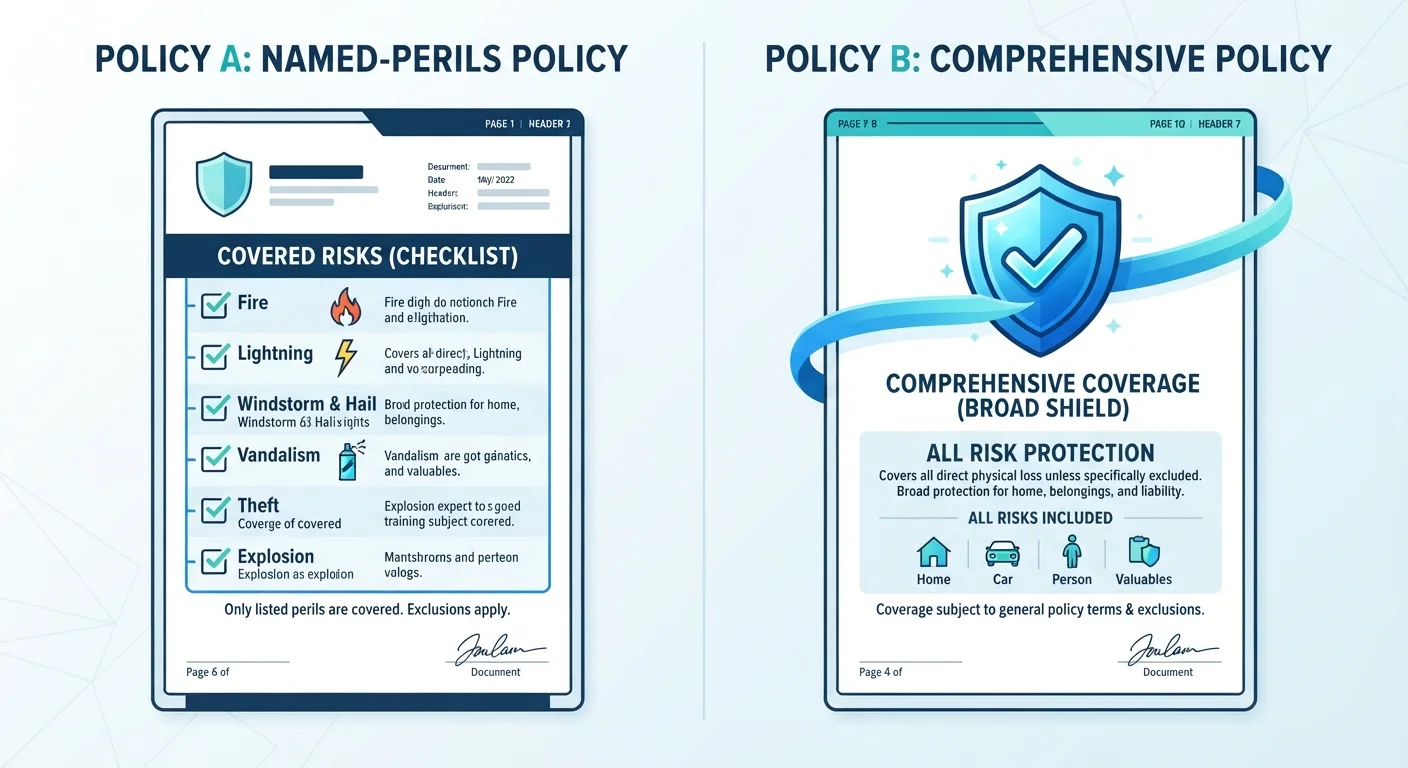
Key Takeaways
- Named perils policies only pay claims for risks explicitly listed in the policy document.
- Open perils policies cover all causes of loss except those the policy specifically excludes.
- The burden of proof differs: under named perils, you prove the cause; under open perils, the insurer must show an exclusion applies.
- Most standard homeowners policies use open perils for the dwelling but named perils for personal property.
- Neither policy type covers everything — reading the exclusions section is essential for both.
- Consulting a licensed insurance agent helps you assess which approach matches your actual risk exposure.
Option A
Named Perils Policy
The explicit, list-based approach to coverage.
Best for: Consumers who want a lower-premium option and are comfortable with a narrower, clearly defined set of covered risks.
Option B
Open Perils Policy
The broad, exclusion-based approach to coverage.
Best for: Homeowners and property owners who want wider protection and fewer surprises at claim time.
If you want predictability and lower premiums on a tighter budget
Named Perils Policy
Named perils policies typically carry lower premiums because coverage is narrower and the insurer's exposure is more limited. The trade-off is that any unlisted cause of loss won't be covered.
If you want broader protection and fewer gaps at claim time
Open Perils Policy
Open perils coverage catches unexpected causes of loss that a named perils list might omit, reducing the chance of a denied claim for an unforeseen event.
If you own high-value property or have significant assets to protect
Open Perils Policy
Broader coverage reduces the risk of a large, uncovered loss that could threaten financial stability — though reviewing exclusions carefully remains essential.
If you are insuring a rental property or secondary structure with known, limited risks
Named Perils Policy
When the risk profile is straightforward and well understood, a named perils form may adequately cover the exposure at a more manageable cost.
The Core Difference: Lists vs. Exclusions
When you file a property insurance claim, the first question your insurer asks is: what caused the loss? Whether that cause is covered depends entirely on how your policy defines its scope — and that comes down to one foundational structure: named perils or open perils.
A named perils policy covers only the specific causes of loss written into the policy. Common examples include fire, lightning, windstorm, hail, theft, and vandalism. If your loss results from a cause not on that list — say, a pipe that freezes and cracks in an unusual way not specifically enumerated — the claim can be denied. The list is the policy's entire scope.
An open perils policy (sometimes called an "all-risk" policy, though that term can mislead) works in reverse. It covers any cause of loss unless the policy explicitly excludes it. Flood, earthquake, wear and tear, and intentional acts are common exclusions. Everything else is presumed covered.
| Criterion | Named Perils | Open Perils |
|---|---|---|
| Coverage scope | Only listed causes of loss | All causes except exclusions |
| Burden of proof at claim | Policyholder proves listed peril | Insurer proves exclusion applies |
| Typical premium | Generally lower | Generally higher |
| Common use in HO-3 policies | Personal property coverage | Dwelling (structure) coverage |
| Surprise denials risk | Higher — unlisted perils excluded | Lower — but exclusions still apply |
| Flood & earthquake coverage | Excluded unless listed | Excluded in standard policies |
| Best suits | Known, limited risk profiles | Broad or unpredictable risk exposure |
This structural difference matters enormously in practice. Under a named perils form, you bear the burden of proving the cause of loss matches a listed peril. Under an open perils form, the insurer must demonstrate that an exclusion applies. That shift in burden of proof can significantly affect how contested claims are resolved. For a deeper look at how coverage gaps form even when a policy is in place, see The Coverage Gap.
How These Policy Types Appear in Common Insurance Products
Most consumers encounter both structures within a single policy — often without realizing it. Standard homeowners insurance in the U.S. commonly uses a hybrid approach: open perils coverage for the dwelling (the structure itself) and named perils coverage for personal property (your belongings inside). This is typical of what insurers call an HO-3 form, the most widely sold homeowners policy type.
Renters insurance policies frequently use named perils coverage for personal property by default. A broader open perils form for contents is available but may require upgrading to a different policy form, such as an HO-5. Understanding which form applies to your belongings matters — a renters policy that lists "sudden and accidental water damage" as a peril may not cover every water-related scenario you might assume it does. Common coverage misconceptions often stem from exactly this kind of assumption.
~96%
U.S. homeowners with some property insurance
According to the Insurance Information Institute, the vast majority of homeowners carry property insurance, yet many are unaware of their policy's peril structure.
HO-3
Most common homeowners policy form in the U.S.
The HO-3 form uses a hybrid structure — open perils on the dwelling, named perils on personal property — making it the default experience for most policyholders.
Commercial property insurance operates similarly: basic and broad forms use named perils, while special forms use open perils. Whichever structure your policy uses, the exclusions section deserves as much attention as the declarations page. Insurance misconceptions frequently trace back to skipping that section entirely.
Making the Right Call for Your Situation
Neither policy structure is universally superior. The right fit depends on what you own, where you live, and what risks you realistically face. A few practical questions can sharpen that assessment — and Before You Pick a Policy offers a structured checklist to work through them.
Start by reviewing the perils list on any named perils policy you're considering. Ask yourself whether causes of loss common to your region — wildfires in the West, ice damming in northern states, severe storms in the Southeast — are explicitly included. If your area faces risks that aren't on the list, a named perils policy may leave meaningful exposure unaddressed.
Flood and Earthquake Are Almost Always Excluded
Regardless of whether your policy is named perils or open perils, flood and earthquake damage are excluded from virtually all standard homeowners and renters policies. Flood coverage is available through the National Flood Insurance Program (NFIP) and some private insurers; earthquake coverage requires a separate endorsement or policy. Never assume these are included without verifying in writing.
For open perils policies, the analysis flips: scrutinize the exclusions. Flood and earthquake are almost universally excluded from standard property policies regardless of form type, requiring separate coverage. Understanding what the policy won't cover is just as important as understanding what it will. Supplemental liability protection, such as an umbrella policy, operates under its own coverage logic — see Umbrella Policies for how that layer works alongside your base coverage.
Before making any final decision, speak with a licensed insurance agent or adviser who can evaluate your specific property, location, and asset profile. This article provides general educational information and is not personalized insurance advice. Coverage terms, exclusions, and availability vary by insurer and state.
This article is for general informational purposes only and does not constitute personalized insurance, financial, or legal advice. Policy terms, coverage, and exclusions vary by provider and jurisdiction. Consult a licensed insurance professional before making coverage decisions.