

Key Takeaways
- Life milestones like marriage, divorce, and home purchases often change your risk profile significantly.
- Failing to update policies after major changes can leave you underinsured or paying for coverage you no longer need.
- A coverage review doesn't require a life crisis — scheduled annual check-ins catch most gaps early.
- Adding dependents, income sources, or assets typically means existing coverage limits need to be reassessed.
- Consult a licensed insurance agent whenever a major life change occurs to ensure your policies remain accurate.
Why Life Events and Insurance Are Closely Linked
Insurance is designed around your current life circumstances — who depends on you, what you own, what risks you carry, and what you could afford to lose. The problem is that life doesn't pause to notify your insurer. When your circumstances shift, your old policy keeps running exactly as written, even if it no longer fits.
Most people think of insurance as something you set up once and forget. But policies written around a single renter in their twenties look very different from what a married homeowner with children actually needs. The gap between what your policy covers and what your life actually requires is where real financial risk lives. Our guide on why having a policy isn't the same as being protected explores this dynamic in detail.
The life events below are the most common triggers that should prompt a deliberate, structured review of every policy you hold — not just the obvious ones.
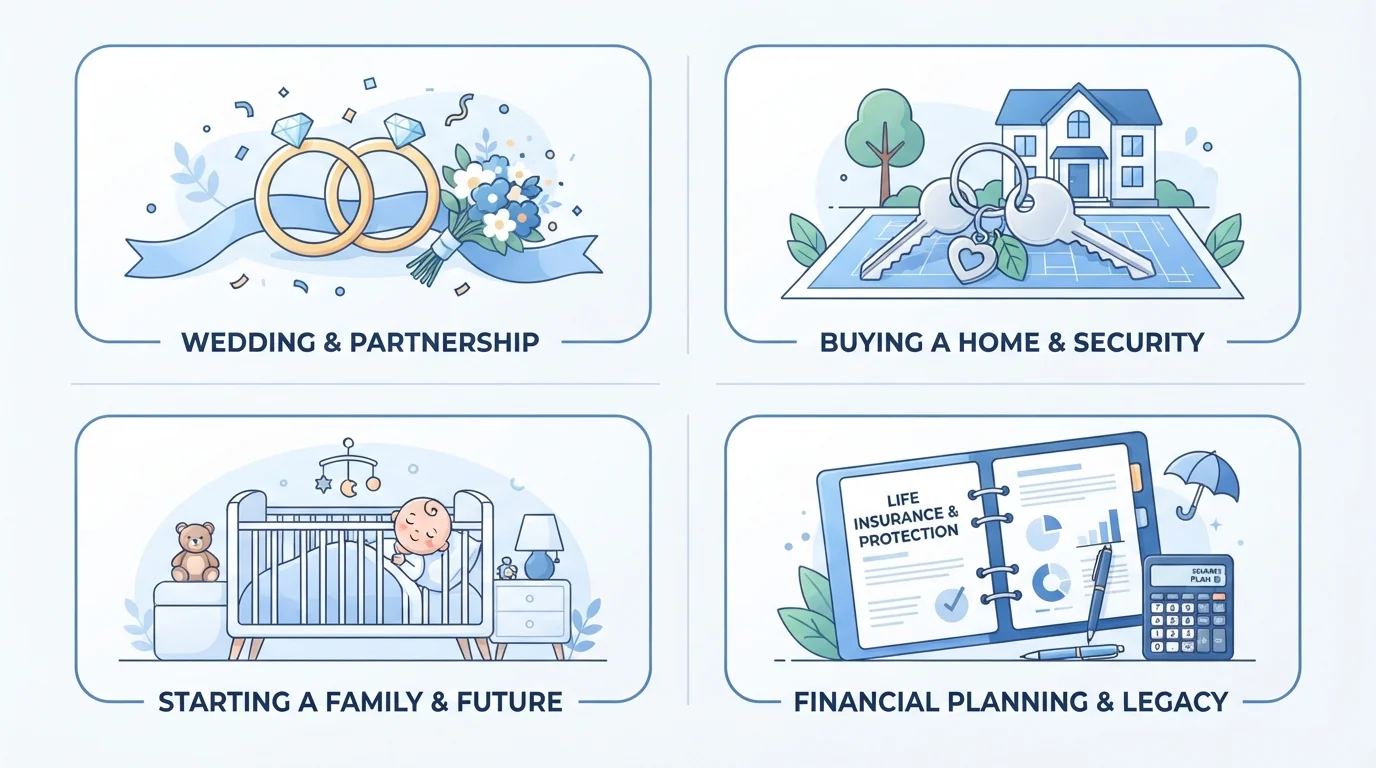
Getting Married or Entering a Domestic Partnership
Combining households means combining risk profiles. Auto policies may need to reflect both drivers; home or renters coverage should account for combined property. Life insurance beneficiary designations — on policies, retirement accounts, and employer plans — need updating to reflect your new partner. Health insurance may also shift, particularly if one partner's employer plan offers better coverage than the other's.
Beyond logistics, marriage often increases what's at stake financially. If one partner were to die or become disabled, the other's financial stability could be seriously affected. This is a natural moment to evaluate whether existing life and disability coverage limits are still adequate.
Marriage combines risk profiles — and exposes gaps neither partner noticed before.
Buying a Home
Homeownership introduces a category of risk that renters insurance simply doesn't address. A standard homeowners policy covers the structure, personal property, and liability — but the limits and exclusions matter enormously. Flood damage, for example, is typically excluded from standard homeowners policies and requires a separate policy entirely.
If you have a mortgage, your lender will require homeowners coverage, but their minimum requirements protect the lender's interest, not necessarily yours. Review your dwelling coverage limit to ensure it reflects the actual cost of rebuilding — not just the purchase price or market value. These figures can differ significantly, especially in high-labor-cost areas.
Your lender's required coverage minimum protects the lender — not necessarily you.
Having or Adopting a Child
A new dependent changes nearly everything about your coverage calculus. Life insurance becomes significantly more important when someone relies on your income for daily survival. If you already have a term policy, check whether the death benefit would realistically replace your income for the years your child would need support.
Health insurance enrollment windows open when a child is added to the household — and employer plans, marketplace plans, and Medicaid/CHIP eligibility all warrant a fresh look. Auto coverage may also need review if your driving patterns change, and an umbrella policy becomes worth considering once dependents are in the picture. For guidance on structuring life insurance around your family's timeline, see our article on term vs. permanent life insurance.
A new dependent means an existing life insurance benefit may no longer be enough.
Starting a Side Business or Working from Home
A personal insurance policy is not a business insurance policy. If you're running any kind of side business — selling goods, offering services, seeing clients — your homeowners or renters policy almost certainly excludes business-related losses. Equipment, inventory, and liability arising from business activities typically require separate commercial coverage.
Working from home for an employer may also affect your auto coverage if you drive for work purposes beyond commuting, or your home policy if business equipment is regularly stored there. Even a modest freelance operation warrants a conversation with a licensed agent about where your personal coverage ends and a business policy begins.
Personal insurance policies almost never cover losses tied to a home-based business.
Divorce or Separation
Divorce requires immediate attention to beneficiary designations — some states automatically revoke a former spouse's beneficiary status upon divorce, but many do not. Life insurance policies, retirement accounts, and bank accounts with payable-on-death designations all need to be reviewed and updated, often before the legal process concludes.
Auto and home coverage must also be restructured once you no longer share a household. A policy written for a couple's combined vehicles and shared home won't transfer cleanly to two separate situations. Check whether your current insurer requires notification of household changes and what that means for your policy's validity.
Beneficiary designations on life insurance don't automatically update when you divorce.
A Significant Increase in Assets or Income
Standard liability limits on auto and homeowners policies are often sufficient for modest asset levels, but they can fall short if your net worth increases substantially. If a judgment against you exceeds your policy's liability limit, your personal assets — savings, investments, property — may be at risk.
A personal umbrella policy provides an additional layer of liability coverage above existing auto and home limits and is generally considered cost-effective relative to the protection it offers. It's worth reassessing liability limits any time your financial situation changes meaningfully, whether through income growth, an inheritance, or the accumulation of significant savings. Our pre-policy checklist can help you think through your actual exposure before speaking with an agent.
When net worth grows, standard liability limits may no longer be enough to protect your assets.
Making Your Review Count
A coverage review doesn't need to be overwhelming. Start by listing every active policy — auto, home or renters, health, life, umbrella, disability — and note the key limits, beneficiaries, and exclusions on each. Then ask whether those details still reflect your life as it is today, not as it was when you signed up.
Schedule an Annual Coverage Check-In
You don't have to wait for a major life event to review your policies. Setting a recurring annual reminder — perhaps at renewal time — lets you catch quieter changes before they become gaps. Even if nothing dramatic has changed, premium costs, coverage limits, and your own risk tolerance can all shift over time. A brief check-in with a licensed agent costs nothing and can prevent significant surprises at claim time.
If you want a structured approach to that process, our insurance coverage audit checklist walks through the right questions for every policy type. And if you're building coverage from scratch after a major change, thinking about your policies as a coordinated portfolio — rather than separate purchases — reduces the chance of gaps forming between them.
This article provides general insurance education only and is not personalised insurance, financial, or legal advice. Coverage terms, eligibility, and regulations vary by provider and state. Always read your actual policy documents and speak with a licensed insurance agent or adviser before making changes to your coverage.