

Key Takeaways
- Lowering your deductible generally raises your premium, and vice versa.
- Higher coverage limits cost more in premiums but protect against large, catastrophic losses.
- A low premium does not equal good value if the coverage limit leaves you underprotected.
- Your risk tolerance and financial cushion should drive deductible selection, not the premium alone.
- These three variables must be evaluated together, not in isolation.
Deductible, Premium & Coverage Limit
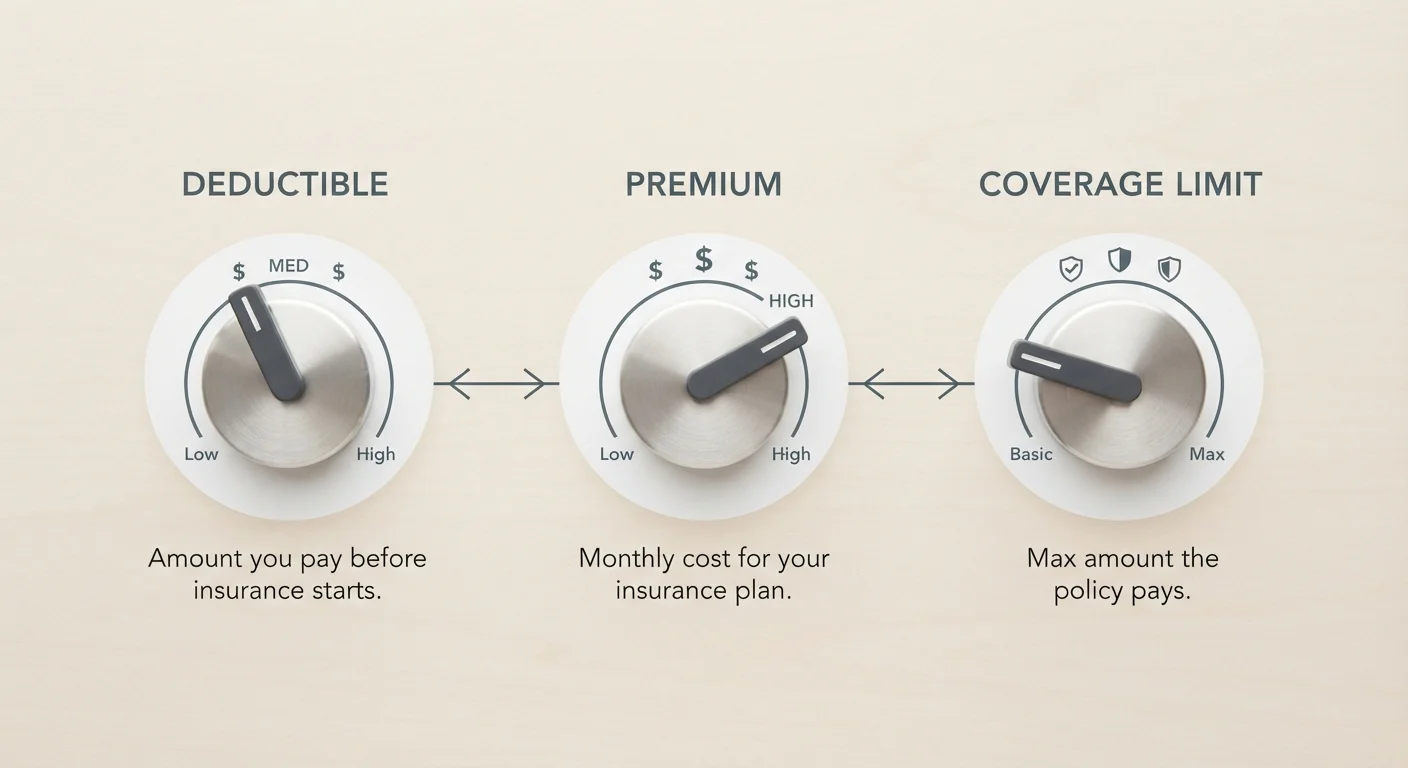
Every insurance policy is built on three financial levers: the premium (what you pay regularly to keep the policy active), the deductible (what you pay out of pocket before insurance kicks in), and the coverage limit (the maximum your insurer will pay on a claim). These three numbers are not independent — changing one almost always shifts at least one of the others. Understanding how they interact helps you choose a policy that fits both your budget and your actual risk.
In some policy types, such as health insurance, additional cost-sharing tools like copays and coinsurance sit alongside the deductible and interact with the out-of-pocket maximum, adding further layers to the premium-deductible relationship.
The Three-Variable System Every Policy Uses
Insurance pricing is not arbitrary. Every policy quote reflects a deliberate balance between three core variables: the premium, the deductible, and the coverage limit. Insurers use these levers to price risk, and consumers use them — knowingly or not — to define how much protection they actually receive.
Think of it as a triangle: each side is connected. Push one side in, and the others respond. Most people shop on premium alone, which is understandable — it's the most visible cost. But making premium your only filter often means accepting deductibles and limits you haven't fully thought through.
For a broader look at how gaps form when these variables aren't aligned, see our article on why having a policy isn't the same as being protected.
40%
Americans who say they are underinsured
A Kaiser Family Foundation survey found roughly four in ten insured adults felt their coverage left them exposed to significant out-of-pocket costs.
$1,763
Average annual auto insurance premium (US)
According to the National Association of Insurance Commissioners, average auto premiums vary significantly by state, deductible choice, and coverage level selected.
1 in 20
Homeowners file a claim in any given year
Insurance Information Institute data suggests most homeowners go years without filing, which is a key reason higher deductibles often make financial sense for stable households.
How Deductibles and Premiums Pull Against Each Other
The deductible-premium relationship is the most direct of the three connections. In general:
- Higher deductible → Lower premium. You absorb more of the early loss yourself, so the insurer charges less to take on the remaining risk.
- Lower deductible → Higher premium. The insurer steps in sooner, which costs more to provide.
This trade-off makes sense mathematically, but it has a practical implication: a low deductible is only advantageous if you actually file claims — and filing too many small claims can affect your future rates or insurability. Conversely, a high deductible saves money monthly but requires you to have funds available when a loss occurs.
Use the 'Can I Pay This Today?' Test
Before finalizing a deductible, ask yourself whether you could write that check today without putting yourself in financial difficulty. If the answer is no, the deductible is too high — regardless of the premium savings. Building a dedicated emergency fund equal to your deductible is a practical way to make a higher deductible genuinely workable.
The right deductible is one you could realistically pay without financial hardship. If a $2,500 deductible would be genuinely difficult to cover, the monthly savings from a lower premium may not be worth the exposure.
Coverage Limits: The Ceiling on Your Protection
The coverage limit is the maximum dollar amount your insurer will pay on a covered claim. Everything above that ceiling is your responsibility. This is where many policyholders discover they are underinsured — often only when they file a major claim.
Limits interact with premiums similarly to deductibles, but in reverse: higher limits cost more in premium because the insurer takes on greater maximum liability. Lower limits reduce premium cost but shrink the safety net.
When evaluating limits, ask what a realistic worst-case loss would actually cost — not what feels comfortable on paper. For a home policy, that means the cost to fully rebuild, not the market value. For liability coverage on an auto policy, it means considering what a serious accident could realistically cost in damages.
Coverage types vary significantly in how limits are structured. Our hub on coverage types explains how limits work differently across health, auto, home, and life policies.
Putting It Together: A Practical Framework
When reviewing any policy — whether you're buying for the first time or renewing an existing one — evaluate all three variables together rather than one at a time.
- Start with the coverage limit. Determine the realistic maximum loss you need to protect against. Set the limit there, not lower.
- Choose a deductible based on your financial cushion. How much could you pay out of pocket today without serious disruption? That number should guide your deductible choice.
- Let the premium be the result. Once limits and deductibles are set appropriately, the premium is what the coverage actually costs. If it's unaffordable, revisit the deductible — but be cautious about reducing limits to cut costs.
This framework won't give you a single answer, but it keeps the right variable — your real-world protection — in the driver's seat. For a structured set of questions to guide this process, see questions worth asking before you pick a policy.
“People focus on what insurance costs them every month. What they should also ask is what happens on the worst day — and whether their policy is actually designed to handle it.”
— Insurance Basics Editorial Team, Consumer insurance education publication
This article provides general insurance education and is not personalized insurance, financial, or legal advice. Coverage terms, limits, deductibles, and premiums vary by insurer, policy type, and individual circumstances. Always read your actual policy documents and consult a licensed insurance agent or adviser for guidance specific to your situation.